Home › Eygpt 3300 Years Ago › Eygpt 3300 Years Ago: Asia
Eygpt 3300 Years Ago: Asia
THE preceding facts must have fully occupied the first two years of the reign of Mei-Amoun, and it was probably only toward the beginning of the third that, having provided for all that the accomplishment of his vast designs demanded, and having confided the government of Egypt to the Queen, assisted by a council of regency, he set in movement for the conquest of Asia the masses which he had accumulated with that intent on the borders of the Isthmus.
HEDIBRAUD Egyptian Cavalry.
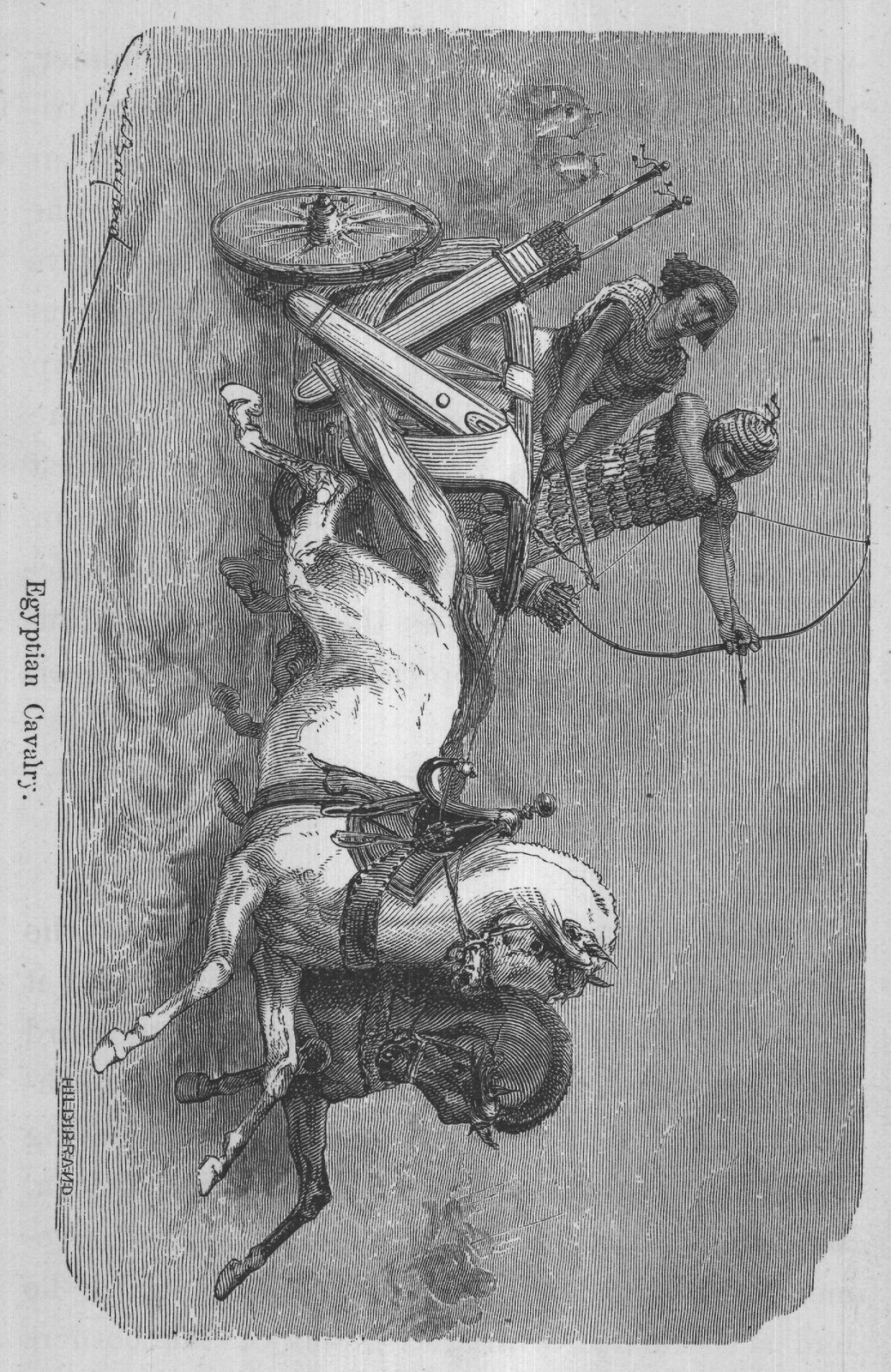
If the monuments have not placed it in our power to correct the assertions of the ancients with regard to the numerical strength of that army, they at least leave us in the way to compensate for the silence that they have maintained with regard to the material of which it was composed.
The cavalry of our modern armies was represented in it, as it continued to be for a long time afterward by squadrons of war-chariots manned by the flower of the Eris.* The rest of the military caste furnished the hoplites or troops of the line on foot, who, protected by a cuirass and shielded by a buckler, used the lance, the sword and the battleaxe in combat, and manœuvred, according to prescribed rules, eight or ten men deep. Then, there was the light infantry, whose duty it was to reconnoitre and clear the roads, to skirmish in the advanced guard, and to cover, with its cloud of archers and slingers, the wings of the army and the intervals between the chariots. It probably recruited among the auxiliary tribes on the frontiers, and from the Ethopian allies its numerous soldiers * The number of these chariot teams, each consisting of two horses at least, indicates clearly the importance and the degree of development which the business of raising and training that noble race of animals had assumed in the few generations that had elapsed since their introduction on the borders of the Nile. was, armed with all the projectile weapons known at that period, held also in reserve for hand to hand struggles that terrible battle scythe or sickle, the murderous use of which has been perpetuated to this day in Africa, among the Abyssinians and the Gallas, and in Asia, among the Ghoorkas of the Himalayas and of the Western Ghauts.
All these troops performed their evolutions to the sound of the trumpet and the drum, under the banners of their respective chiefs; but above all these special and subordinate symbols, there rose at the extremity of a tall and strong staff, the ensign of the Empire, all glittering with the splendor of pure and massive gold. It consisted of a ram's head surmounted with the solar disk, the double symbol of Ammon-Ra leading his worshippers against the hostile races. Borne along on a magnificent chariot, which had to be kept close to that of the sovereign, under all circumstances, this venerated emblem, indicated to the gaze of all, on the march, and in actual battle, the centre of the army and the presence of its leader, and when in camp, the position of the royal pavilion.