Home › Eygpt 3300 Years Ago › Eygpt 3300 Years Ago: Rameses
Eygpt 3300 Years Ago: Rameses
FROM the borders of the Nile to those of the Tigris, Rameses could follow routes upon which nearly all his predecessors, dating from Thothmes I., had left some land-marks. Since the opulent Pentapolis of the Jordan had sunk in the bituminous gulf of the Dead Sea, the most compact centres of permanent population, existing between Egypt and upper Asia, were the maritime establishments which the Cushites of Canaan, driven from the shores of the Erythrean gulfs by convulsions of the soil, had founded upon the Syrian coast; the fortified cities which the Khetas had built between the Orontes and the Euphrates, and, lastly, Babel in the land of Shinar, where a celebrated temple of the Sun and a great navigable river, attracted caravans and flotillas of pilgrims and traders from all directions. To the eastward of the Naharain country-Naharaina-Kah on the Ipsamboul inscriptions, meaning Mesopotamia,-rise the mountainous regions, that, at a later period, were to form the nucleus of the empires of Semiramis and Cyrus. Here, for Rameses, the realm of the unknown began, and an entire new world opened before him, in which he, undoubtedly, had no other guide than the instinctive hatred against the men of the Northeast that animated his army, and the fugitive currents of the tribes and races with which he came into collision as he passed on.
Nevertheless, one may infer from the narrations on this subject which the ancients have left to us, separating them from the exaggerations credited by Diodorus, that the march of the Egyptian conqueror, at first directed eastward, touched, perhaps, on the Hindoo Koosh and Bactrian country, and then diverging toward the north, turned back again by a long elliptical curve and debouched upon the European shores of the Propontis. Thus, Rameses II. after having left the imprint of his feet upon the rocks of Cape Guardafui, could, after an interval of some years, cause images of himself to be graven on the mythical terraces of the Indian Parnassus, and appear in the semblance of a fearful and unknown god to the savages inhabiting the shores of the Thracian Bosphorus. We must run down along the lists of chronology more than ten centuries in order to again find in the son of Philip so indefatigable a promoter of the mixture of races, and the diffusion of ideas.
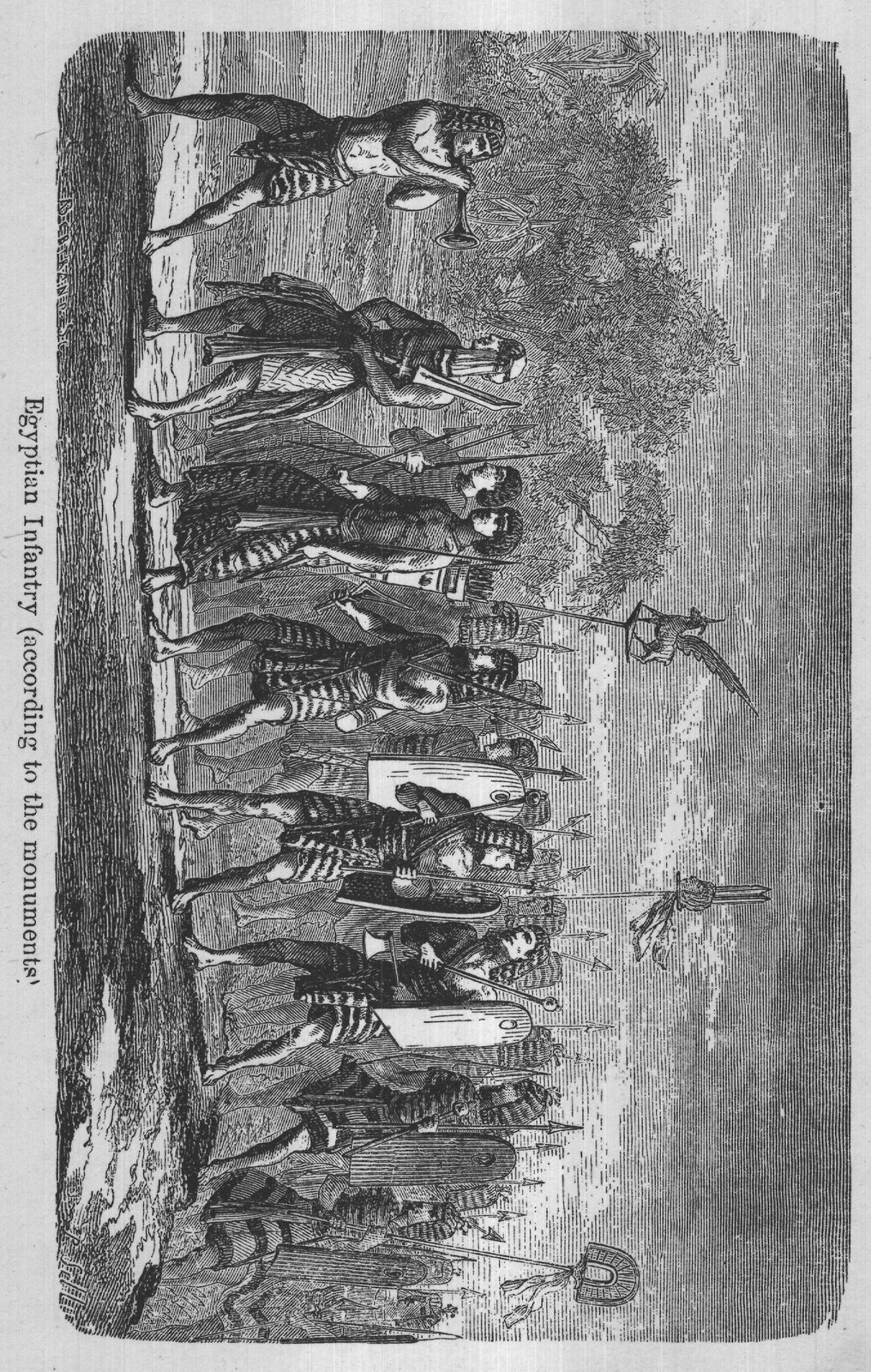
When Germanicus, one of the latest heroes of antique society in its decline, for whom Rome wept bitterly and whom Tacitus extolled, repaired to the Egyptian Infantry (according to the monuments!
East where a prematnre death awaited him, he visited the vast remains of Thebes in sober meditation, and, having asked one of the priests then present, a living relic in the midst of so many ruins, the meaning of the sacred characters that covered the edifices still standing, the latter replied while he interpreted the inscriptions, that the King Rameses, at the head of an army of 700,000 men, had subjugated Libya and Ethiopia, the country of the Medes and Persians, Bactria and Scythia; that he had brought under the yoke of his empire, the countries inhabited by the Syrians and the Armenians, Cappadocia, which is near to them, and all hither Asia from the Sea of Bithynia to that of Lycia.*. ..
VI.