Home › Contents › Claplant Ante
Claplant Ante
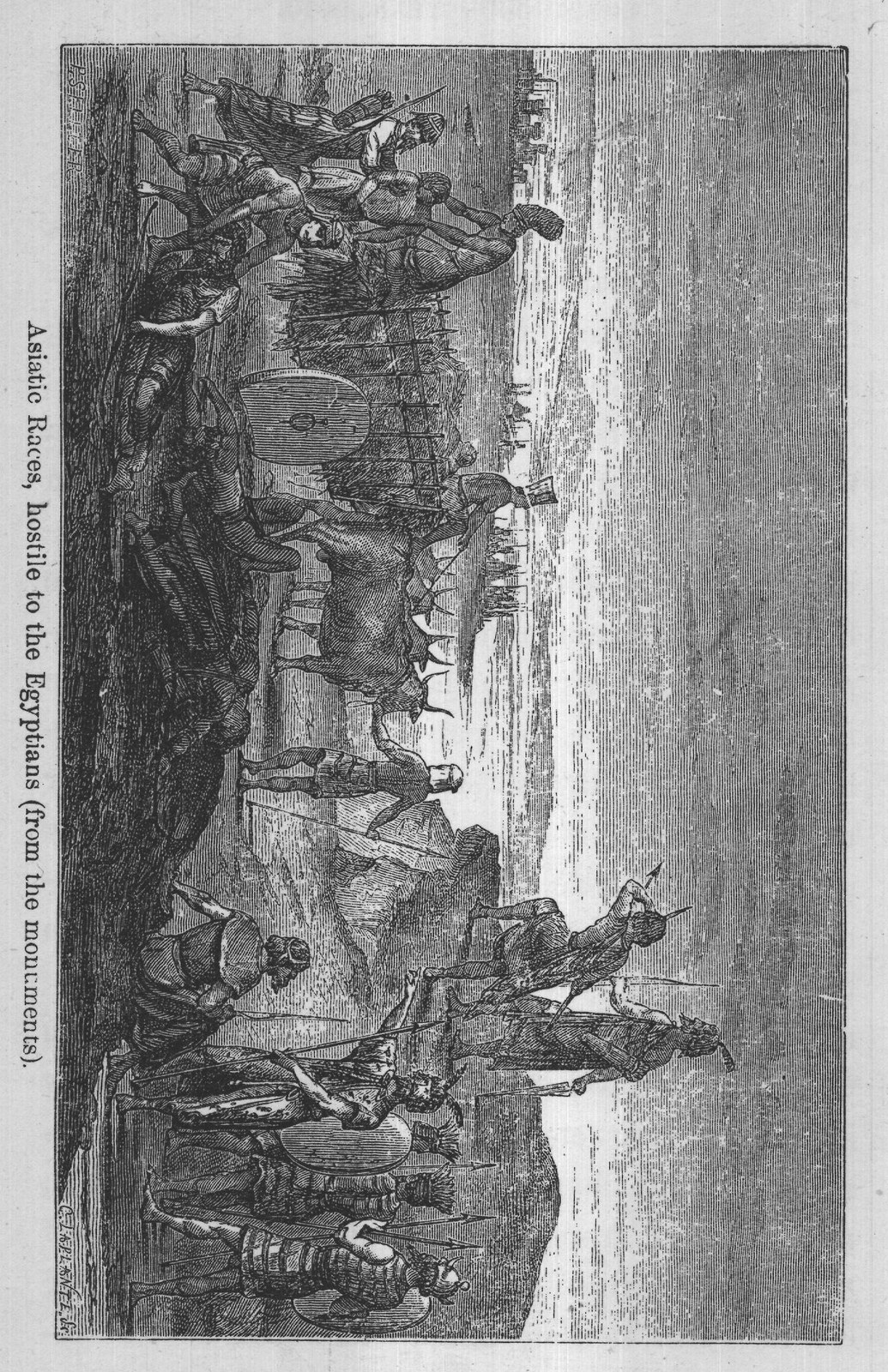
Asiatic Races, hostile to the Egyptians (from the monuments). ment, to wit: the great peril to which Rameses was exposed, when separated from his army and attacked, with his feeble escort, by a picked force consisting of twenty-five hundred chariots. This is the characteristic trait that enabled me to recognize the same incident carved on all the temples. The poem of Pen-ta-ur was esteemed by his contemporaries, for it had the distinguished honor to be carved upon one of the walls of Karnak, which it completely covered. It is too much defaced, at the present day, to serve for the completion of the manuscript; but the number of the columns formerly filled with hieroglyphics leads us to conjecture tha at least the first third part of the poem is lacking.
The historian may fill this deficiency, to some extent, by the aid of the official bulletins of the campaign, which the pictures of Ipsamboul and the Rameseum have preserved almost intact; they will explain to us by what stratagem the hostile leader had succeeded in cutting off the Pharaoh and his retinue from the bulk of his army.
But I must first give notice that we are not as yet able to exactly determine the locality of the occurrence. The tribes of Mesopotamia figure with those of Syria in the confederation commanded by the Prince of Kheta; the city of Atesh, near which the fight took place, was the strongest post in the control of those tribes; the Egyptian armies moved via the north of Syria to reach the country in question, and the city was washed by a river called the Aranta. This name naturally recalls that of the Orontes, the only river of importance in Syria; yet this is all that we can say, at present, with regard to the position of a place that underwent several sieges, beheld bloody battles fought under its walls, and seems to have been the culminating point of the earliest struggles made, in those primitive times, for the mastery of the world.” "Such are the facts that stand forth from the story of the campaign as it is found carved at Ibsamboul and in the Rameseum. "In the fifth year of his reign, on the ninth day of the eleventh month, (Epiphi,) Rameses was in Asia with his army, marching against the insurgent tribes commanded by the prince of Kheta. The king was advancing to the southward of the city, but he lacked information concerning the position of the hostile army, when some Bedouins came in to offer their services, and told him that the prince of Kheta, intimidated by the Egyptian advance, had retired toward the south, in the direction of the Khirab country. But these rovers were emissaries of the foe, specially entrusted with the task of misleading the Egyptians by their false reports. The confederates had really massed their forces secretly to the northward of Atesh. Rameses, thus deceived, moved to the northwestward of that city, and drew near to the enemy. At this juncture, his scouts brought in to him two other Kheta spies, who, after being severely bastinadoed, confessed that they had been sent to examine the position of the Egyptian army, and that all the confederate forces were concentrated behind the city of Atesh watching the movements of the Pharaoh for an opportunity to attack him at advantage. "Rameses calls his generals together; reprimands them sternly for their lack of vigilance, and informs them that the Prince of the Khetas, uselessly pursued toward the south, by the Egyptian army, is there under the walls of Atesh ready to precipitate himself upon them. The generals acknowledge their delinquency, and that of the leaders of the scouts, who had obtained no information concerning the enemy's movements. An officer is then despatched in hot haste, to the main body of the army which is pursuing its march to the southward, thus uncovering the position of the king more and more. "While this council of war is being held, the Prince of Kheta causes his troops to advance rapidly to the southward of Atesh, and long before the Egyptian army has time to retrace its steps, the little band of followers and attendants who accompany the king is dispersed, and Rameses finds him self surrounded by the hostile chariots."* It is into the midst of this critical phase of the action that what remains of the poem of Penta-ur transports us. The papyrus, worn and rent in many places, as it is, exhibits many a gap; and we confess, with all humility, that we have endeavored to supply some of its deficiencies by the help of the notes that Champollion has left, in reference to the same subject.t VIII.