Home › Stories About Flags, Continued, and Description of An › Stories About Flags, Continued, and Description of An: Crawford
Stories About Flags, Continued, and Description of An: Crawford
Now walks in the hero of our tale and the ancestor of the Polloks. His name was Captain Crawford; he offered to command a small but determined company, that should march from Glasgow upon a certain night, just as the clock should strike twelve. Scaling-ladders and other appliances were, with the greatest secrecy, secured, and all the approaches to the castle were cut off, to prevent any possible rumor of the proposed attack from reaching the fort. Then, at the dead of night, out they stole from Glasgow. The moon had set early, and, although the sky up to that time had been starlight clear, a fog now made the atmosphere thick. They approached the highest and most perpendicular part of the cliff, as they concluded that at this supposably least accessible point there would be the least amount of watchfulness shown. The first ladder was placed, but so impetuous and hasty were the besiegers that, too great a number scrambling upon it, down it fell. Fortunately, no one was hurt, and the thickness of the air prevented the garrison being alarmed. Crawford now scrambled part way up the rock, and fastened a ladder in the roots of a tree that grew from a cleft. After great difficulty, the little band managed to reach this spot; but the top of the ladder was, even then, seen to be a long way from the base of the wall. However, up the ladder they started again, and now another accident befell them. Just as one of their number reached the middle round, he was seized with a fit, and clung, apparently without life, to the ladder. What should be done? Crawford's ingenuity was equal to the emergency; he hurriedly bound the hands of the unfortunate man to the round, so that when he awoke he should not fall, and then, turning the ladder over, the rest mounted without further trouble. It was now beginning to grow gray in the east, and the wall still remained to scale. But one agile fellow at last managed to reach the parapet, and was preparing to leap upon it when an astounded sentinel caught sight of him. Short time was given him in which to sound an alarm before he was shot down. Another and another scrambling Scot followed the first adventurer over the wall; and before the half-dressed garrison could do more than spring from its quarters, the castle was in the possession of the dauntless little band of men. Not one of Crawford's men had lost his life, and the satisfaction of the victors can be imagined. Since that time the crest of Dumbarton Castle, and the motto, "Expugnavi" (I have won it), have been borne by Crawford's descendants. But besides castles, swords, helmeted ladies, etc., we have ladders, foxes, and even trees. The latter adorns the coat-of-arms belonging to the honorable family of Wallers, and was the gift of a captive who rose to the throne of France. During the battle of Agincourt, Sir Richard Waller was so fortunate as to take this monarch, then only Charles, Duke of Orleans, prisoner. At the close of this battle he took his captive with him back to his home, at Groombridge, in the English County of Kent. There the royal prisoner remained during twenty-four years; but the time was not allowed to hang heavily upon his hands, and, as a result of kind treatment and a proper appreciation of each other's noble qualities, a warm friendship sprang up between captor and captive. At the close of this long period of exile from his home, France ransomed the Duke. But after reaching his country the Duke found that his memory of the happy days of captivity was so pleasant to dwell upon, that he caused the somewhat decayed family mansion in Groombridge to be rebuilt for Sir Richard, and bestowed many benefactions upon the little church of Spedhurst, over the door of which his arms may still be seen. He also begged the knight to assume as his crest, in remembrance of him, a tree in full leaf, and bearing on one of its branches a shield displaying the arms of France - a blue ground, with three golden lilies, and a slight additional mark. The last English crest that I will mention is the one belonging to the Duke of Hamilton. An ancestor of this house, Sir Gilbert Hamilton, was one of the courtiers that surrounded Edward the Second in London, and, although a very devoted adherent to the English king, was a warm admirer of the great Robert Bruce. One day he chanced to speak in glowing terms of the Scottish King, forgetting or not caring that such language was not acceptable to English ears. John de Spencer heard the eulogistic words, and, being a favored satellite of Edward's, considered them as an insult to his master. He permitted his temper to flash out, not only in words but in a stinging blow on the offender's face. In an instant Sir Gilbert resented the insult, and challenged him to a duel on the next day. In this duel De Spencer was killed; and Hamilton, fully aware what the wrath of the king would be when the news of the death of his favorite should reach his ears, fled from London. As he expected, a pursuit was hotly pressed, and, notwithstanding his vigorous efforts to reach the Scottish border, he found the pursuers almost upon his heels. At this juncture he reached an extensive forest, and, finding woodmen there, busy felling trees, he bade them exchange garments with him and his servant. Scarcely had this been done, and, saw in hand, the fugitives were industriously playing the part of common peasants, than the troopers rushed by in headlong haste. The servant was so terrified that, as the band swept by, he paused and gazed at them with an agonized look of apprehen- "Through," called out the knight, and, thus recalled to his senses, the servant was in an instant as busy as his master, and they escaped. In remembrance of this adventure, a crest consisting of a tree with a saw upon it, and the word "through" for a motto, was adopted. sion.
Before the separation of the colonies from the mother country, a few drops from the shower of royal favors fell upon the settlers in New England. Sir William Pepperell was one of those whom the royal George dignified by raising to the baronetcy. He was only an ordinary trader at Piscataway when the governor and council requested him to take command of six thousand men who were to be sent out against the French in Cape Breton. This he consented to do, and, aided by the gallant Commodore Warren and his fleet, laid siege to the great fortress of Louisbourg, one of the best built forts that France could construct. The siege lasted seven weeks, and the garrison then surrendered. To prevent any further trouble Lord Ponsonby Batcheler.
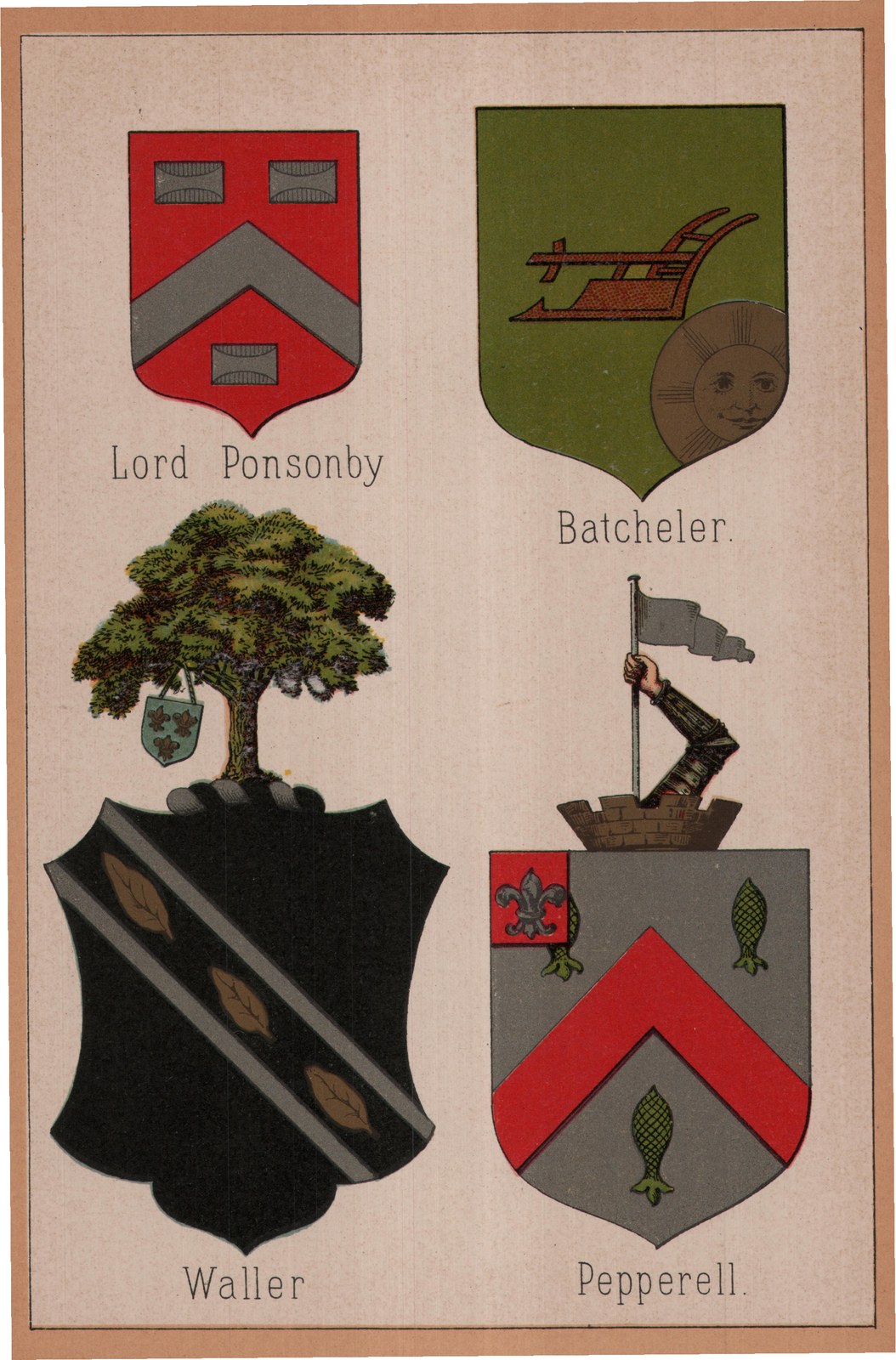
T Waller Pepperell.
from so nearly impregnable a fortress, the English levelled it to the ground, and now when a stray visitor, flitting solitarily through the Canadian-besprinkled island, visits its site, there is nothing save little irregularities in the ground to indicate the spot where it once stood. After his return, Sir William woke one morning to find himself a baronet, and entitled to wear as a crest a mural crown, with an arm covered with armor and grasping a flag issuing from it. Over the crest was placed a little motto, "Peperi," "I have accomplished it."
Another instance of the goodness of the king, as shown towards the Colonies, although not manifested in the gift of a crest, was when the Rev. Stephen Batchelor became the first pastor over a church in Ligonia. He was not created a baronet, to be sure, but he was given a coat-of-arms, lucky man that he was, and quite a unique one also. In the centre of a bright green shield behold a plough, and way down in the right-hand corner of the escutcheon a droll little sun, spiked round about with golden beams. These two symbols were given him as emblems of his vocation - the plough was to indicate that his life was to be spent " in ploughing up the fallow ground of their hearts," and the frolicsome-looking little sun "that he was dispensing light in that part (or corner) of the world."
The helmet that rests upon the top of the shield represents the rank of the owners, - a slight difference indicating to which of the various grades in the peerage it belongs.
The coronets rest upon the helmets, and are of several kinds. After those borne by royalty is that of the duke, then the marquis, then the earl, then the viscount, then the baron.
From the coronet drops a veil, called "Mantling," and is made of crimson velvet, lined with ermine. This was to act the part of a shield for the helmet, as did the surcoat to the steel body-coverings. It was frequently much torn and slashed in battle, consequently the heraldic painter usually represents the mantle with a jagged edge, thus paying the ancestor of his noble patrons such honor as he may by assuming that they had been mighty men in war.
When William the Conqueror possessed himself of England, in order to satisfy the clamors of his Norman nobles he gave them not only vast estates, but created them barons, so that, although the title now ranks as lowest in the peerage, it was at that time the highest title below the princes in the land. Not only that; these old feudal barons became so powerful that the throne, again and again, trembled and almost tottered from the blows struck it by some almost kingly vassal.
A viscount, as you noticed in my list of titles, is that which ranks next above the baron of to-day. This title was formerly given to the sheriff of a county, and it was not until Henry VI. became king that the designation was introduced into the company of noble titles. This title is always limited in time. The first viscount, Sir John Beaumont, was permitted to transmit it to his son and grandson, but there it ceased. Then comes the earl. Nobles bearing this title existed in England long before the Conquest. But the earls, like the barons, have seen upstart titles spring up and carry off all the honors of precedence, such as the Marquis and the Duke. ” The original office of a "marquess was to guard the frontiers of a kingdom, called marches - that being a German word signifying "limits." Such were the marches of Scotland and Wales before they became part of the kingdom of Great Britain.
But Richard II. had a favorite, Robert de Vere, who for no special services, but purely from the fancy of the king, was greatly esteemed by the sovereign. He created him marquess, and bade him consider himself as standing on a higher round of the peerage ladder than even the haughty earl.
But the duke still holds his own. This title was first introduced into England by King Edward III., some fifty years before the title of marquess became a position of dignity between the duke and the earl. This king created his son the first duke, making him Duke of Cornwall.
Upon the shields of the lower knights the coronet used is always the ducal coronet, and as we use the name it occurs to me that perhaps some of you are not aware that the coveted title of knight had its origin in the servile one of "Knecht," or servant. Not a few of the great nobles sprang from some such humble beginning, as, for instance, the noble Lord Ponsonby, whose escutcheon bears noble witness to the fact that an ancestor of his was barber to the Conqueror! Lord Dudley had a goldsmith, or wealthy jeweller, for his first recognized ancestor; and, as for the Earl of Dartmouth, he sprang from even humbler origin.