Home › Decorations Taken from Other Sources. - Hatchments › Decorations Taken from Other Sources. - Hatchments: Henry
Decorations Taken from Other Sources. - Hatchments: Henry
The Crown and the Bush owes its appearance upon a tavern signboard to a singular circumstance that occurred during the dissensions between Richard III. and Henry VII. of England. Sir Reginald Bray was a warm friend of the mother of Henry VII., and, by his wise and adroit management, contrived to make the Red and the White Roses, exhausted by their long and thorny wars, to grow peaceably upon the same bush. This he did by marrying the Princess Elizabeth, daughter of Edward IV., to Henry. Henry and Richard met on Bosworth Field to decide the question as to who should sit on England's throne. Sunday evening, just before the battle was to take place, King Richard, mounted on a light gray horse and dressed in regal attire, with the crown upon his head, rode, in great pomp, through the town of Leicester; and the next morning, still wearing the crown, he appeared upon the field of battle, and addressed his army from the crest of what has ever since been called Crown Hill. Whether he took it off during his harangue to the soldiers, or whether, during the battle, he became oppressed with the heat, and so laid it aside, is not known, but Sir Reginald found the crown on a thorn-bush, and he gave it into the custody of Lord Stanley. This nobleman, at the close of the engagement, placed it, amidst loud acclamations of the triumphant army, upon the head of the victorious Henry, who, from this time until his death, reigned as Henry VII. of England. Sir Reginald Bray, in memory of this event, adopted the thorn-bush bearing a crown as an ensign of honor, and it can still be seen in the painted windows of his great manor-house at Stene, in Northampton, shire. It also appears in the windows of Henry VII.'s Chapel at Westminster, the taste of Sir Reginald being the inspiration that produced this glorious specimen of Gothic architecture. He also caused the stately chapel of St. George, at Windsor, to be built.
One of the great Marshals of France, Sieur D'Aubigney, one of the greatest military officers of the French king, was a relation of James IV. of Scotland, and took great pride in displaying, upon his shield of silver, the Red Lion of Scotland. The silver field, or background, he powdered with buckles, to show that it was his valorous self who alone was able to unite Scotland and France against the hated English. For the same reason he chose as his motto, Distantia jungit - "It unites the distant."
A Checker-board Pattern was sometimes used on the shield, as on that of the Earl of Warren and Surrey. It is said that the early ancestors of the Warrens crossed the Channel with William the Conqueror, and, for some remarkably good reason no doubt, received his royal permission to make and sell malt liquors.
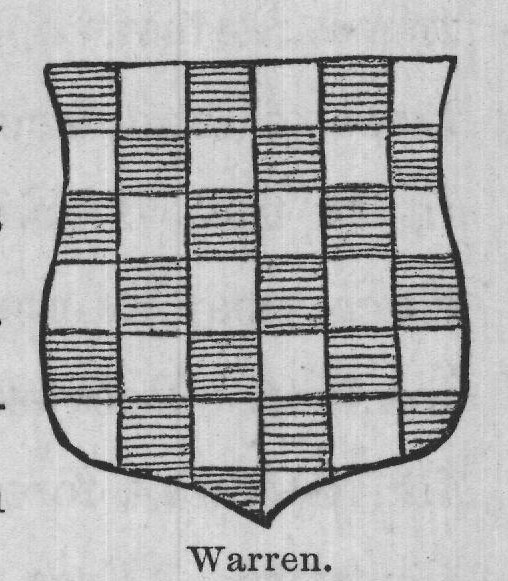
To enable their agents to collect the consideration money easily, the door-posts were painted in checkers. Their descendant, the Earl of Arundel is said to have exercised the use of this prerogative. Warren.