Home › Stories About Flags, Continued, and Description of An › Stories About Flags, Continued, and Description of An: Bruce
Stories About Flags, Continued, and Description of An: Bruce
The Kirkpatricks, too, whose blood the beautiful one-time Empress of all France is not ashamed to acknowledge as flowing in her veins, display with Scottish pride the singular crest of a hand holding a knife, from which fall drops of blood. It was in this wise that they claim to have won the right to wear it. When Robert the Bruce was straining every nerve to maintain his right to the throne of Scotland, he chanced to be in Dumfries, and, going into the Gray Friars' Chapel, met the Red Comyn. Words were hastily exchanged; and Bruce, in a moment of rage, drew his dagger, and, springing upon Comyn, stabbed him to the heart. Then turning, he rushed from the building, seized the bridle of his horse, and was on his back and away from all pursuers, exclaiming hurriedly, as he did so, to the astonished Kirkpatrick, who as a trusty comrade had accompanied him to the door of the chapel, "I doubt I have slain Comyn!" "You doubt!" shouted back Kirkpatrick, as he saw the chieftain galloping out of sight; "then I mak sicker" (I'll make sure). So saying he strode into the church and stabbed his wounded enemy to death. An instant later, another horse was flying over the rough hillsides in the track of Robert Bruce. And swift indeed would the riders be who could catch the bold chieftains before they were safe in the trackless glens of their mountain rendezvous. In memory of this, Roger de Kirkpatrick of Closeburne took as his crest the sanguinary one of a hand grasping a dagger, from which fall drops of blood, with the motto, I mak sicker.
In the crest of the McClellans the sword also appears, with the point piercing a human head; and it is said that when James the Second of Scotland was master of that kingdom, he was occasionally much annoyed by predatory hordes, probably gypsies, but who, as they had dark complexions, were styled Saracens or Moors. They were very troublesome, and, though often beaten back to Ireland, they never failed to return, as filled with the spirit of the marauder as ever. The suffering coasts of Galloway, which knew more of their desolating visits than did other portions of the kingdom, made loud and bitter complaint. The king strove to relieve them, but with such ill success that finally he offered the Barony of Bombie to whoever should be so fortunate as to either kill or capture the chieftain of these dark robbers. Many resolved to thus enrich themselves, but, oddly enough, it happened that McClellan, the son of a former laird of Bombie, was the fortunate one who succeeded in so doing. This laird had been dispossessed of his property for some act that did not meet his sovereign's approbation, but the valor of the son restored it to the family. After slaying his antagonist, he cut the head off, and, with it bleeding on the point of his sword, presented it to his sovereign.
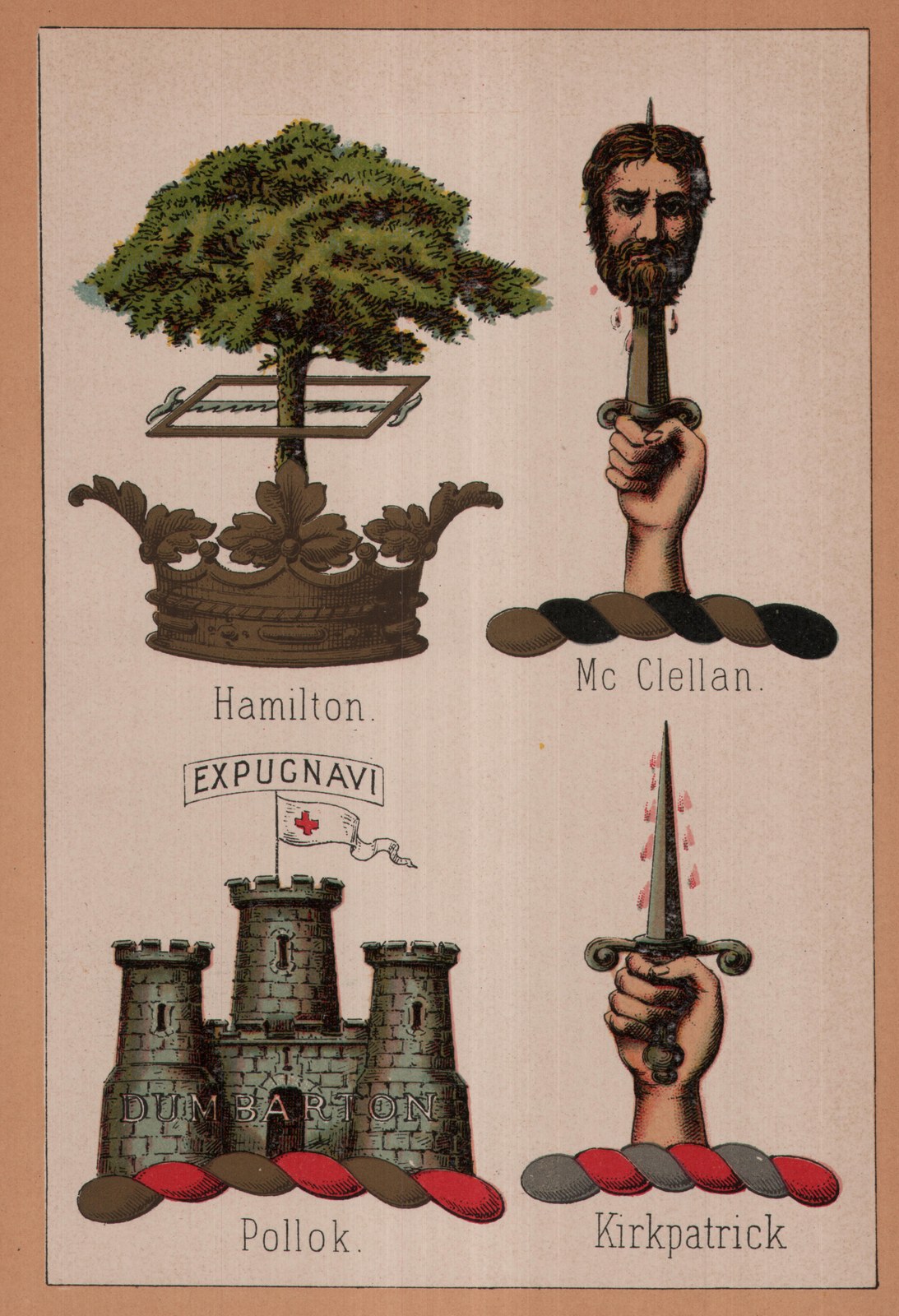
Another crest is that of a castle, and belongs to Sir Hugh Pollok. When the beautiful Mary Queen of Scots was a captive in the strongholds of her powerful and jealous cousin, Queen Elizabeth, and little James VI. of Scotland was but a laughing boy, the Earl of Lennox was made Regent of the Scottish kingdom. The adherents to the cause of the unfortunate queen were numerous, and retained some strong fortresses in her name. Among them was that of Dumbarton Castle. It stood on the crest of an almost precipitous rock which rose from the centre of a plain, and was considered almost impregnable. It commanded the river Clyde; and as the mouth of this stream seemed to be one of the best points at which the French could land troops to aid the Catholic Scots, it was deemed Mc Clellan.
Hamilton.
EXPUGNAVI DUMBARTON Pollok.
Kirkpatrick important to wrest it from the adherents of Queen Mary. It was apparently so unassailable that the commandant of the fortress did not exercise the usual caution in guarding its ramparts, and trusted too much to its position and strength of wall. One of the privates within the fort had been outraged by treatment that he felt he had not merited, and, nursing his wrath in silence, he made a careful map of the whole fortification, and sent it to the leader of the opposing forces, - the Earl of Lennox, - explaining to him the most practicable way in which to take it.