Home › Stories About Flags, Continued, and Description of An › Stories About Flags, Continued, and Description of An: Cathedral
Stories About Flags, Continued, and Description of An: Cathedral
As soon as the war was ended, for which the aid of the flag was invoked, it was always the duty of the king, who had taken it from the Cathedral of St. Denis, to carry it back himself. In one battle with the Flemings, when Philip Van Arteveldte was slain, an old chronicler tells us of the magical effects of the flag: - "It was a most excellent banner, and had been sent from heaven with great mystery. It is a sort of gonfanon, and is of much comfort in the day of battle to those who see it. Proof was made of its virtues at this time; for all the morning there was so thick a fog that with difficulty could they see each other, but the moment the knight had displayed it, and raised his lance in the air, the fog instantly disappeared."
This banner is said to have been destroyed during the lively antimonarchial days of the First Revolution in France, but some one has declared that should you chance to visit the old Abbey Church of St. Denis some day, you may see it hanging from the eastern extremity, near the high altar.
After this flag came the "cornette blanche." This was a plain white banner, and was a symbol of the Virgin Mary. It was borne by Henry IV. at the Battle of Ivry, when the king - "Bound a snow-white plume upon his gallant crest"; and cautioned his followers: - "And if my standard-bearer fall, as fall full well he may, For never saw I promise yet of such a bloody fray, Press where ye see my white plume shine amid the ranks of war, And be your Oriflamme to-day the helmet of Navarre." Afterwards it was powdered with golden fleurs-de-lys. Later the color of the flag was changed to blue, and all but three of the golden lilies taken away.
STORIES ABOUT FLAGS AND CRESTS.
I believe that the most recent national flag that has appeared in Europe is that of the German Empire. It originated when Barbarossa was crowned in Frankfurt Cathedral (1152). The entire roadway from the Romer Palace, where the gay doings were going on, to the Cathedral, where the solemnity of coronation took place, was covered with a gorgeous carpeting of red, black, and gold. After the ceremonies were over, the carpet was given to the people, who slit it into innumerable pieces, and carried them as flags through the city. A little later and these colors were adopted as the German colors, and so remained until Napoleon's victories in 1806. About the middle of this century they were again produced, but the question as to which color should form the upper and most honorable one arose. Some one suggested, "Powder is black, blood is red, and golden flickers the flame; that is the old imperial standard." King Friedrich Wilhelm II. decided it in this little line: - "From night, through blood, to light." and so the colors are now displayed.
The significance of flags is not always noticed, but it adds to their interest, as in the banner of the Italians, hoisted at Venice in 1848, and consecrated by the Patriarch of Venice, glorious in his scarlet gown and cap, and flashing with his diamond crosses; at this ceremony America alone was invited to be present. "Red for the patriot's blood, Green for the martyr's crown, White for the dew and the rime, When the morning of God comes down."
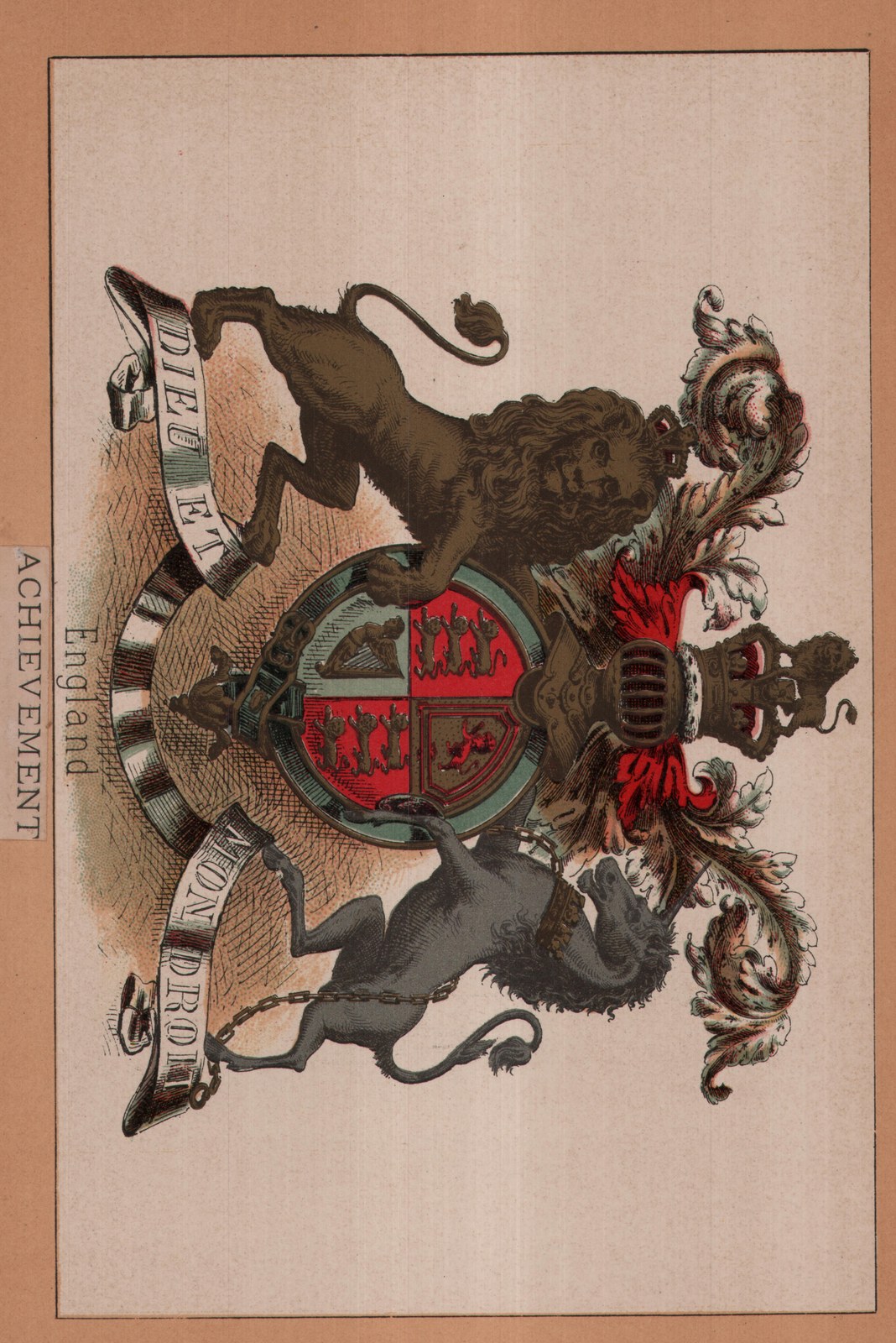
So having had this introduction to Old Mother Flag and to her most interesting family - and having had a peek through the palings of the ancient tournament-grounds, let us take up one of Polly's pretty pictures and give it a good look. Here is one where all that is necessary to form a perfect "Achievement," or coat-ofarms, can be seen. First we will notice the shield, and we see that resting upon it is a helmet; upon this helmet rests a crown, with a sort of ragged veil flowing from it, over the helmet. This is called the mantling. On either side of the shield stand two figures, whose feet rest upon a scroll that runs under the shield, and on which the motto, if there is one, is written. High above the shield, and rising from a wreath, is the crest. The badge does not appear upon an Achievement.
All of these little adornments have a meaning; and before we hear the tales that the shield has to tell us, we will try to understand what the minor ornaments mean. "Minor, indeed!" exclaims the outraged crest, fairly quivering with indignation. "Was I not placed far beyond the shield in the estimation of the warrior knights in the good old days! Could any one display me unless they had won the right to do so on the battlefield! Minor, indeed!" - Dear, dear! what an uproar that crest is making! Such a simple remark as that of mine who could have dreamed that it could have hurt the feelings of any one! Of course, the crest is honorable, very honorable; and it was only to the helmet, the coronet, and such trifling things, that I referred. This I say in a whisper, for if they too show such jealousy as does this arrogant crest, we shall have anarchy reigning supreme, and you will never hear a single one of all the interesting legends that most of them can tell. But the crest is shaking its feathers and carrying on in such a dreadful way that I am sure it will interrupt us every moment DIEU ET England ACHIEVEMENT TON DROIT STORIES ABOUT FLAGS AND CRESTS. unless we ask her forgiveness and tell her we are dying to have her open up her store of queer stories. We know very well how nobly it used to conduct itself in the red days of strife and bloodshed, inspiring fresh courage simply by its appearance when flying from the helmet of some idolized and trusted commander. But, with all respect to its feelings, let it be said, it has never been known to ward off a blow from its possessor, as the shield with its dinted and hacked appearance clearly shows it often has; and its introduction into the collection of ornaments that now decorates the silver, paper, and carriages of all noble families was of much later date than that of the shield. But, when it was introduced, we acknowledge with all haste that its possession was considered a higher distinction than that of simply displaying the shield. A crest (see! it is growing good-tempered now) could, in early days, only be borne by a knight who had known what it was to win honor on the battle-field, whereas the shield could be passed from father to son. This now has all changed, and, with the rest of the owners' insignia, belongs to the son as well as to the father. Yet the crest still insists upon certain restrictions in its use, it having a good deal of the crusty old bachelor in its composition. We Americans set its rules at defiance, and do as we choose; but the English ladies are not permitted to use the crest - that is the prerogative of the "man of the family" alone. The importance attached to the ability to display the crest is easily recognizable by the way in which it appears upon the seals of the old "noblesse." Certainly there, at least, it bears but little resemblance to a "minor ornament," towering as it does above the almost microscopic shield. The unfortunate shield looks like some poor little hen-pecked husband, half hidden by the voluminous skirts of an Amazonian sort of a wife. You can almost hear him cry.
The first crest given by a king to a subject was that of an Eagle, which Edward III. bestowed as a mark of high favor upon a Montagu-or Montacute, as the name used to be spelled - the Earl of Salisbury. With it he gave him a goodly estate, so that the honor was not an empty one. "Crest" is a word that in Latin means the comb or tuft that grows upon the head of many birds, and chieftains used these crests as a proud distinction upon their helmets. When not made of feathers, it is supposed to have been made of boiled leather, light, and susceptible of any shape desired, and many were the curious conceits which were embodied in its form.
In Germany, they regard the crest even more highly than we do, as with every marriage between noble families where a new quartering is grafted on to the family shield, the crest of the wife is superimposed on those already belonging to the shield. But in France the crest is quite neglected, so that many families never display it. Even in England there are many coats-of-arms where the crest is missing, although the reason for such an omission is not at all from lack of desire to have it.
The crest is always represented as rising from a wreath of six strands of twisted silk, used in memory of the admiration with which the turbaned heads of the hostile Saracens were regarded by the Crusaders.
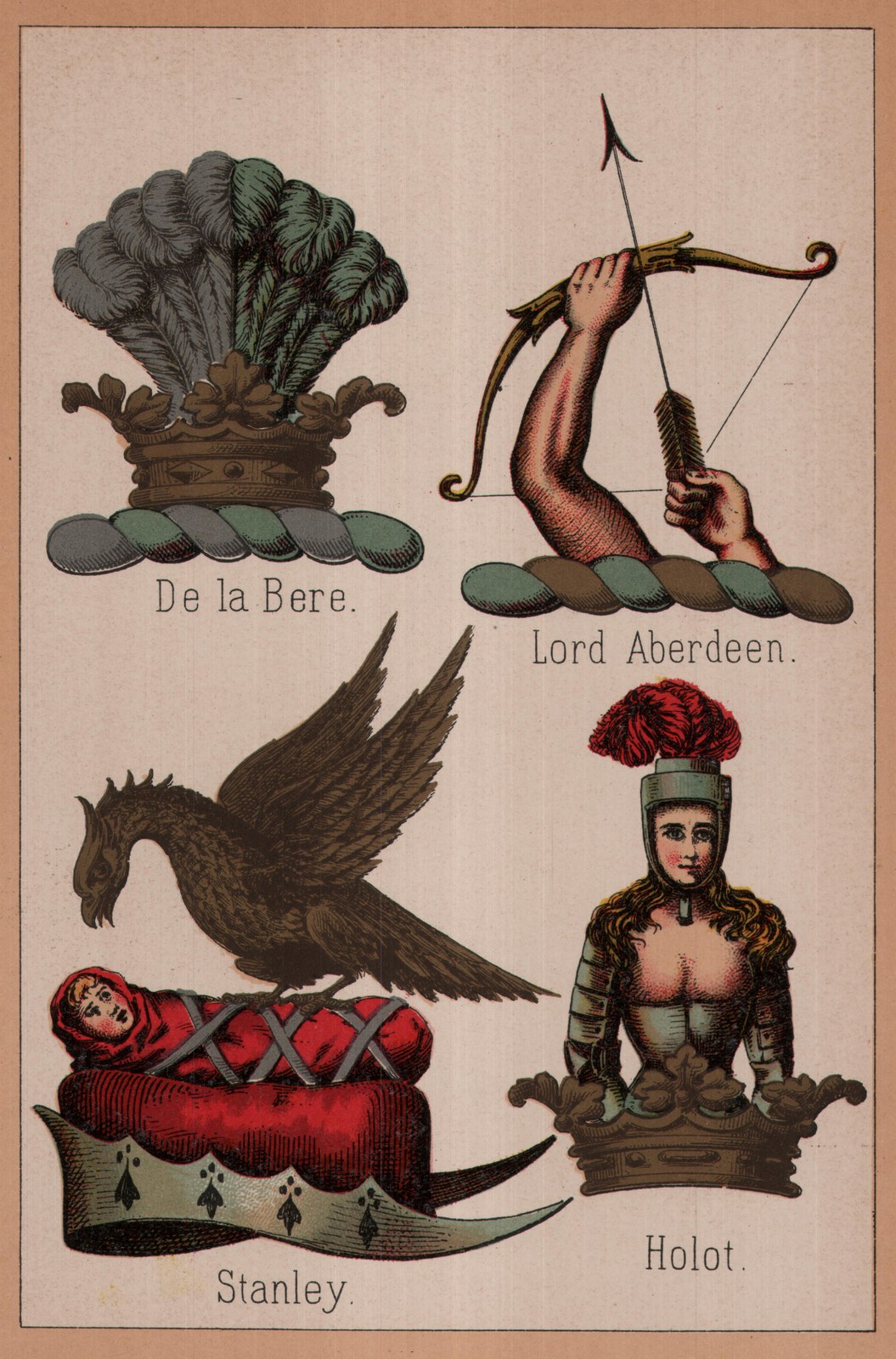
Many of the crests borne by Englishmen have curious stories connected with their origin; and one such is the legend of the Stanley crest, belonging to Lord Derby. According to this, we are / STORIES ABOUT FLAGS AND CRESTS. to believe that there was once a good old knight called Lord Latham, who lived with his wife in Latham Hall. He had grown old, and at the time of our story both he and his wife were not far from four-score years, and yet no little feet had ever pattered through their halls, and no din of children's voices had either fretted or gladdened the hearing of the good old couple. They loved each other dearly, but ah, how they grieved to die without an heir of their very own. A stranger would squander what they with so much care had hoarded, and alien occupants would fill the grand old hall. Back of the castle stretched a dense forest called Ferlistowe Wood, through whose tangled underbrush none but woodsmen ever forced their way. These woodsmen, however, as well as all other retainers of the old noble, knew how he mourned his lonely condition, and sympathized with him in his grief. One day, while busily engaged in felling trees, one of these men discovered, to his intense amazement, that in an eagle's nest, where lay three fine young eaglets, was a new-born babe, "swaddled and clad in robes of red," - evidently a treasure just brought by the mother bird to whet the appetites of her young brood. The news of this surprising discovery being brought immediately to the lord, he rode with all the speed that he could make into the wood. There, to be sure, carefully guarded by the wood-chopper, lay the babe in the strange society of the little birds. Stooping down, he lifted the weeping child in his arms, and, bearing it straightway to his wife, they adopted it as their own, making it the darling of the house. A linen cloth filled with salt was fastened about its neck, according to the custom then prescribed with children who had not been baptized, so they had it christened Oskell, and he became their heir. Sir Oskell grew up a wise and good man, married, and became the lord of the castle. He had one daughter, the beautiful Isabella, with whom, after she was grown, Sir John Stanley fell in love and stole away one stormy night. But the father forgave them, and eventually left them all his great estates. The child in the eagle's nest became the well known Stanley crest, and the eagle's leg was taken for the badge. Another extremely interesting crest is that of Lord Aberdeen. It is associated with the death of the Lion-Hearted King of England. His French possessions were very dear to the English king, and shortly before his death he was in France, engaged in one of the tussles with the French king, that were so common during the years when England maintained her right to certain provinces in the north of France. He was bringing the difficulty of the moment to a favorable close for English claims, when he learned that one of his vassals, the Viscount of Limoges, had discovered a treasure, and, with the hope that his liege lord might not hear thereof, was holding it for a while in his castle of Chalus. But the world is full of ears that hear, of feet that carry, and of tongues that tell all news, both good and bad, so it was not long before Richard was made aware of the secreted treasure. He posted a messenger off, without any delay, therefore, to his perfidious subject, demanding it to be sent to him forthwith. The Viscount, though wrathful that his good luck should have become known to the king, and having forty good ways of spending the money himself, still did not dare to entirely refuse the king's demand, so he filled sacks with half the amount, and, loading them on the back of a mule, sent them to the king. If he expected this would be satisfactory, Richard soon disabused him of such an idea. The Viscount then remonstrated, De la Bere.
Lord Aberdeen.
Holot.
Stanley. .
STORIES ABOUT FLAGS AND CRESTS. saying that "Gold treasure belongs to the liege lord; silver is divided." At this the king issued marching orders to his army, and before long they were encamped before the refractory noble in his castle. The garrison defended it as best they could, but, not anticipating the attack, or the king's appearance being more sudden than it was supposed possible, the provisioning of the castle had not been completed. They offered, therefore, to capitulate. But the king, whose temper was never under the best of control, had become so exasperated that he swore he would take the place by storm and hang every varlet in it. When this answer was received, the miserable garrison resolved to defend itself to the death. One young archer, peering through some loop-hole, spied the king and one of his generals examining some point of attack, and so close to to the castle that they were within bowshot. He was not the man to lose such an opportunity, and, swiftly placing an arrow within his bow, he sent it with such certainty of aim that he struck the king in his shoulder. A surgeon was called, but so unskilful was he that in endeavoring to withdraw the arrow he broke it, and the steel point remained to rankle in the wound. Meanwhile, the castle was stormed and taken, and, as the king had commanded, the soldiers were put to death. Bertrand de Gourdon, whose hand had laid the king upon his dying bed, was summoned by the monarch to his couch. "Wretch," said he, "what had I done to you, that you should have attempted my life?" "You have put my father and two brothers to death," was the spirited answer, "and you wanted to have me hanged." The king's brows knit heavily, as he regarded for a few moments the daring young soldier; then he suddenly exclaimed, "I forgive you; let his chains be removed, and let him receive one hundred shillings." And with these words the king expired. But so enraged were his generals that they paid no heed to his request, and, in their transports of grief and wrath, took the unlucky prisoner and flayed him alive. The children of Gourdon, terrified at their father's fate, fled to Scotland, and there established this celebrated family of Gordon, afterwards Earls of Aberdeen. Another crest is one where the half figure of a woman is conspicuous. It is borne by the Lyons, Earls of Strathmore. Old Sir John Lyon was so fortunate as to gain the good-will of King Robert II., and with such great favor did the king grow to regard him that he permitted him to marry his own daughter, the Lady Jane. Such a magnificent alliance could not be permitted to slip by unnoticed, and the family have ever since borne as their crest this figure of a lady, within an arch of laurel and holding a thistle in her hand.
The crest of the De la Beres was given to the family just at the close of one of the great English and French battles. There is an old, old house in Cheltenham that belonged to them, where, in an ancient painting, Sir Richard de la Bere, Knight Banneret, is represented as receiving his cognizance, the badge and crest of plumes. When the Black Prince was in great danger during the battle of Crecy, this noble knight succeeded in extricating him from his perilous position, and, to show his appreciation of his valor, the Prince, at the close of the battle, gave him this crest, resembling his own. The crest can still be seen in the window of the great parlor at Southam.
An interesting little display of womanly heroism is associated with a crest worn for many years by the Dudleys. It represents a STORIES ABOUT FLAGS AND CRESTS. woman with an open helmet and her hair falling about her shoulders. The story of this gallant woman's deed so worked upon the imagination and fired the enthusiasm of a solitary monk, living in the shadows of the fourteenth century, that, instead of pattering his Ave Maria, or counting off his Pater Nosters in his lonely cell, he wrote the tale of her exploit. It seems that this fair maiden, whose name was Agnes Hotot, was the loving daughter of a very hotheaded old father. The father had a troublesomely opinionated neighbor, and between them a disagreement arose over the proprietorship of a certain tract of land. The discussion grew so warm that they finally decided to meet at a certain time upon the disputed ground and settle the quarrel by combat. As ill fortune would have it, the father of Agnes fell sick, and on the appointed day was unable to keep his appointment. "Then," says the good monk, "his daughter Agnes, unwilling that he should lose his claim, or suffer in his honor, armed herself cap-a-pie, and, mounting her father's steed, repaired to the place of decision, where, after a stubborn encounter, she dismounted Ringdale, and, when he was on the ground, she loosened the stay of her helmet, and, letting down her hair about her shoulders, she showed him that he had been conquered by a woman." This muscular lady became afterwards the heiress of her family, and marrying a Dudley, the crest was assumed and worn by them.