Home › Supporters. - Mottoes. - Shield. - Colors. - Metals. - Furs › Supporters. - Mottoes. - Shield. - Colors. - Metals. - Furs
Supporters. - Mottoes. - Shield. - Colors. - Metals. - Furs
AND now we will look at the supporters. - In old tournament days when the knights placed their arms within the lists, previous to beginning the jousts, they left as guards on either side of their equipments, two men, fantastically dressed perhaps as dragons, mermaids, angels, or as any form that caught their fancy; and it is thought that this custom gave rise to these strange figures that appear on so many coats-of-arms. Unless supporters are inherited, they can only be displayed by special permission from the sovereign. Here is the "achievement" belonging to the Scottish family of Hay, Dukes of Errol. Nothing of the hobgoblin type acts as supporters to their shield, but two farmers, each of whom carry an oxyoke. In the southern borders of Scotland, there is an ancient town called Perth, and many years ago, when invasion by the ferocious Danes was as dreaded as a pestilence is now, Kenneth III. was routed in an encounter with them near this town. As the defeated clansmen fled before their foes, a stout-hearted farmer, who, with his two sons, was ploughing in a field, saw the disgraceful rout, and springing to the narrow mountain gorge through which their cowardly countrymen were fleeing, they flourished the gear of their plough around their heads, and threatened to strike dead any one who should attempt to force their way by them, upbraiding SUPPORTERS. them as they did so for their caitiff desertion of king and colors. So determined were they in their obstruction of the defile, that they infused fresh courage into the panic-stricken troops, who, at last, plucking up heart, turned upon their pursuers. The Danes, utterly astounded by their unexpected onslaught, felt assured that re-enforcements must have arrived, and, wheeling about, retreated towards their boats, leaving the Scots masters of the field. Great was the rejoicing and loud the plaudits showered upon the loyal farmer and his sons, as they were brought into the presence of their sovereign. To reward them, the king bade the farmer let a falcon fly from his hand, and promised him the length and breadth of as much land as the swiftly flying bird would pass over before seeking to rest herself by perching.
In this way did a vast estate in the district of Gowrie pass into the hands of the future dukes of Errol, and they commemorate the occasion by displaying their yeomen supporters.
Supporters cannot be taken at will. They are only given in Great Britain by the Queen, and, with her permission, by the kingat-arms, called Lyon, of Scotland. Sometimes the supporters represented the office of the noble who carried them, as under the old monarchical rule in France, where the Admiral bore two anchors, the Grand Butler two bottles, the Great Huntsman two bugles, etc.
Even where supporters are permitted to be borne by favored subjects, occasionally the wish of the receiver is to display but one, as when the Lord of Stoke Tyne having done the king some important service, Charles the First offered to knight him. This he, with many thanks, declined, and requested instead to be permitted to place the arms of his family upon the breast of a hawk. His petition was granted, and the lords of the manor have since that time always so borne their arms.
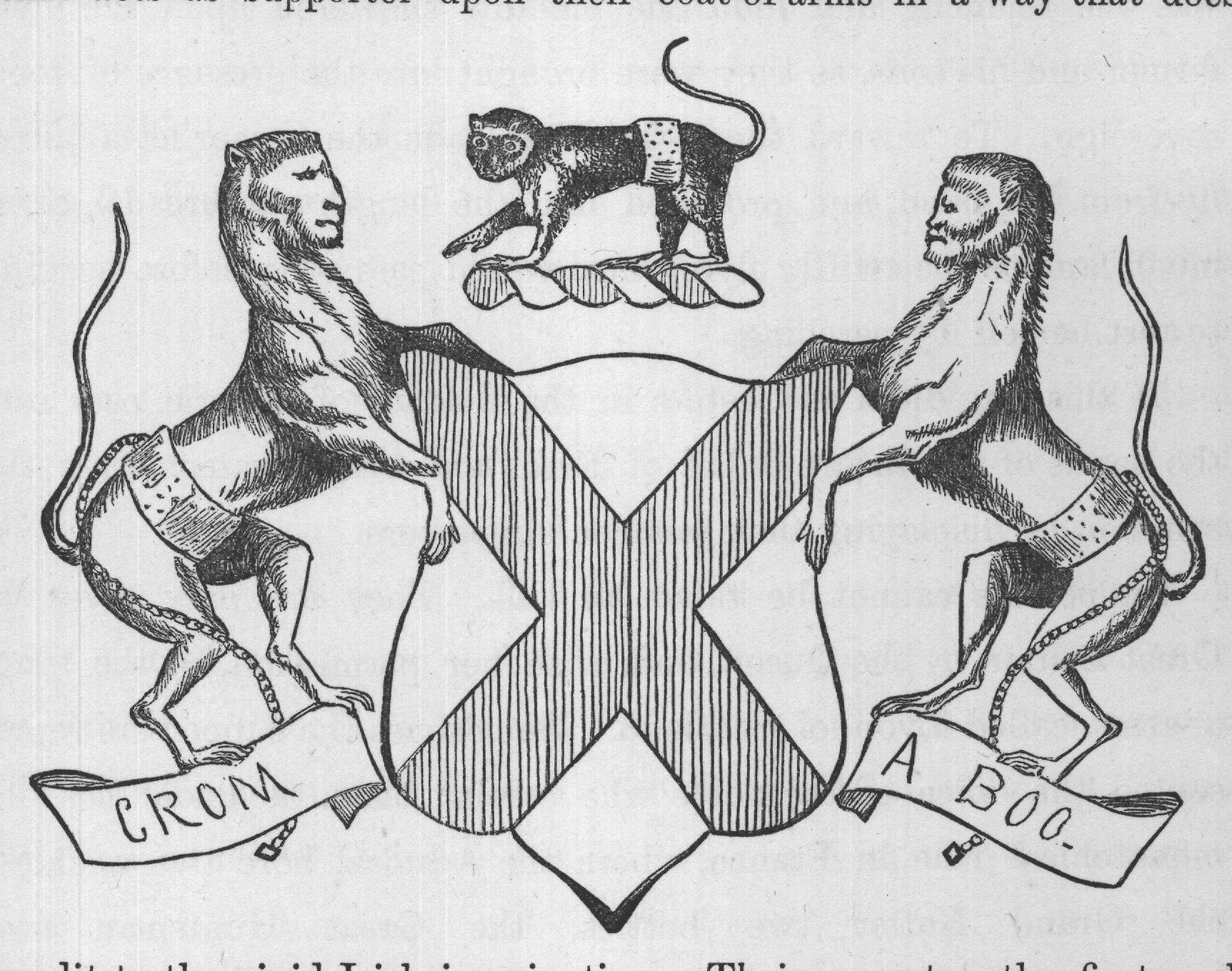
In France, where supporters are treated with more respect than is the crest, they sometimes introduced no less than four, two standing upon the other two. The Earls of Kildare explain the appearance of a singular animal that acts as supporter upon their coat-of-arms in a way that does CROM 000 A BOO co credit to the vivid Irish imagination. Their ancestor, the first earl of Kildare, bore the nickname "Nappagh," or ape, from a little adventure that befell him when an infant. He was but nine months old when his father and grandfather were both killed in a battle waged between them and their old-time enemies, the McCarthys. When this occurred the child was being cared for at Tralee, but his SUPPORTERS. nurses, upon receiving the dreadful tidings of what had befallen the family, became so frantic that they rushed out of the house, leaving the child in its cradle. There it lay, crowing and cooing to itself, until it attracted the attention of a great ape, or baboon, which was kept on the grounds. He went to the laughing little fellow, and, easily lifting him out, proceeded to escape with his burden from the house. Once outside the door, he scampered along the ground with the astonished child in his arms, and contrived to reach the neighboring abbey without being seen. Chattering with delight, he now began to clamber with him to the roof, which he did in safety; then, not satisfied with such a performance, he proceeded without more ado to scale the steeple! Here he cut up various antics, to his own intense satisfaction, and to the horror of the poor maids, who, having recovered from the first bewilderment of grief, had returned to look after their charge. Not finding him, they left the house to search for the missing child, and it was not until after much hunting and calling that they at length spied him in his appalling position. There was nothing to do but wait the pleasure of the animal, as should he become enraged or alarmed he might drop the baby at any moment. At last the monkey became weary of his sport, and began to descend with extreme care, clutching the howling infant with a grip of iron. He reached the ground and replaced the terrified and screaming baby in its cradle, and then, followed by a shower of dust-pans, kettles, brooms, or whatever substitutes were used in those days, he made a hurried exit.
On another coat-of-arms we see a couple of beavers used as supporters. The shield belongs to General Carleton, whose name is not especially dear to American boys who have read the pitiful account of the winter march, so painful and so trying, made by our brave Revolutionary soldiers through the forests of Maine up to the Heights of Quebec, and their disastrous repulse by this general. He pursued them for some distance up the St. Lawrence, and on Lake Champlain contested their possession of that sheet of water. During this struggle he made great havoc in the American fleet, and, in the words of an admiring Briton, "by his vigorous exertions, he was able to postpone the day of final separation between the colonies and Great Britain." He became Lord Dorchester, and, after returning to England, was elected a Knight of the Order of the Bath; and the beaver, which abounds in Canada, was given him as his supporters, one wearing a mural crown about his neck, and the other a naval coronet, in honor of his successful endurance of the siege at Quebec, and his victories on Lake Champlain. Now, nothing remains for us to look at, before attacking the shield, except the motto. These are of two kinds, one which originated in the battle-cries of the powerful nobles whose wealth and power, as we have noticed before, sometimes fully equalled that of the king. Such as the "Crom a boo" of the Fitz Geralds, Earls of Leinster. This war-cry was taken from the favorite castle of the family, situated in the small town of Crom, about twelve miles from Limerick. "A boo" means "to the rescue " and mottoes similar to this are occasionally seen - as on the Butler coat-of-arms we read Butler a boo," and on that of the Desmond's "Shanet a boo," Shanet being the spot where they had built their castle. -- When Henry VII. was made king, he abolished the use of all these family " cris de guerre" upon the battle-field, on account of the feuds and rancors that often existed between these haughty chiefs, MOTTOES. and bade them call alone "St. George and Merrie England," or upon the name of the king.
Other such mottoes are the "A Home," of Dunbar; and the "Dieu aide au premier Chrétien," the arrogant war-cry of the great House of Montmorenci.
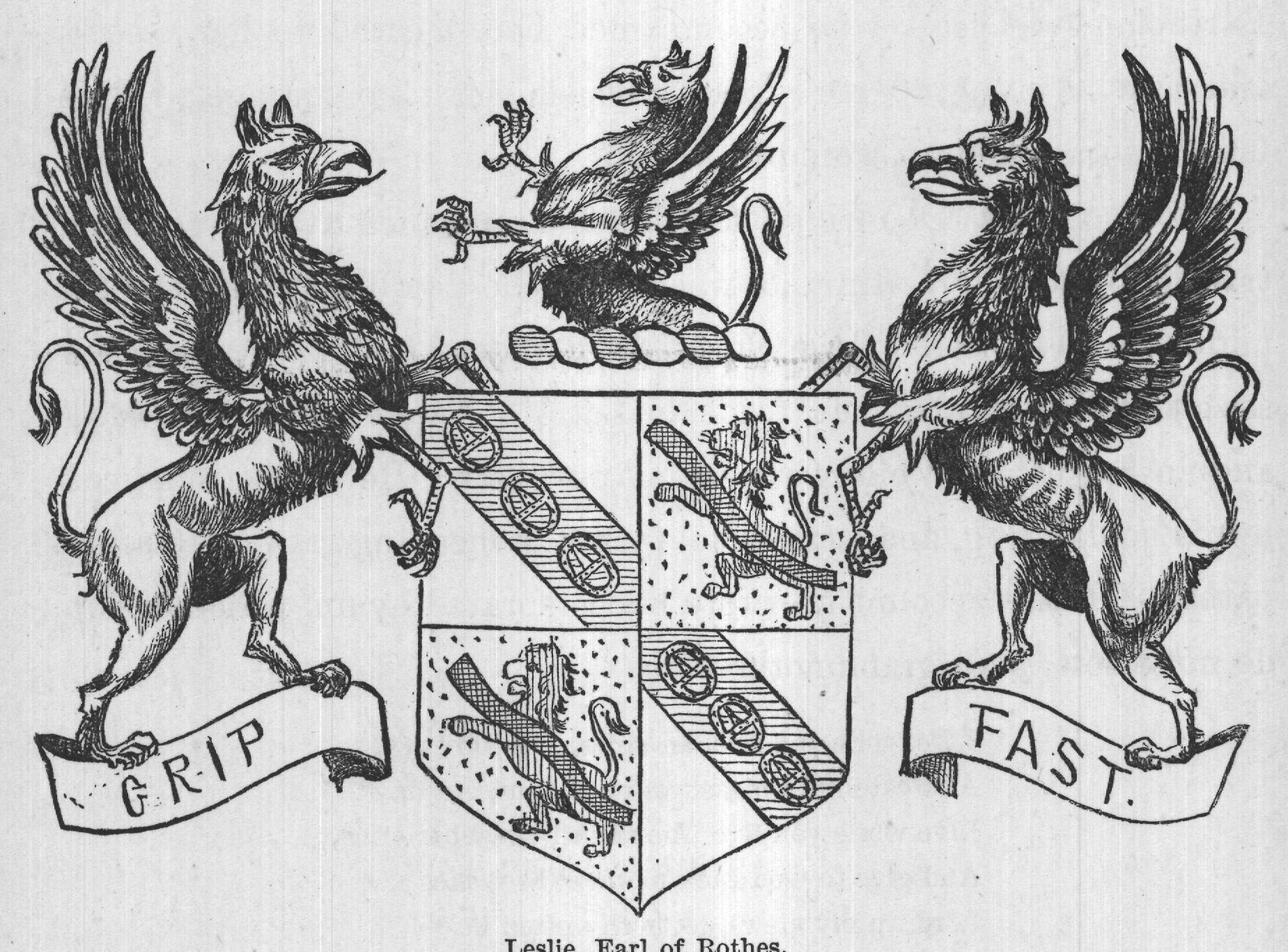
The other class of mottoes includes anything that suits the fancy GRIP FAST.
Leslie, Earl of Rothes. of its owner, for the use of the motto is optional with any one who has the right to bear a coat-of-arms. Unlike the crest and supporters, it is not the gift of the sovereign or college of arms. Mottoes are often exceedingly amusing - sometimes expressive of some pious thought - or they are puns on the names of their owners; in fact, they are of all varieties.
The motto of the Leslies, Earls of Rothes, is "Grip fast," and was chosen by the family in order to keep fresh in their memories, and those of their neighbors, a gallant act of devotion shown by one of their forefathers toward Queen Margaret of Scotland. The Queen was attempting to ford a stream, when her palfrey grew suddenly weak, and she was in imminent danger of being drowned. Bartholomew Leslie, who accompanied her, hurried to her rescue, and as she clung to his girdle, he bade her take courage; "Grip fast," he said, and all would be well.