Home › Other Decorations, Taken from Living Objects › Other Decorations, Taken from Living Objects: Douglas
Other Decorations, Taken from Living Objects: Douglas
The body of man himself was not excused from the covetous fingers of the heraldic painter. The Heart of Bruce appears again and again on Scottish shields. This honorable position it owes to the good Sir James Douglas, better known perhaps to our boys and girls as the "Black Douglas," whose mailed hand was laid so heavily on the shoulder of that poor, affrighted mother who, in the fancied security of some castle stronghold, was crooning her baby to sleep: - "Hush ye, hush ye, little pet ye, Hush ye, hush ye, do not fret ye, The Black Douglas shall not get ye!"
You remember how he suggested to her the foolishness of trusting in any such delusion. But though he slew many that night, he showed his right to be called the "Good Sir James," in that he protected the hapless mother and her babe.
This warlike knight was, of all his followers, the dearest to the noble Bruce. As this renowned king lay dying, he told his knights of a longing he had always felt to make a pilgrimage to the Holy Land; but the Lord, he said, had given him so much else to do that he never had been able to undertake the journey, and he begged Sir James, as his most trusted and best beloved knight, to carry his embalmed heart to Jerusalem, and bury it under holy soil. When the good knight could so far control his bitter weeping as to be able to speak, he said: "Gallant and noble king, I return you a hundred thousand thanks for the high honor you do me, and for the valuable and dear treasure with which you entrust me; and I will most willingly do all that you command me, with the utmost loyalty in my power. Never doubt it, however I may feel myself unworthy of such a high distinction."
The king replied: "Gallant knight, I thank you; you promise it me, then?" "Certainly, sir; most willingly," answered the knight. He then gave his promise upon his knighthood.
The king said, "Thanks be to God! for I shall die in peace, since I know that the most valiant and accomplished knight in my kingdom will perform that for me which I am unable to do for myself."
The Bruce died, and Douglas had his heart carefully taken out, and embalmed with the most potent spices and perfumes; he then laid it within a silver case, which, after being padlocked, he hung about his neck, on a cord of twisted silk and gold. Then, with a long train of the most gallant of Scotland's knights, he set forth on his long and wearisome pilgrimage. Long and wearisome it was but harder to bear did his faithful followers find the mournful sequence of the expedition; for the good Sir James never saw Scotland's glens and moors again. His body, wrapped in many folds of cloth-of-gold, was brought back by them, and now rests in the little old church of St. Bride.
On his way to the Holy Land, while still strong and vigorous, the vessel carrying Sir James and his knights touched the coasts of Spain. King Alfonso, the Spanish monarch, was at that time resisting with all his might the invading hosts of the Moors, and, ٠٠ learning of the arrival of the great Scottish chieftain, whose prowess in battle was so remarkable, he immediately hastened to receive him with all possible honor, hoping to persuade him to unite with him in ridding Spain of the hated Infidel. He represented to him what great service he would render to the Christian cause if he would pause before continuing his voyage to the Holy Land, and help him drive out the Saracen Infidel of Granada.
The Douglas agreed to do so; but the eastern mode of warfare was unfamiliar to these valiant mountaineers, and the Scottish ranks became broken and scattered. Douglas, as he was dashing forward to the rescue of some of his companions, whom he saw sadly beset by the savage Moors, found himself hopelessly surrounded by his enemies. He seized the heart of Bruce, tore it from his neck, and, exclaiming, "Pass first in fight, as thou wert wont to do, and Douglas will follow thee, or die!" he flung the silver treasure far before him, in the centre of the opposing host, and, rushing towards it, fell, pierced by many a spear.
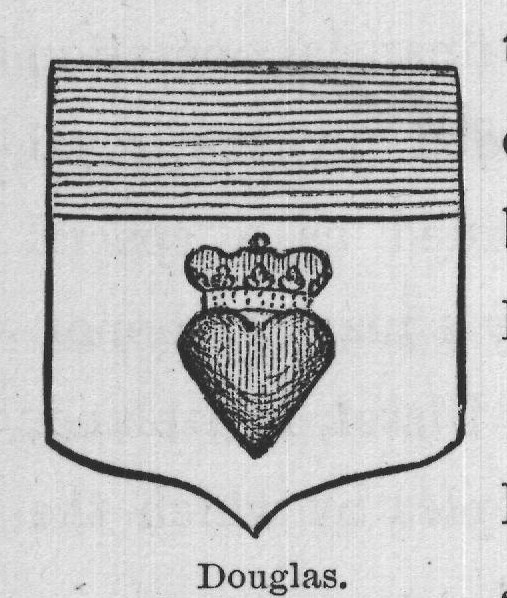
This is a sad close to the life of so mighty a warrior as was Good Sir James. He is said to have fought, in the space of twenty-four years, fifty-seven battles with the English, and thirteen with the Saracens. "Certes," exclaims one of his biographers, "he must have been one of the noblest 'butchers' of them all." Remembering his gallant death, the Douglases have ever since that time worn a bloody heart bearing a crown upon it. One thing was quite remarkable about the appearance of Sir James. Although he had been engaged in so many wars, his face had never been scratched, and some brave Spanish knight, whose visage bore marks of many bloody and horrible fights, could not refrain from asking him how he so escaped. The Douglas replied that he thanked God for having always enabled his hands to guard and protect his face!
Whenever you see this crowned heart, you can always recall this tale of the swarthy old hero; for, in some way or other, every such coat-of-arms is connected, either by blood or by association, with this Black Douglas, or with the Bruce himself. Douglas.
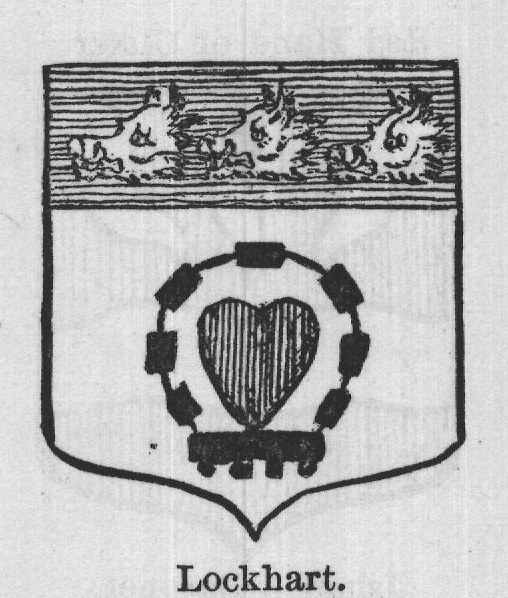
Sir Simon Lockhard of Lee was among the knights that accompanied Douglas on his mission, and was entrusted with the care of the heart of Bruce when Douglas fell in Spain. He brought it back to Scotland, and buried it in Melrose Abbey. In honor of this trust, he adopted for his device a man's heart with a padlock upon it, Bruce's heart having been padlocked in the silver case, - and men called him thenceforward Sir Simon Lockhart, instead of Lockhard, as formerly. The heart of Bruce appears again and again.
And, besides the heart, we have the bloody hand - Lockhart. that of Ulster. This, upon a small escutcheon, appears upon every coat-of-arms that belongs to a baronet, and has given rise to solemn and fearful whispers amongst the unlearned.
It has been stated as a dreadful fact that murders have been committed by scoundrelly ancestors of the unfortunate family displaying this device, and the suffering descendants are compelled to wear this ignominious evidence of their shame. To rid themselves of it is almost an impossibility; still, if the owner, or a more than brotherly friend of the owner, can be found who will agree to pass seven long, dark years in a cave, without speaking to any one, or cutting his nails and beard, during the entire time, then can the shield be wiped of its stain, and the family forget the blemish. The formation of the Order of Baronets was a financial operation of James the First's, money being sorely needed in the royal treasury. Permission to bear the title is regarded as a special evidence of royal favor, so that this hand is really a mark of honor. It is derived from the arms of the Province of Ulster, in Ireland, the defence and colonization of which was the plea by which the king was persuaded to create the new order.
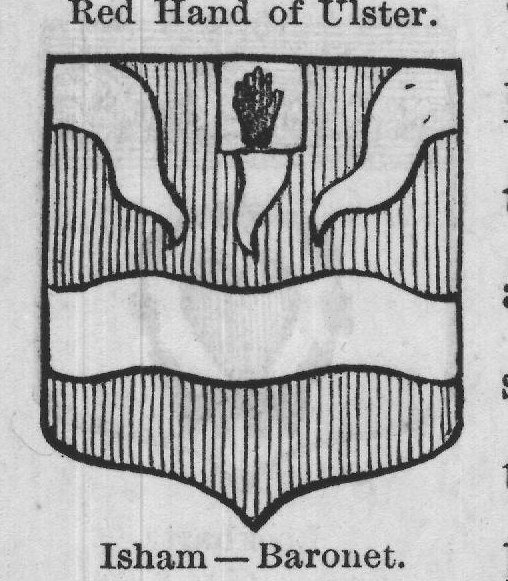
Red Hand of Ulster.
The men of Ulster are proud of their device, and, after giving you their motto, are very willing to tell you the credited tale of "Lamh dearg Erien," - The Red Hand of Ireland. Far back in those days when most of these tales had their rise, an expedition of some adventurers to Ireland set forth, and, in order to shorten the perilous voyage, the leader declared that whoever first touched the shore should be lord of the territory reached. O'Neil, ancestor of Isham - Baronet. the princes of Ulster, vowed he would carry off the prize, and every stroke of his oars seemed to promise success. But there were other hardy and muscular contestants, and, to his intense chagrin, just as they neared the shore, another boat shot past his own. A moment more, and the O'Neils would never be the powerful princes of this Irish land that the ambitious soldier craved to make them; so he bent with greater energy than before to his oars; but, in spite of all his efforts, he could not drive his boat at greater speed through the billows - he was almost exhausted. The arm of the soldier was wearied; his brain was as active as ever. A thought flashed through his mind - he would be victor yet; and with feverish haste he grasped his sword; then, just as his competitors were raising a shout of derisive triumph, a brawny, bleeding hand went whirling over their heads, spattering them with drops fresh from O'Neil's bold heart; and before the boat-keel of the astonished mariners could scrape the gravelly beach, there, on the green turf, far beyond the reach of the tide, it lay, and the province was declared to belong to O'Neil.
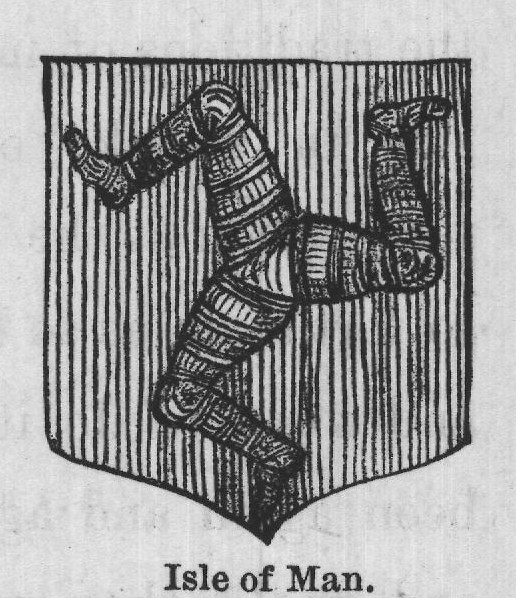
Isle of Man.
Then the coat-of-arms belonging to the Isle of Man, which in this case should be styled a coatof-legs. Three legs intertwined appear upon its shield, and one sunny old chronicler remarks that "if he might be permitted to be jocular upon so grave a subject as armory, he should consider the coat a happy allusion to the geographical position of the island, as it lies between the three kingdoms of England, Scotland, and Ireland, - as if it had run away from all three, and were kicking up its heels in derision of the whole empire!"