Home › Other Decorations, Taken from Living Objects › Other Decorations, Taken from Living Objects: Dauphin
Other Decorations, Taken from Living Objects: Dauphin
He was adopted as a device by the young Dauphin of France who afterwards became Charles V. of France. If you will look upon a map of France, you will notice three little "departments," as they are called, tucked snugly away in the southeastern corner - Hautes Alpes, Isère, and Drôme. In olden times these formed the Province of Dauphiné, a most fertile and sunny bit Dauphin. of France, and when given by Louis the Bavarian to Guy VIII., of the noble house of La Tour de Piu, the honored knight rejoiced greatly over his good-fortune.
On his shield he bore for a device a dolphin, and for this reason called his new possessions "Dauphiné." Many years after this, one of his descendants found himself suddenly bereft of an only son, and, in his despair and grief, renounced his claim to this fair inheritance, and offered it to the French King Philip the Sixth. When making the gift - if such it could be called, when a sum of money was to be given in exchange, he padded it well with conditions; but the French king was so delighted with the idea of so largely increasing the extent of his dominions, that he accepted the offer, encumbrances and all. It is needless to say that, the recipient being a monarch, the "conditions" faded completely from the royal memory all but one. It was expressly stipulated that so long as there were heirs to the French throne, so long the eldest son should bear the name of Dauphin. The grandson of Philip bore it, and all his successors, until the Duc d'Angoulême abandoned it in 1830. - The lucy, or pike, was worn by the family so dear to the heart of Shakespeare, and whose country-seat perhaps those of you who have visited Shakespeare's home, in Stratford-on- Avon, will remember passing when riding from the quaint little town towards Leamington.
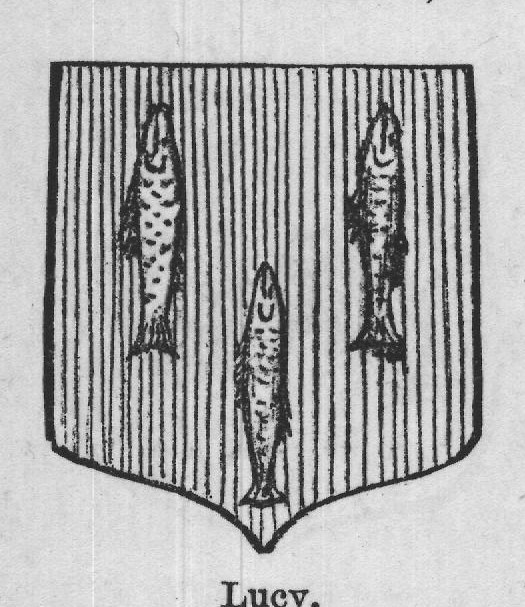
Lucy.
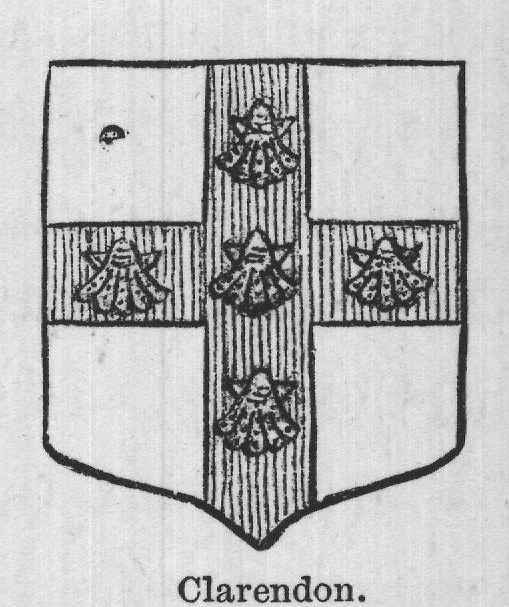
As for the escallop shell, Pope Alexander IV., in the thirteenth century, forbade all but pilgrims who were truly noble the right of placing this charge upon their shields. When it is seen on a coat-of-arms it usually means that the family claim a drop or two of old Crusader blood.
The Earls of Clarendon wear them as their device upon a red cross, as a souvenir of the crusade under Edward I.
Then the mythical animals - strange hobgoblin beasts - some with scaly bodies and bat-like wings; others, part horse, part lion; many of them, creations of the Saracen imagination; others, brought from sources nearer home. The unicorn was introduced by the Anglo- Saxons into Britain on one of their standards, and was then carried into Scotland by their descendants, when William the Conqueror drove them out of England, and was then selected as supporter for the Scottish shield. In the place it now holds, as part of the royal arms of Great Britain, it is represented as the guardian of Virtue, while the Dragon is that of Wealth. Clarendon. 1 His horn in olden times was thought to be an infallible test of poison, and on this account the wild beasts of the forest wisely constituted him "Water conner," and never ventured to slake their thirst until, with his horn, the unicorn had stirred up the water to see if serpent or dragon had, with malicious intent, therein deposited his poison. To catch him it was said to be necessary to find the glade that he haunted, and there to place a beautiful woman. When the unicorn, pressed by the hunters, rushed by, it was expected he would see the woman. If he but once caught sight of her, he would instantly lose all his fierceness, and, seeking protection of her, sleep at her feet until he was taken and slain. When England and Scotland were united under James I., one of the silver unicorns was taken from the supporters of the Scottish shield, and one of the golden lions from the English insignia, and placed one on either side of the British shield.