Home › Other Decorations, Taken from Living Objects › Other Decorations, Taken from Living Objects: Beatrice
Other Decorations, Taken from Living Objects: Beatrice
Many centuries ago lived Beatrice, the only daughter of the Duke of Cleves, at her castle of Nymwegen, on the Rhine. It was one morning when the sun was shining brilliantly that she sat singing by a window that overlooked the river. Suddenly she stopped her little song, for a singular object had appeared, just coming around a bend in the river.
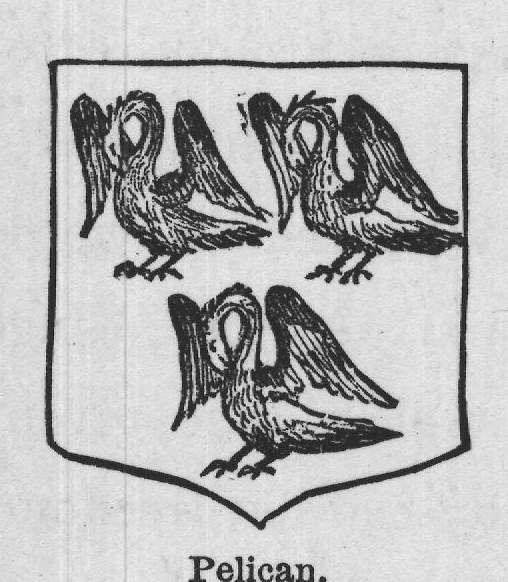
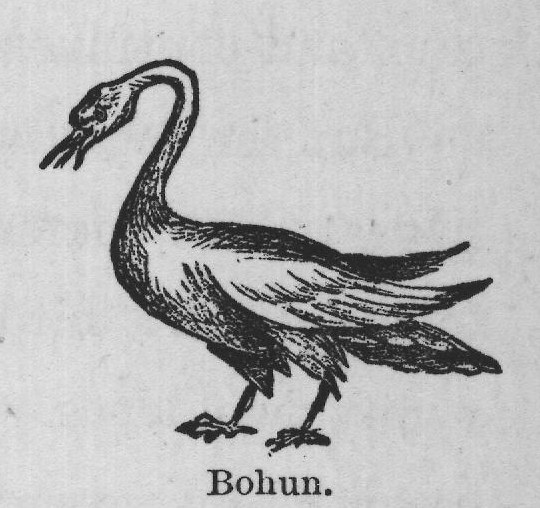
But before we tell you what she saw, we must let you know that about this time, but far away from the Rhine, there lived a noble and handsome prince, named Helios, and although we will not trouble ourselves much about the pedigree of the fair singer, Beatrice, we shall have to learn a little about that of Helios, so as to really appreciate Queen Anne's gift to the inn-keepers of Merrie England.
In this country where Helios was born there was once a king who married the daughter of another royal personage. She was very pretty, but I am sorry to say had no better a disposition than many other pretty young damsels have who are not of the blood royal. But, amiable or vixenish, she loved her husband, and by and by a very noble young son grew up in their castle, and he carried joy to the hearts of his parents in whatever he did. Then the father died, and the young prince, who had never seen any one whom he loved better than his mother, became king, and the two lived in the great palace. One day the king was hunting in the forest, and, as all kings in fairy tales are apt to do, he lost his way in his own familiar woods. He rode hither and thither, but, no egress from the leafy prison being discernible, he dismounted by the first bubbling fountain that he happened to see, and tried to cool and comfort his bewildered self, and strengthen his drooping horse. As in this plight he sat, a very melancholy knight by a very beautiful stream, a lovely young lady, whose name was Beatrice, appeared, and with her a damsel or two, and a knight. They conducted the monarch back to his palace, and the king, being smitten with love at first sight, married the fair Beatrice. Now the Queen-mother's evil temper, that had been lying dormant during the years of her prosperity, suddenly began to make its claws do active service for its unfortunate possessor. This piece of pink and white prettiness was a very unwelcome addition, so the mother-in-law thought, to the royal household, and endure it she would not; no, never! So, soon after the wedding, when the king was obliged to start toward some quarter of his realm where insurrection had broken out, he bade his mother take excellent care of his young wife, she promised she would, but with a mental reservation. After a while six little sons and a lovely little daughter, all wearing silver chains about their necks, appeared, but these dear little creatures were, every one of them, hurried off by the Dowager Queen's squire, Marks, who had instructions to drown them, every one, in the swift, deep river. But the babies looked so sweetly at him, and were so pretty, that the squire felt his heart swell with pity; murder them he could not; so he carried them into the woods, and when he reached a favorite spot, at a long distance from the royal city, he spread his cloak upon the ground, and upon it laid the seven innocent little beings. Then he departed, but, soon after, a hermit, who lived in a lonely grove near by, happened to pass near the children, and heard the concert of seven voices, which was now being given in vigorous if not melodious accents. He hurried to the spot, and, as soon as he could recover from his surprise, he put them all into his own capacious mantle and bore them to his grotto. He immediately baptized them all, and they lived to grow up charming children. But one, named Helios, being more beautiful and manly than the others, grew to be the old man's darling, and he often took him with him on his begging excursions. During one such absence a yeoman of Queen Malabrune's (for this was the name of the evilly disposed grandmother) chanced to be chasing in the forest, and saw the children playing together near the grotto, and eating wild apples. The unusual sight of costly silver chains about the necks of such poverty-stricken little people astonished him, and upon his return to the castle he told Queen Malabrune. Her wicked heart was assured by her good memory that these were her grandchildren, and she bade him take six trusty followers and slay them. This he started to do, but the beauty of the children again softened the hearts of the would-be executioners, and, instead, they simply wrenched off their silver chains. These they gave to Malabrune, with some plausible tale. But, alas for the children! upon losing their chains they were immediately transformed into white swans, and with many mournful cries they spread their wings and flew away. The hermit was now informed by an angel whose the children were, so he took Helios to the castle, confronted the wicked old Queen with the tale of her sinful deeds, and rescued Beatrice, who, upon false charges made by her mother-in-law, was about to be killed. Helios then took the silver chains, and made a solemn vow to visit every pond and lake until his missing brothers and sister should be found. Just before starting, however, they suddenly appeared upon the lake in the royal park, and came with many demonstrations of delight to meet him. As he embraced them he slipped the chains over their necks, and they were again his darling companions - all save one; for Malabrune had melted one of the chains so as to make a silver goblet. After enjoying himself with them for some time, Helios felt his spirit stir within him, and one day he saw the solitary swan, drawing a boat, approach the shore of the lake. It began to cry to him, and persuaded him to enter the little skiff. As he did so, Helios bade his parents and his friends a long adieu, and, carrying his arms and his silver shield, with a cross of gold upon it, was soon in the boat, which the white swan rapidly drew away. Day after day they sailed, until they reached the Rhine, and after a few more days of sailing they turned a sharp and rocky cape that cut deeply into the river, and he saw the picturesque turrets of a castle.
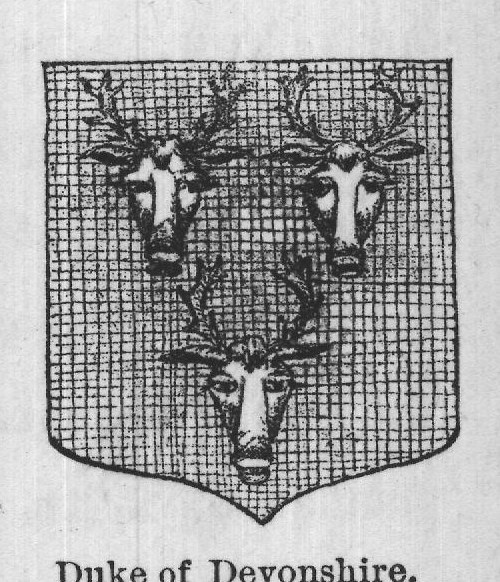
Now we will go back to our little princess, who was gazing out of her window and watching with so much interest an object that was sailing along the river towards the castle. As it drew nearer, and still nearer, her curious eyes discovered that it was a boat, and moving - not by the vigorous use of oars, but drawn by a snow-white swan, attached by a golden chain to the prow of the boat. In this vessel Helios sat. As they reached the castle, the swan drew the boat to the shore, and our hero sprang upon the ground. He met the maiden, and, winning her heart, married her, and became the Duke of Cleves. For many years they lived most happily together, but there was a Bluebeard's Chamber in her life; her husband, in marrying her, told her he could do so only on one condition, and that was that no questions should ever be asked by her as to who he was, or from whence he came. At first her present happiness was so great that the command imposed upon her never caused her a moment's thought; but her curiosity, or, if she had none, perhaps that of Mrs. Grundy, who, no doubt, had as frisky a tongue then as now, prompted her to solve the much debated question. So it was that upon a dark day the dreadful question was propounded by the luckless wife. Very sorrowfully then did the handsome, nameless knight rise up. He gently rebuked his inquisitive wife, took his sword, and, calling for his children, put into their little hands his sword, his horn, and his ring, bidding them never to lose them. As he did so, he kissed them very lovingly, and, with a last adieu to his wailing wife, down he went to the sedgy bank of the Rhine. Instantly the swan appeared at the bend of the river, drawing the tiny shallop after it. On seeing Helios it uttered loud cries of joy, and hastened towards him. Helios sprang into the boat, and, waving a last farewell to the watching and lamenting group on the bank, he was gone forever. Then you will often see the stag's head, cut off at the ears, as in the shields of both the Duke of Devonshire and Lord Derby. Duke of Devonshire.
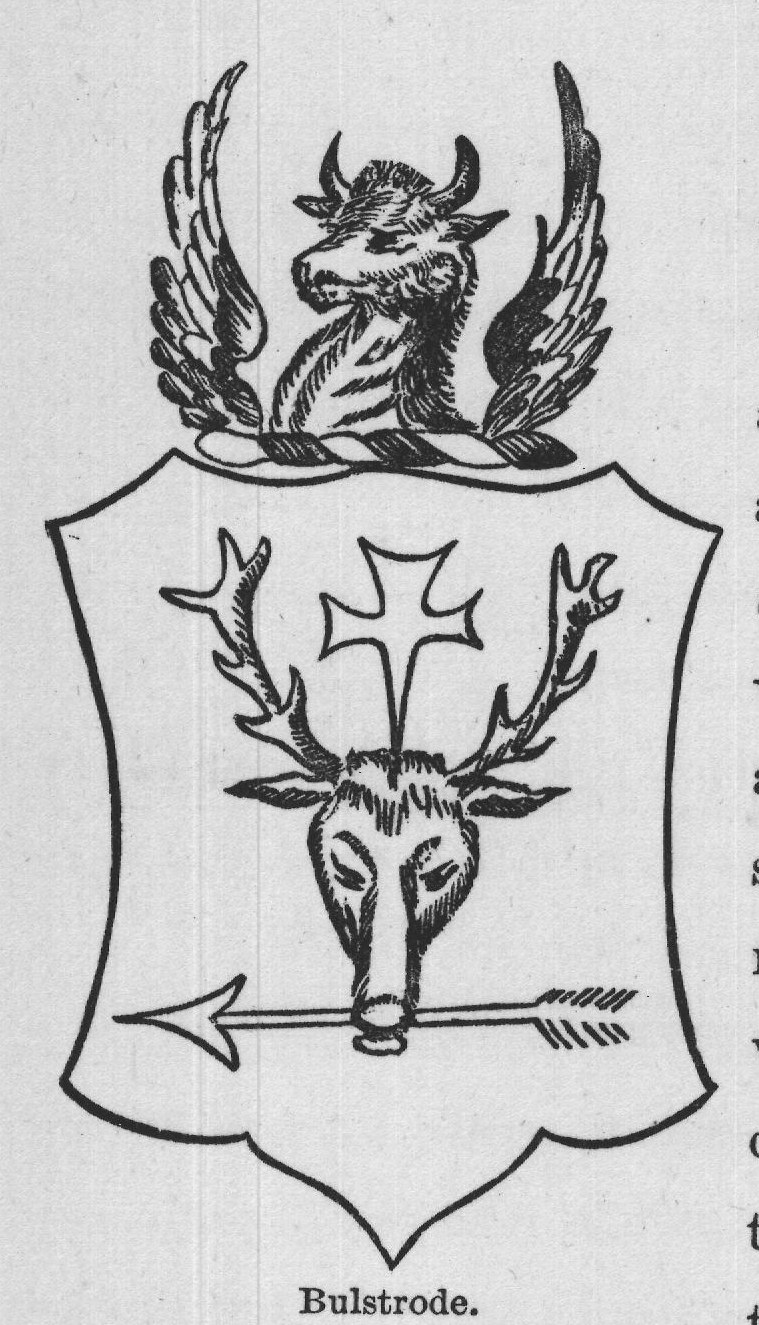
The Bull's Head, too, was worn as a crest by the Bulstrodes. They can tell, if they will, their little legend, and, as in regard to all these marvellous tales so linked with many of the names in an ancient pedigree, you may be credulous or not.
When William the Conqueror at last made himself master of the British Isles, he gave the estate of this family to one of his own followers: and to enable him not only to drive off the former proprietors, but to keep possession of the gift, he lent him the help of a thousand stalwart soldiers. Now, the rightful owner of this bit of coveted property did not feel satisfied with this "without your leave" disposal of his lands, and therefore, calling in the aid of some sympathizing neighbors, and throwing up earthworks, one of which is still pointed out, he defended himself. The well armed Normans were gradually overcoming their resistance, when he and his comrades determined to make a sortie. Lacking horses, they mounted themselves on bulls, with which, to an unprecedented degree, they seem to have been provided, and fell upon their enemies. The besiegers were taken unawares, and, hearing the frightful bellowing mingling with the outlandish outcries of the riders, and seeing the dreadful capers of the beasts, who themselves were well nigh frantic with their novel occupation, became so affrighted that, hurrying to flee from what seemed the imps of hell themselves, they fell upon and under each other, and were thus trampled or slashed to death. Those that were not slain put their trust in their heels, and rescued themselves by flight.
The Conqueror, upon hearing of this, felt some curiosity to see the wrathful and inventive defender of his estates, and, promising him a safe-conduct to and back from the Norman camp, persuaded the hardy Saxon to make him a visit. This he did, riding upon a bull, and followed by his family of seven sons, equally well mounted. As a result of the interview, the property was allowed to remain with its original owner, and the well satisfied Saxon returned home to receive the congratulations of his good-hearted neighbors, and As a Bulstrode. to announce to them the name that henceforth it was his intention to assume - Bulstrode! The crest is such as may be seen, a bull's head. The good heraldist who repeats this tale whispers something about its being something like what is called a "cock and bull" story, but the family resent that intimation, and repeat a little couplet which they preserve to prove their ancient lineage: - "When William conquered English ground Bulstrode had per annum three hundred pound."
The old Swiss cantons of Uri and Valais, the purest popular government known, have existed for more than a thousand years. Every spring, the little army of Uri, bearing a banner of "the bull's head," marches to a green meadow among the mountains; all the men of lawful age following on foot, the magistrates on horseback, and the chief magistrate bearing a sword. Reaching the meadow, the people gather around the chief ruler; there is a brief pause of silent prayer; and then and there, in the general assembly of the people, the magistrates resign their trusts, the chief magistrate delivers up the sword of his office, leaves the chair, and takes his place with the other citizens. If he has served them well, they bid him take the chair again; for there is no rule that he may not be re-elected.
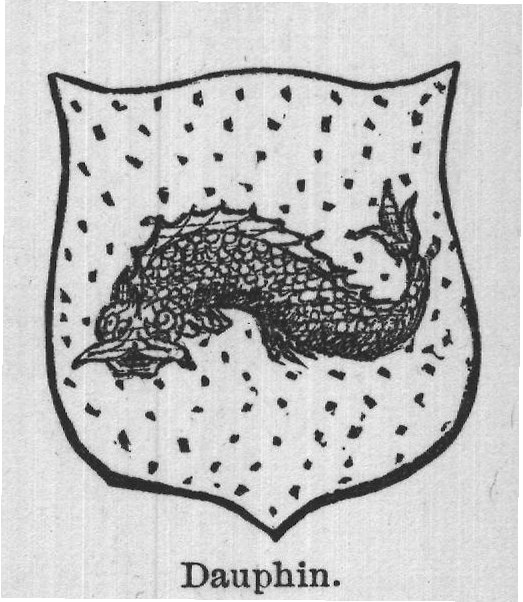
Old Ocean, too, has treated the shields of the old noblesse with a lavish hand. The dolphin has a truly royal curve in his august little back.