Home › Decorations Taken from Other Sources › Decorations Taken from Other Sources
Decorations Taken from Other Sources
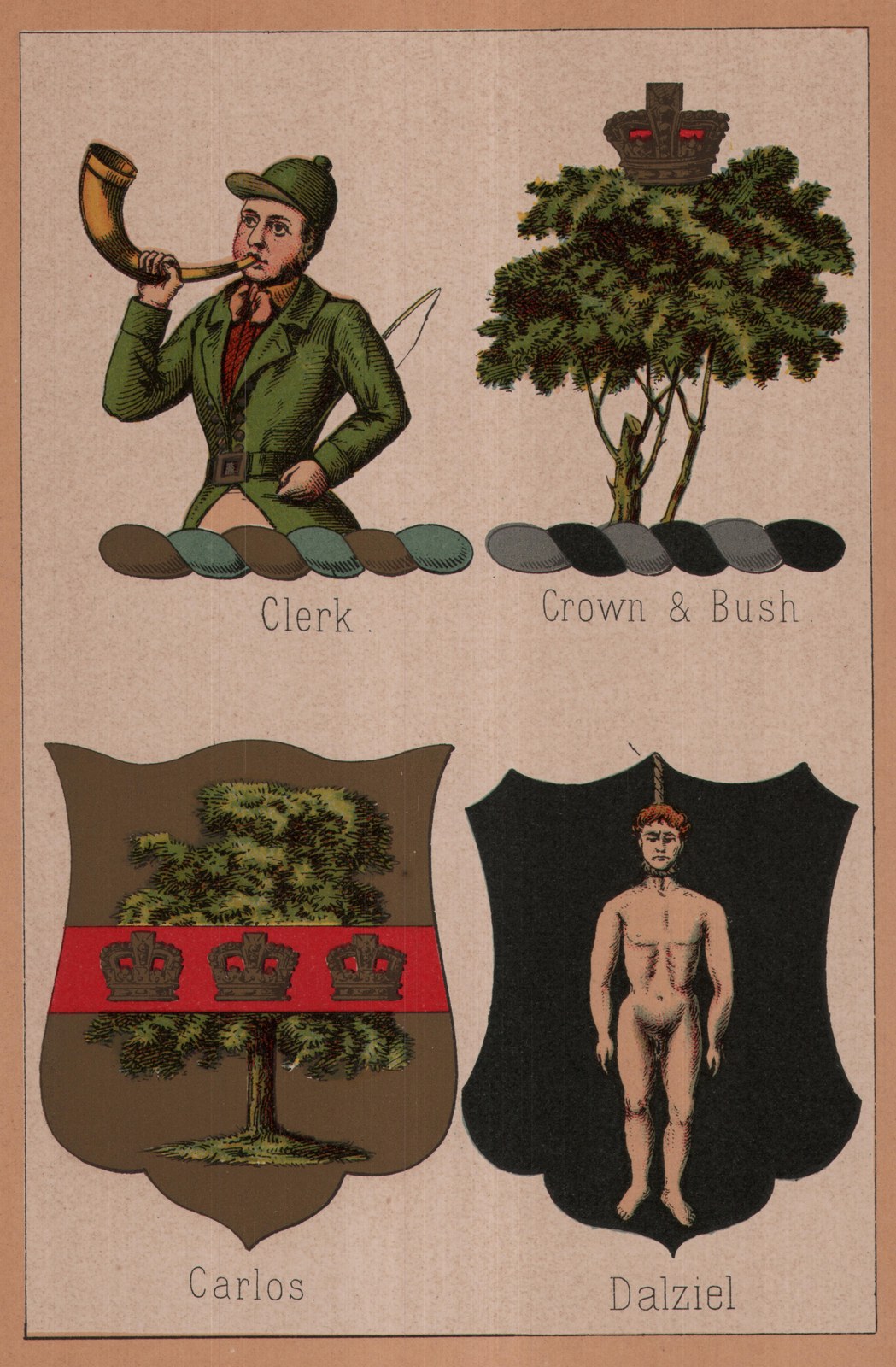
THE reigns of Kenneth and Malcolm in Scotland, according to the traditions of many eminent Scottish families, seem to have been rich in warlike episodes that deserved and received immediate recognition at the hands of their sovereign. The Dalziel family are so fortunate as to have had some relative who knew just what to do and when to do it at that early day. Those miserable Picts had been again and again tormenting the life of good King Malcolm, and finally they succeeded in getting possession of some favorite cousin of the king, and ignominiously hanged him on a tree. This was a most disgraceful death; and the king, both grieved and incensed that the body of his relative should remain there exposed to the ridicule of all passers-by, offered a great reward to any one who should get the poor corpse and bring it to him. For some reason this was a most hazardous enterprise; and, although the reward offered was great, no one seemed ready to run the chances of exchanging places with even the dead favorite of a king. At last one gallant subject presented himself before the king, exclaiming "Dalziel," which in the old Gaelic language signified "I dare." And dare he did; and with such address did he execute his enterprise that the king, before long, had the satisfaction of getting his cousin's bones laid wherever he desired. He not only paid the reward promised, but gave him his present coat-of-arms, with the Clerk Crown & Bush Carlos Dalziel DECORATIONS TAKEN FROM OTHER SOURCES. motto "I dare," and permitted the soldier thenceforth to be called "Dalziel." He was the ancestor of the Earls of Carnwarth. Flowers, too, have been gathered to beautify the shield, and a fallen foe on the field of battle often saw Death staring at him out of the hearts of white or crimson roses, or grinning in the cup of a golden lily.
The Wars of the Roses, as you all know, were so called because the rival houses of York and Lancaster wore the rose of different tint, each upon his shield. Very likely, some of you have stood upon the grassy lawn of old Temple Garden, and perhaps have been so story-wise as almost to see Plantagenet, the hot Duke of York, tear a white rose from its bush, and could hear him say: - "Let him that is a true-born gentleman, And stands upon the honor of his birth, If he suppose that I have pleaded truth, From off this brier pluck a white rose with me دو and then seen his vengeance-breathing adversary, Beaufort, Duke of Somerset, the proud Lancastrian, stride to the bush crimson with flowers, and, as he broke one from its stem, hear him retort: - "Let him that is no coward, nor no flatterer, But dare maintain the party of the truth, Pluck a red rose from off this stem with me."
It was not until the days of Henry VII., who wedded Elizabeth, the fair Yorkist, that the two roses ceased to represent opposing factions, and in forming what is called the Tudor rose - quarterly silver and red - obliterated all but the memories of forgiven feuds. Many are the coats-of-arms on which you will find a rose red or white, and usually a reason can be given for the bearing of the same. Upon the shield of the Marquis of Abergavenny, whose ivy-covered country-seat perhaps you have seen, between Tunbridge and London, is displayed a red rose upon the centre of his cross. He is the descendant of the mighty king-maker, Richard, Earl of Warwick, who placed the red rose plucked from the Temple Gardens on the centre of his shield, to show his glad allegiance to the House of York (?).
Neville, Marquis of Abergavenny.