Home › Augmentations › Augmentations: Henry
Augmentations: Henry
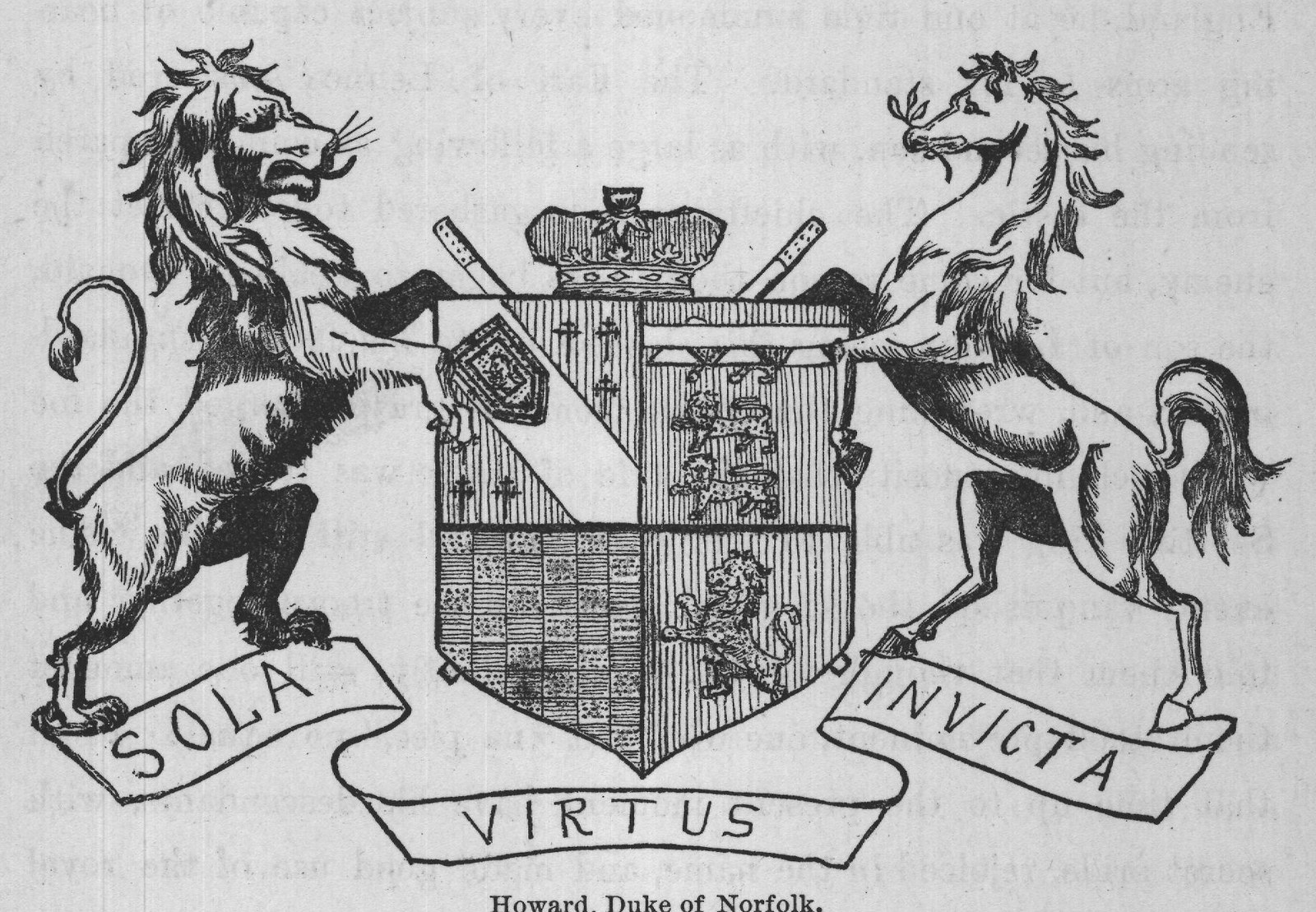
We see the Tressure on another coat-of-arms, that belonging to the noblest peer in all the realm, one who through many generations has frequently been the most beloved of kings or the most hated; and if his importance could be demonstrated in no other way, I think you might perhaps see it in his modest title, "His Grace Henry Fitzallen Howard, Fifteenth Duke of Norfolk, Earl of Arundel, Earl of Surrey, Earl of Norfolk, Baron Maltravers, Baron Fitzallen, Baron Clun, Baron Oswestry, Premier Duke and Earl next to the Blood Royal, Hereditary Earl Marshal and Chief Butler of England." The present duke is now thirty-eight years old, almost a title for every year. The family is an illustrious one, and it is said that the very first augmentation given by an English king to a subject was one given to an early ancestor of this SOLA INVICTA VIRTUS Howard, Duke of Norfolk. house, and which consisted of the arms of Edward the Confessor. This never appears upon their shield at present, as through it much grief and sorrow befell the family, but in the honorable quarter of their shield, in the upper right hand, you will see an augmentation which has given the name of the "Bleeding Lion of Surrey" to the house. One of the ancient Howards, a certain Earl of Surrey, was a knight much trusted and beloved of his sovereign. So dear was he to AUGMENTATIONS. the king that when, in order to forever end the bitter discords that existed between Scotland and England, the English Henry VII. consented to give his own daughter Margaret, as bride to James the Fourth of Scotland, he entrusted her safe carriage to the hands of this same Earl of Surrey. But Henry VII. died, and with him seemed to die all peace and concord between the nations. Henry VIII. became England's master, and it is not hard to believe that differences, as of old, arose between the rival kingdoms. These quarrels became more violent as years passed by, and the young Queen of France, whose country was hostile to England, fomented the disturbance as best she might by flattering the handsome Scottish monarch. She called herself his mistress and his lady-love, and extracted from him a promise that for her sweet sake he would march for three miles upon English ground. To seal the compact, she drew a ring from her own white hand and sent it to him. Meanwhile, King Henry set off for France, on warlike purposes intent, and James, remembering his pledge to the royal princess, and desirous of revenging past grievances of his own, deemed it an excellent opportunity in which to make incursions into his enemy's domains. As a pretext, he remonstrated in peremptory terms with the English king for making this attack on France, and bade him abstain from all aggressions against his ally, the monarch of the French. Henry, surprised and indignant, flung back a menacing refusal, and James, gathering his nobles together, invaded the English dominions. Scotland had just begun to enjoy the unaccustomed comforts of peace, and the clansmen were unwilling to again shake out the flag of war. But so popular was the king that, though unwilling, they still answered his call; and the Scottish army, with their arrows and Ir their spears, were soon again "over the Border." James met with great success. Fortress after fortress fell into his possession, and a great mass of plunder was divided amongst the valiant mountaineers. But here, while on the full tide of success, the king paused. His attention was temporarily diverted (a pair of bright eyes, it is said, being the cause), and the English Earl of Surrey had time to collect from all parts of England a formidable army of twenty-six thousand men. As they marched northward, his army was daily swollen by additions from the terrified northern counties. As rapidly as the English army grew, so rapidly did the Scottish army shrink, not because of lack of confidence in their king, but because they had enlisted for only forty days, and had but a limited supply of provision. These were already exhausted, the time for which they had agreed to follow the king had expired; and, anxious to place their booty in the secure recesses of their Highlands, clan after clan hurried from the army. The two armies finally met. The earl, by wise maneuvering, obtained the advantageous point upon the field of battle. The contest was keen, the Scots fought with bravery and that perfect disregard of life, always so characteristic of their nation; but the English troops easily surrounded them. The division commanded by James, and which was composed of the picked men of the entire army, was engaged by the Earl of Surrey in a bitter and unyielding struggle. Bows and arrows were flung away, and the huge weapon known as a bill was used instead. Gradually the sun sank and the shadows of night fell, but when the stars came out they shone upon the dead body of the rash monarch, pierced with many arrows. Around him lay bishops, earls, lords, abbots, and nobles of every degree, while above them AUGMENTATIONS. all the English banner waved in the cold night breeze. Great was the satisfaction of the English king when the news of the struggle - this famous battle of Flodden Field - reached him. He could not bestow too much honor on the brilliant and sagacious leader who had won the day, and he granted him permission to place upon the bend that crossed his escutcheon the Tressure of the Scottish shield, with the head of Scotland's lion in its centre The lion's mouth is pierced with an arrow, to indicate the way in which death met the king.