Home › Honorable Ordinaries. - Sub-Ordinaries › Honorable Ordinaries. - Sub-Ordinaries: Byron
Honorable Ordinaries. - Sub-Ordinaries: Byron
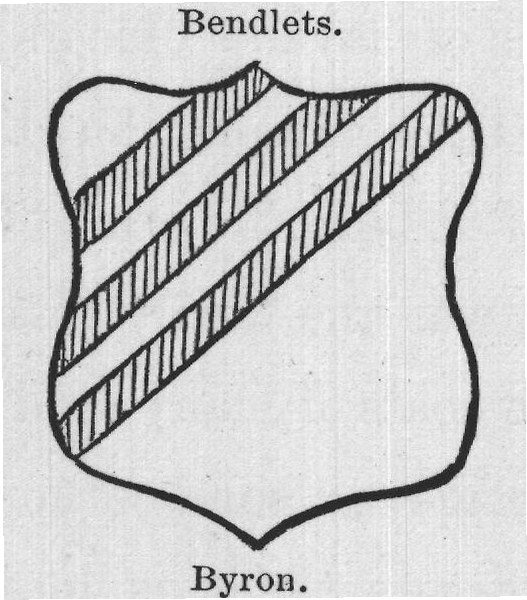
When several bends appear upon a shield, they are called "bendlets," as on Lord Byron's shield.
This shield of Lord Byron has been adopted by the city of Manchester as its coat-of-arms.
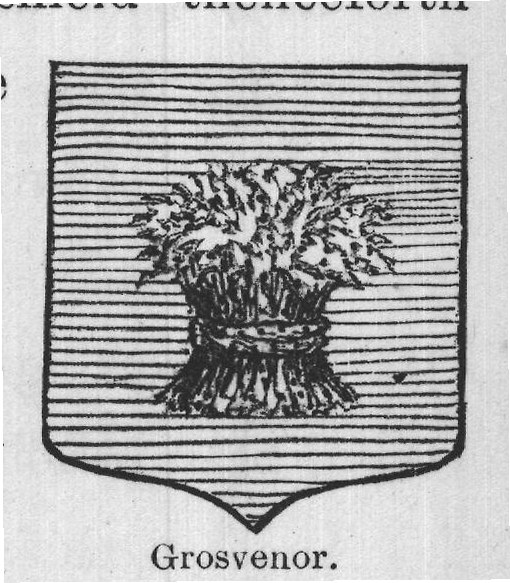
Grosvenor.
In stories of chivalry, you have read of the "Bar Sinister," but it should be "Bend Sinister," and though it usually was considered Bendlets.
Byron. a disgraceful addition to any shield, it is not always so regarded. The bend in this case goes from the left-hand upper corner to the lower right-hand corner. The wealthy Lords of Buccleugh look with serene contentment upon their escutcheon thus embellished, for by means of it alone they show their claim to two or three drops of royal blood, which came to them through Charles the First. A droll story is told of a Frenchman and an Italian, each of whom swore that the arms he bore were his, and belonged to no one else. The French king had hired a large number of Genoese troops to aid him in his wars with the English, and among the number was one on whose shield was painted the head of an ox. Seeing this, a nobleman of France, whose coat-of-arms was similar, took umbrage, and challenged the right of the Italian to display them. So long they strove in words, that finally they needs must fight. The day came, and to the place appointed the fiery Frenchman hurried, while with slower step thither sauntered the Italian, laughing as he went. ."Now, wherefore should we fight," said he to his antagonist. "Marry," said the irate Frenchman, "I will make good with my body that these arms were mine ancestors' before thine." "And what were your ancestors' arms?" again queried the Genoese. "Anox-head," said the Frenchman. "Then truly," said our Italian, throwing down his weapons, "here needeth no battle, for this I bear, behold! - it is but a cow's head."
Another mark is that called a chevron, and looks like the gable of a house, lying on the centre of the shield. Every cadet at West Point is familiar with the chevron, which is as prominent on the sleeves of the corporals and sergeants as spurs are on the heels of cavalry officers. Chevrons.
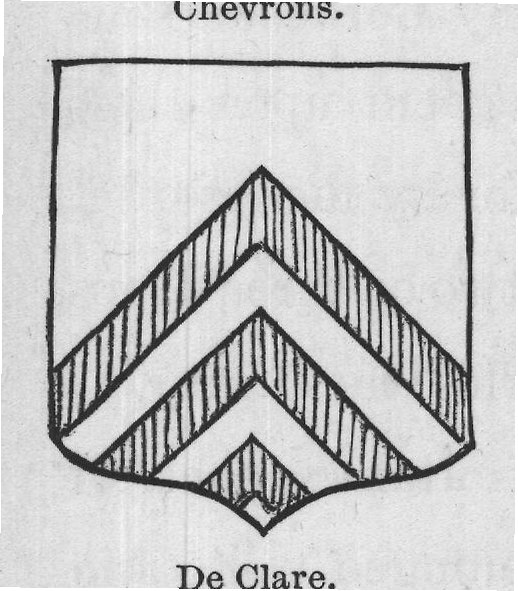
The old family of the De Clares displayed their simple shield, with its three chevrons, with as much pride as if it bore the arms of England itself. So powerful was the family that their device appears upon the coats of many families allied to them by marriage or some other means. The city of Cardiff wears them, as does also Clare College, at Cambridge.
De Clare.
After the chevron we have the pile, which some think represents the sacred nails driven into the hands and feet of our Blessed Lord. Be that as it may, it was displayed by one gallant knight who honored Old England with his achievements. There is a little story told by Froissart about the first unfurling of his banner when just created Banneret on the field of battle. In days gone by, as you already know, any very conspicuous deed of valor was often rewarded immediately upon the close of the day with some advancement or gift. When this was the case, should the banner or pennon of the good knight be one that had never waved above a conquerer's head, it bore, as at first, its swallow-tail end. But when victorious and honored by the commander, the points were torn off and the pennon carried square.
Pile.