Home › Honorable Ordinaries. - Sub-Ordinaries › Honorable Ordinaries. - Sub-Ordinaries: Chandos
Honorable Ordinaries. - Sub-Ordinaries: Chandos
Sir John Chandos, one of the Knight Founders of the Order of the Garter, appeared upon the field with his maiden banner to be displayed upon the field for the first time just before the battle of Naveret, in Castile. "He brought his banner in his hands, rolled up around the staff, and said to the Prince of Wales (the Black Prince): 'My lord, behold! here is my banner. I deliver it to you in this way (still rolled round the staff) that it may please you to display it, and that this day I may raise it; for, thank God, I have land and heritage sufficient to support the rank, as it might be." Then the Prince and the King - Don Pedro, King of Castile - took the banner, which was of silver, with a sharp red pile, between their hands, by the staff, and, displaying it, tore off the ends and returned it to him, the Prince saying, 'Sir John, behold your banner. May God grant you may do your duty!" Then Sir John Chandos bore his banner, so displayed, to his own company, and said, 'Gentlemen, see here my banner and yours; preserve it as your own." Do you think they failed to do it?
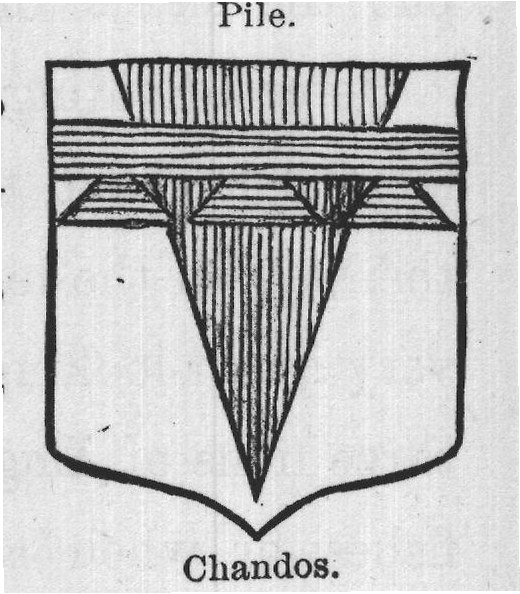
Chandos. - The right to display a square banner upon the field was also an indication of high rank, as no one of less degree than a baron was permitted to do so.
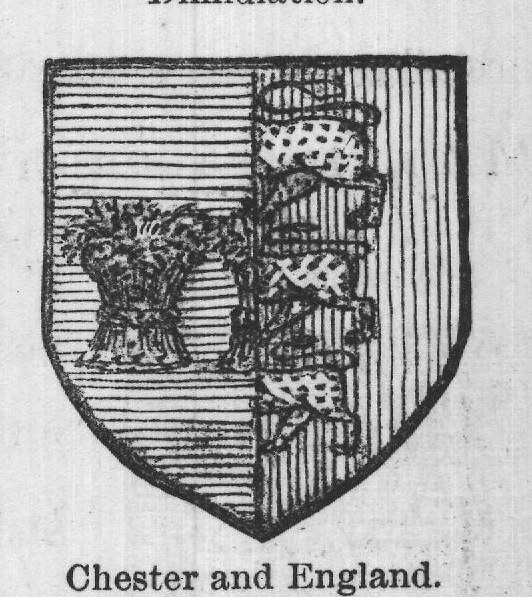
Quarterings meant, originally, the shield divided into four quarters; afterwards, when the arms of wealthy wives came to be added to the shield, it meant any square divisions that were introduced for such a purpose, no matter how numerous they might be. This is a very important ornamentation of the shield, for it is by quartering the shield into any number of little squares that the wife, if she happen to possess the lands and the title of her father -no big brother or near male relative interfering to prevent her from enjoying all that the good father can bequeath - is able to put the shield of her family upon that of her lord and master. Before dividing the shield in this way, it used to be fashionable to let the husband take the right half of the shield, and give the wife the half on the left; but sometimes such a combination produced a very queer-looking shield, as when the heads and fore legs of the three lions of England had for their extremities the halves of three fishes, or when an eagle and a lion were joined together. Altogether, the appearance of the family shield was not pleasing, so it was thought that by narrowing up the husband's coat-of-arms into Quartering.
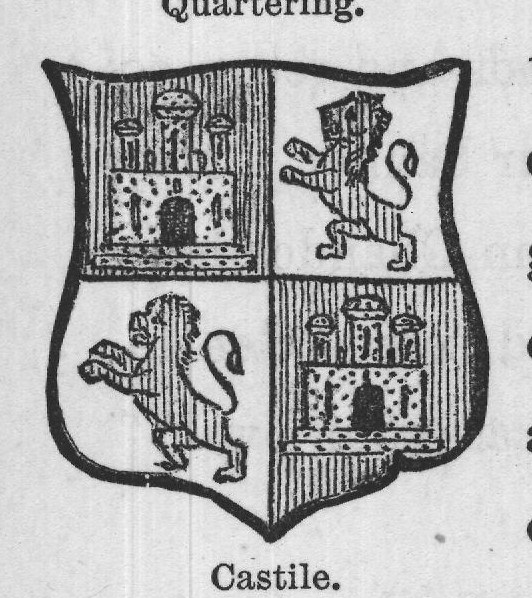
Castile. just half the width of the shield, and treating the wife's in the same way, the arms of both could be made plainly visible. But such elongated lions and wonderful looking objects of every kind were produced that this plan was abandoned. About that time one of the Queens of England, Eleanor of Castile, introduced the custom of quartering, her husband taking for two representations of his shield two of the quarters, and the wife for the double display of hers the remaining two. In England, they only quarter the arms of a wife who is so fortunate as to bring both the title and the fortune of her father with her, there being } no brothers, or descendants of brothers, to whom they could descend. Then her husband wears her arms on a little escutcheon in the centre of his, and his children put it in a square with their father's upon the family shield.
Dimidiation.
Chester and England.
The Dukes of Athol must have been wonderful magnets for the wealthy beauties of the land, as, should they choose to do so, they can display a thousand quarterings! The Grahams of Montrose, on the other hand, have sought their brides where the ducats did not "gild refined gold." But the complexity of the one shield and the simplicity of the other alters not the pride which both take in their coats-of-arms. The ancient family of Rodney also show a shield where their own device appears alone. In Europe, sixteen quarters - seize quartiers - are, as some one has said, a "Sesame" to almost every office of preferment, and thirty-two quarters are a still greater desideratum. Sixteen quarters show that for four generations the family has been constantly allied with gentle blood, as an ignoble person in Europe in early days could not show a coat-of-arms; and the thirty-two prove it for five generations. Every wife adds her coat to that of her husband, and a place has to be found for it. Of course, if she bears no arms, the shield lacks that one.
But when we look at the cross, as it glitters and glows on the shields of so many knights, what different ideas awake within us. We seem to hear the earnest pleadings, the stirring appeals, the solemn exhortations of the devoted Crusade leaders, and we see a vast concourse of armed men, the very flower of European chivalry, marching under flying banners, - the English knights with their white crosses gleaming on the surcoat, the French with theirs of red, the Flemings with the green, and the Romish States with their crossed keys, - all wending their impatient way towards Palestine. Many are the forms in which the cross appears upon the shield, and Cross Moline.
Molyneux, Earl of Sefton. although the charge probably originated in the strong clamps that kept the framework of the shield and its cover securely fastened together, still the Crusades gave the undoubted cause of its very general adoption. One faithful worker in heraldic lore tells us that he has counted no less than three hundred and eighty-five different kinds of this one device!