Home › Honorable Ordinaries. - Sub-Ordinaries › Honorable Ordinaries. - Sub-Ordinaries
Honorable Ordinaries. - Sub-Ordinaries
A COAT-OF-ARMS is not always colored, yet if properly engraved, every one familiar with heraldry can read at a glance the colors that it possesses. Look at this one, belonging to Sir John Hawkins, the famous navigator. His shield is black, and has three bezants, or, as we called them before, polka dots, in a row at the top, and a little golden lion trotting along at the bottom of the shield, upon a blue sea. For a crest he has a negro, a black man, whose hands Hawkins. !!! are manacled. All this I see without anything but ink being used in the picture. An Italian Jesuit taught the heralds how to do this by means of little lines and dots. If any part of the shield were red, then he covered it with very fine lines, running up and down. If it were blue, then the lines were to run from side to side; if green they were to pass diagonally from the left-hand upper corner to the righthand lower corner. If purple, then just the reverse. If black, then the sidewise lines were made to cross those running up and down. If it were gold, he spotted it with little dots; if silver, it was left pure white. If ermine, then it was white Brittany. with little black streaks like tails sprinkled upon it. If vair, then little objects like peculiarly shaped hats, adjoining each other, were drawn upon it.
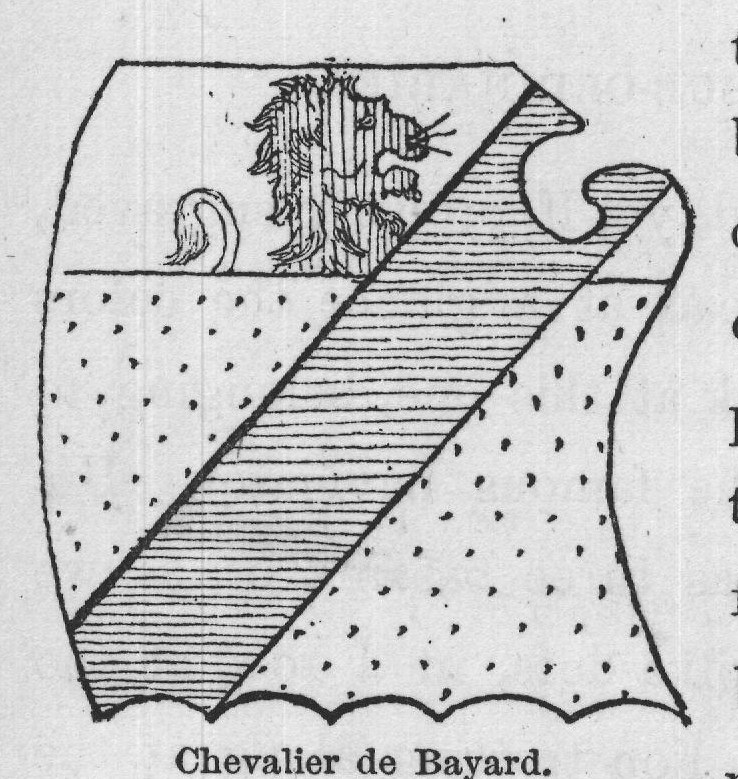
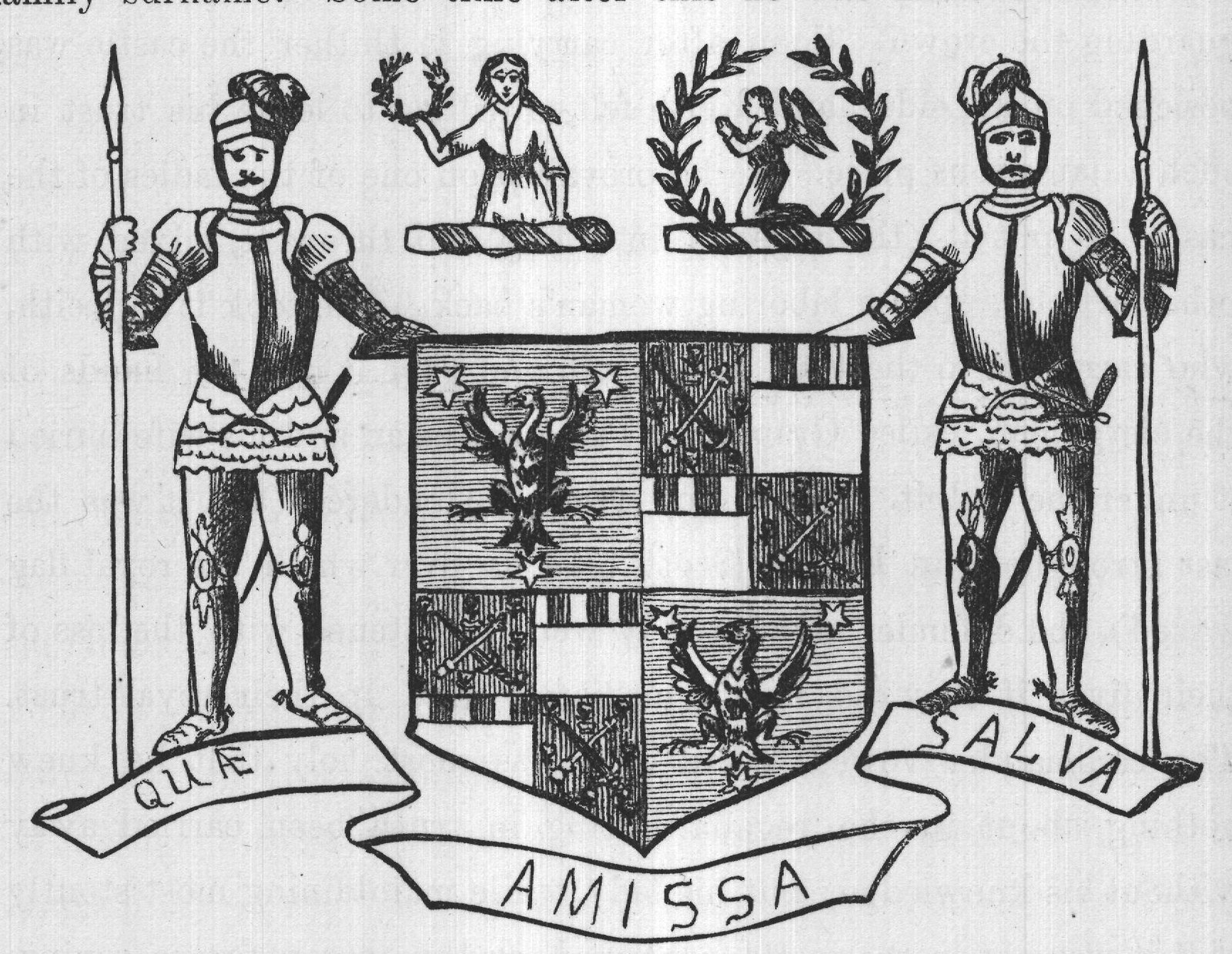
But we want to know what the little stripes and bars formed by the braces of the shield are called. Here is a shield that belonged to the Chevalier Bayard. The little band passing across the upper third, and on which the lion's head is painted, is called the chief - as it is the uppermost portion of the shield. When a second, third, fourth, or fifth son shows his father's arms, he ought to put a little bird, star, or flower, or some one of the nine little objects used for such pur- Chevalier de Bayard. poses, in one corner of this chief. Another very famous coat-ofarms where we see the chief, is that belonging to the numerous family of Keiths. This is a famous Scottish name, and if you look at the coat-of-arms borne by the Earl of Kintore, who has inherited the right to display the devices won by the early Keiths, you will be interested in the stories that make certain portions of the insignia so prized by this family.
That quarter of the shield where you see the chief is partitioned by little red pales, or stripes, belonged to the first distinguished ancestor of the family, a subject of old King Malcolm II. Under the leadership of his king, he fought most courageously with the Danes who had come across the stormy North Sea to conquer the Scottish country. After one of the most severe contests, near Dundee, King Malcolm was so delighted with the gallant conduct of the HONORABLE ORDINARIES - SUB-ORDINARIES. young Highlander that, dipping his finger in the blood of a slain Danish general, he drew three stripes or pales on the heroic soldier's shield, and bade him and his children bear such stripes upon their shield through all generations. In addition to this, he gave him the Barony of Keith, in Lothian. He therefore assumed Keith as the family surname. Some time after this he was made Great Mari- QUE SALVA AMISSA Keith, Earl of Kintore. schal, or Marshal of Scotland, and for many generations this office was held by his descendants. This family became extremely wealthy, it being said that at one time the owner of this coat-ofarms could start from Berwick on the English Border, and ride to the northern coast of Scotland, eating all his meals and lodging everywhere in his own domains.