Home › Honorable Ordinaries. - Sub-Ordinaries › Honorable Ordinaries. - Sub-Ordinaries: Keith
Honorable Ordinaries. - Sub-Ordinaries: Keith
Now you will notice the first and fourth divisions of this little Keith quarter, and there you will see a sword crossing a sceptre, and between them a crown. This is to show that one of the Keiths, during the republican days of Cromwell's rule, fearing for the safety of the Scottish regalia, took it stealthily and concealed it in the Castle of Dunotter, in Kincardineshire, an ancient possession of the Great Marshal of the family, and to whom belonged the duty of guarding the crown. Soon after carrying it thither the castle was besieged on all sides, and Keith felt unwilling to leave his trust in such a dangerous place. So he prevailed on one of the ladies of the castle to put it (the regalia) in a bag, and throw it, mixed with other articles, upon a laboring woman's back. She took it to Keith, who carried it to the Kirk of Kinneff, and gave it into the hands of the clergyman, called Granger. This gentleman and his wife buried it under the pulpit. When the castle surrendered (and it was the last stronghold in Britain, Scott tells us, over which the royal flag waved), the defender and his lady were threatened with the loss of their lives if they did not immediately give up their royal trust. The commander vowed by all that was most holy that he knew nothing about it, the regalia having in truth been carried away without his knowledge; but his lady, while maintaining most stoutly that it was not in the castle, confessed, as the reason for so saying, that one of her ladies had given it to the Keith, second son of the Earl Marischal, and he had carried it off. As Keith had almost immediately afterwards sailed for France, and had had the rumor carefully circulated that he had taken the regalia with him, all further search for the missing emblems of royalty was suspended. For this good service Keith was rewarded by this augmentation to his shield, and a few years later was made Earl of Kintore.
The regalia consisted not only of the crown (which was supposed to be as old as the days of Bruce), but of sceptre, sword of state, treasurer's rod of office, and the badges of the Orders of the Garter and Thistle.
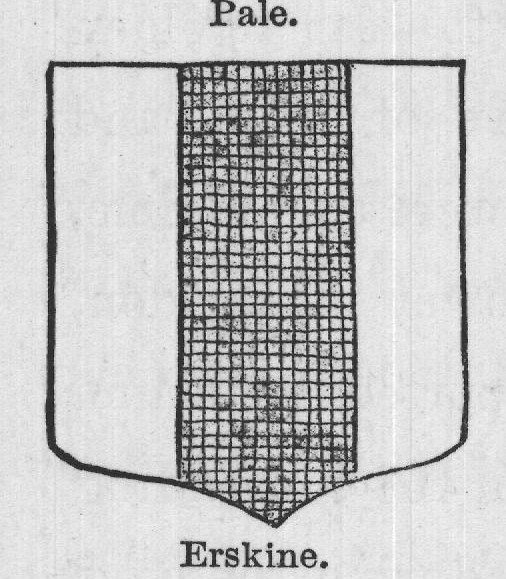
Pale.
Then there are shields on which we see a broad straight band passing from the top to the bottom. It is said that in the early history of English warfare every soldier was expected to carry a stick, or wooden paling, which, when encamping for the night, were stuck by rows in the ground, and so formed a species of fortification. From this arose the use of the word "pale."
Erskine.