Home › Decorations Taken from Other Sources. - Hatchments › Decorations Taken from Other Sources. - Hatchments: Irish
Decorations Taken from Other Sources. - Hatchments: Irish
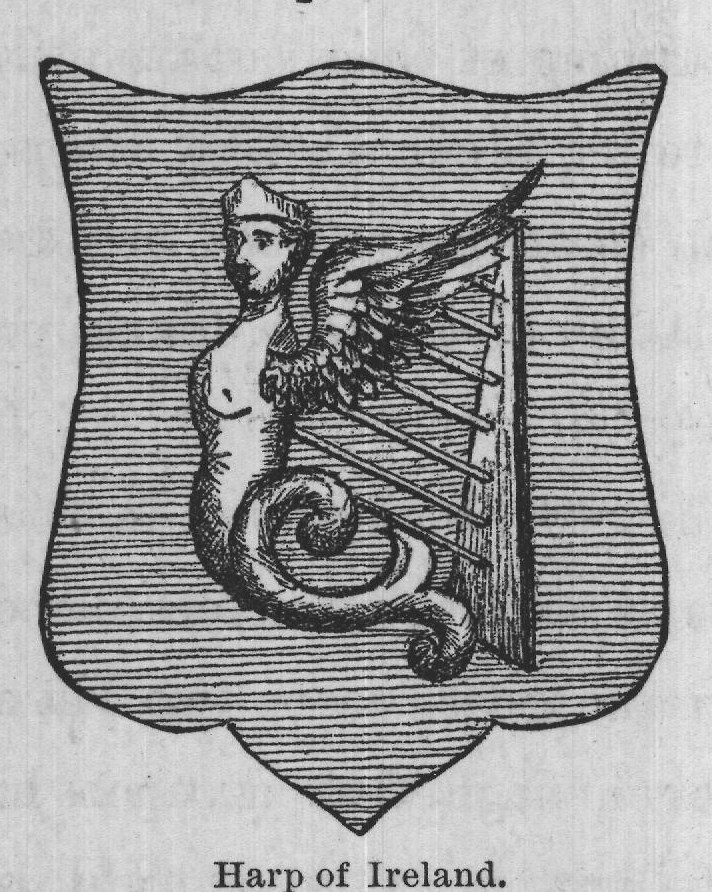
Another charge is that of the Harp, which we see on that quarter of Great Britain's shield which is given to Ireland. Hibernia was the patron goddess of Scotland, and her emblem was a harp. So the Irish monarchs were called "Bards," and carried the representation of a harp upon their standards. One of these standards, belonging to an old Irish king who was slain by the Danes, was carefully kept in Dublin until almost the beginning of this century. Some devout and loving Irish souls firmly believe that the original of this harp was one of those described in the Apocalypse.
Harp of Ireland.
The Horn is not an unfamiliar object, especially upon the arms of such as bear the names of Forester, Forster, and Foster, as it is fancied that they derive their names from the office of forester, which possibly they may have held in the days when Merrie England was a tangle of forest growth, and such an office was considered highly honorable.
The county of Mid-Lothian, that returns England's boldest and truest statesman to Parliament, has within its boundaries a certain tract of land, known as Pennycuik, and its owner, by some clause in the title, is obliged to appear once a year in the forest of Drumsluch, near Edinburgh, and there give a blast of a horn at the king's hunting. Because of this, the family, whose name is Clerk, bears for its crest a forester, sounding a hunting-horn, and uses as a motto the words, "Free for a blast."
Many of the crests and charges that we find on English shields, such as a broad arrow, a red rose, a flying falcon, etc., have probably been placed there for similar reasons by the monarchs from whom the owners received their large estates. In making these gifts the monarch wished the favored chiefs not to forget the allegiance due to the throne, and therefore made the retaining of them conditional. Sometimes, small payments of money were required; at other times, the tax was only nominal, - an annual ceremony, - such as this blowing of a horn, or the yearly presentation of a rose, a falcon, or an arrow.