Home › Decorations Taken from Other Sources. - Hatchments › Decorations Taken from Other Sources. - Hatchments: Wellington
Decorations Taken from Other Sources. - Hatchments: Wellington
The Dukes of Marlborough and Wellington hold theirs in this way. Should any of you be so fortunate as to find yourselves some day at Windsor Castle, you will notice in the guard-room two little objects of interest. They are small French flags that droop over the marble busts of Marlborough and Wellington. One of them is the white Bourbon flag, sprinkled with fleur-de-lys; and the other is a tricolor. These two little flags must annually be presented by the noble dukes, representatives of their illustrious ancestors, upon the anniversaries of the battles of Blenheim and Waterloo, as it is by these little acts that they regularly confirm their titles to their large estates in Blenheim and Strathfieldsaye.
Very highly are these little banners prized by the English sovereigns, and when King William IV. lay dying at Windsor, he roused himself from a heavy stupor into which he had fallen, and, npon asking what day it was, was told it was the 18th of June. "The battle of Waterloo!" he exclaimed, and his mind struggled to clear itself from the films of death. Suddenly his eye brightened; he remembered the little flag that the Duke of Wellington regularly brought to him upon this day, and he asked to look at it. When it was brought, he eagerly stretched out his trembling hand and touched the golden eagle that surmounted the stick. "Ah!" he whispered, as he sank back upon his pillow, "now I feel better." These gold eagles were introduced into the French army as ornaments to the regimental standards by Napoleon I., and, being wrought of pure gold, costing each about two thousand dollars, with long streamers of richly embroidered ribbon attached to them, they were greatly coveted by the opposing army. During the Franco-Prussian war of 1870, the soldiers made desperate efforts to get them, so that during the many disastrous encounters between the French and Germans, no less than two hundred were captured. This costly fashion vanished with the Napoleons.
We will now leave the shield, although many interesting devices are still crying to be heard. But I fear you have heard so many stories about those that are most frequently seen, that you are wearied of them; so we will content ourselves with taking a look at the little badge, nowadays so seldom heard of, and after that you can shut up this book of heraldic tales as soon as you wish. So, now, the Badge. It is often confounded with the crest; but as the badge is always borne by itself, and the crest must rest upon its wreath or crown, the mistake can easily be avoided. Badges are not now as commonly seen as in years gone by. During the time of Queen Elizabeth they began to fall into disuse. They were then worn by the retainers of such knights as possessed them, and were often extremely ornamental. At the time of the coronation of Richard III., no less than thirteen thousand representations of his White Boar were made and worn at that ceremony. The first badge worn in England was the Escarbuncle, or great central clamp of the shield, and was adopted by Henry II., on account of his connection with the House of Anjou. But the badge that claims to be the best known among the English-speaking races is that of Edward the Black Prince, now used by the Prince of Wales, - the famous Ostrich Feather badge, - plucked by him from the blind old King John of Bohemia. We are willing to believe that, though it was his hand that plucked it from the fallen royal head and placed it on his own bright helmet, it was not through any gash made by his good sword that the soul of the poor blind monarch slipped from its darkened cage into the land of spirits. When this old King of Bohemia heard, during the battle of Crecy, that the French ranks were breaking before the English troops, led by the Black Prince of England, who was carrying everything before him, and, worst of all, that his noble son had been severely wounded, he sprang from his seat, buckled his armor on, and bade his knights lead him to the hottest part of the battle, C where he might most surely meet the terrible young English leader. Four of his knights did so, placing him in their centre, and interlacing the bridles of their horses. As soon as the old king was told that his enemy was before him, with savage valor he strove, by his random slashes, to avenge the defeat of his son. It could not be, and he was cut down; but not, they tell us, by the noble-hearted English prince. Messengers brought him the news of the fall of the old Bohemian hero, and, pressing his way toward the spot, he dismountod, took the badge from the dead king, and, placing it upon himself, pronounced aloud its accompanying motto, "Ich dien." Much doubt attaches to the assertion that the badge owes its introduction into England at that time. Many affirm that these selfsame feathers can be found in a family badge of Edward III., as in an old manuscript the different forms in which the ostrich feather was borne by the royal family are described :- "The ostrich feather silver and pen gold is the king's. "The ostrich feather pen and all silver is the prince's. "The ostrich feather gold and pen ermine is the Duke of Lancaster's. "The ostrich feather silver and pen gobony is the Duke of Somerset's." Another famous badge is that of the Earl of Warwick, the "Bear and Ragged Staff." The story hath it that this ancient line sprang from one of the Knights of King Arthur's Round Table, whose name was Arthgal. Now Arth in the British language signifies "Bear," and this badge of a standing bear was adopted as a play upon the name. In later years an earl of the same family appeared to add lustre to the family arms, named Mowidus. He was a man akin to Hercules, for did he not uproot a tree? not too big a one! - and, hastily ridding it of all its boughs, did he not therewith spill the brains of a mighty giant upon the ground? Remembering this remarkable exploit, his descendants bore as their cognizance a silver staff, ragged like the hacked limbs of a tree. This, united with the bear, forms the well known badge.
The present family are troubled over an evil surmise that has in some way reached their ears, and rankles in their noble minds, that their bear, being muzzled, is a witness to the fact that some unworthy ancestor was guilty of a misdemeanor, and for this act was compelled to muzzle the growling beast. Who the miscreant was, or what he did, is only matter of conjecture; but we are assured by painstaking heraldists, who, with spectacles on nose, and quill behind ear, have explored all possible nooks and corners where information might be found, that such injurious rumors are anathema, maranatha - only a slanderous device of some envious, badgeless monster - probably an American ! In Scotland certain plants are still retained as badges of individual houses: - The Buccleuchs have Heath.
MacPhersons - Varigold Box.
Stewarts - Thistle.
Murrays - Juniper.
MacKays - Bulrush.
McGregors - Pine.
Campbells - Myrtle.
Camerons - Oak. - Drummonds Gordons - Ivy.
Holly.
Grants - Cranberry Heath.
Grahams - Laurel.
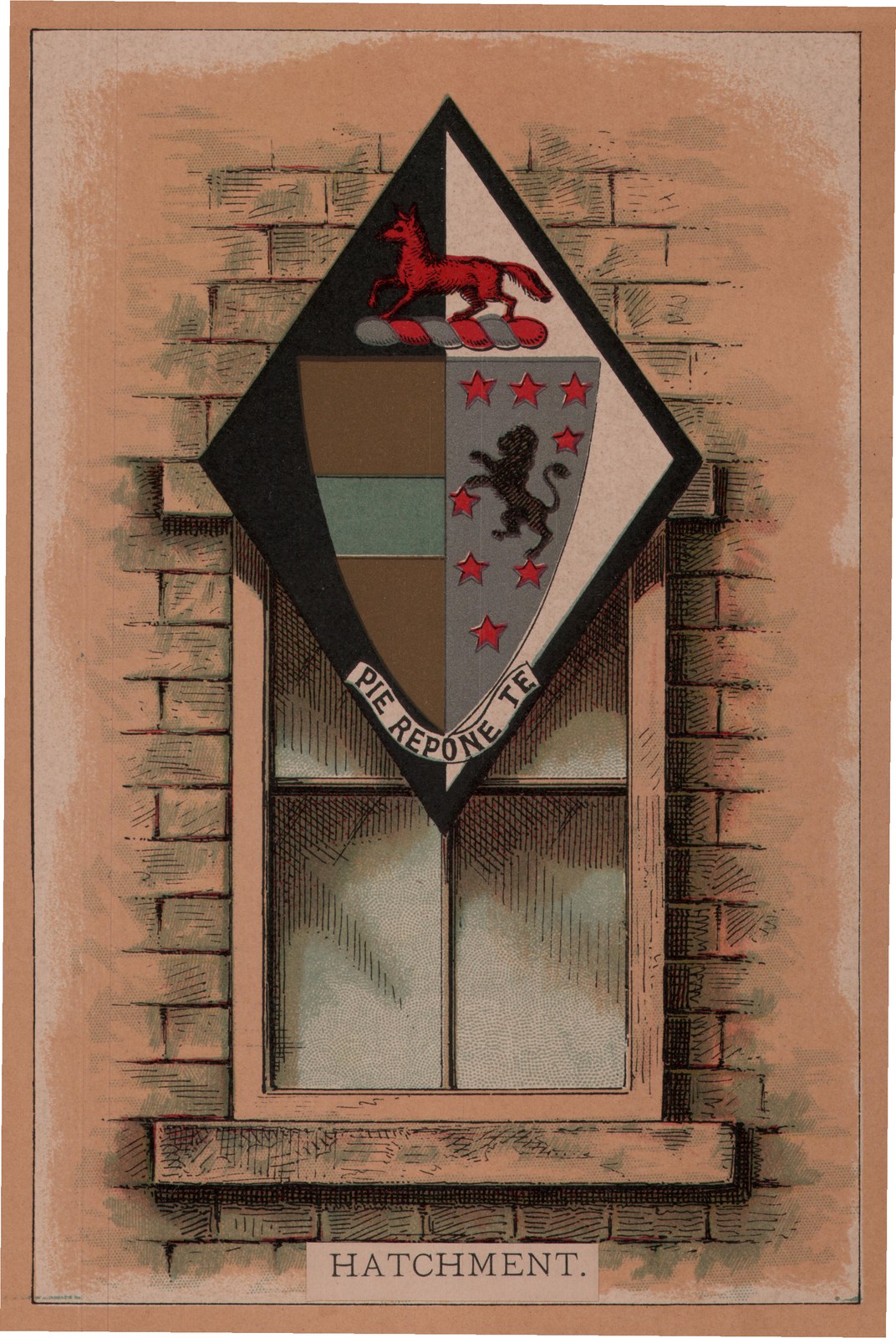
As an addition to some such badge, the House of Murray is alone permitted to wear an eagle feather. This does not prevent the ★★★ TE PIE REPONE HATCHMENT.
chiefs of all other clans wearing the feather in their caps, but forbids their wearing it as a badge. With this last ornament belonging to the Elect Few, we will consider our acquaintance with heraldic decoration as completed. But before we bid Dame Heraldry good-by, we will photograph her as she presides at a ceremony - the last in which her knightly devotees take part. After this last effort on her part, she mutters the old rhyme, "Their swords are rust, their bones are dust, their souls are with the Lord, I trust," and hies herself to the new chevalier, just putting on his father's worn-out slippers. Do you see how curiously decorated the front of this house is? Some one lies dead within its walls; and this curious heraldic custom still prevails in England, although that, too, is gradually shrinking into the past. When a noble, or any prominent member of his family, dies, an immense black frame, shaped like a lozenge, with the family coat-ofarms occupying its centre, is placed against the wall, above the entrance to the house. If it is a bachelor who has died, then the shield appears upon the black background; if a single woman, then a lozenge is used. Married men and women, widowers and widows, are all designated by some peculiar mark or omission; so that any passer-by who is familiar with the laws of heraldry knows in an instant all but the name of the deceased. This is called a "hatchment," and remains on the outside of the house from six to twelve months.
And now, dear children, our story is ended. Dame Heraldry, hearing us narrate the tales connected with the badge, concluded that the close of the book was near; so she donned the best of her decaying grandeur, framed her lips into the most courtly of farewell simpers, and was ready, with a sweeping fifteenth-century courtesy, to vanish from the scene. But our introduction of these last funereal touches to the picture of her days of glory compelled her to rustle a hasty exit. The venerated hatchment is the last fading remnant of her once imposing funeral ceremonies, where all the pomp and parade of heraldic display were added to the natural impressiveness of the occasion, meriting marked consideration by her heraldic Majesty. She therefore reappears, clad in rusty black, with bent head and mumbling lips. Interlacing the attenuated fingers of her palsied hands into the semblance of pious devotion, she poses before us as chief mourner. But the restless, roving glances of her glittering eyes, as they ever and anon peer out from the deep hollows of her haggard face, prove to us the emptiness of her pretensions; and in this position, suggestive of another like solemn occasion, possibly in the near future, where no hatchment will be displayed, and where she will be not only chief, but only mourner, and the very corpse itself, we will take our final leave of her.
INDEX.
Abel, 72 A.
Abercorn, Duke of, 77 Aberdeen, Lord, 110 Abergavenny, Marquis of, 184 Achaius, King, 154 Achievement, 106 Adam, 72 Adams, John, 3, 4, 10 Addington, 68 Adeliza, 30 Agincourt, 14, 98, 118, 160 Albini, William de, 30 Alcantara, Knights of, 74 Alerion, 162 Alexander the Great, 73 Alexander IV., Pope, 174 Alexandria, Bishop of, 90 Alfonso VI. of Spain, 151 Alnwick Castle, 197 Amiens, 60, 102 Andrew, Saint, 96, 151 Angoulême, Duc d', 174 Arms, Paternal, 63 Arthgal, 207 Arthur, King, 78, 133, 207 Arundel of Wardour, 22 Arundel, 30, 203 Athol, Duke of, 147 Attributive Arms, 72 Aubigney, Sieur d', 202 Audley, Lord, 70 Augmentations, 20 Badge, 106, 206 B.
Baltimore, Lord, 12 Bard, 203 Baron, 121, 122 Baronet, Order of, 180 Bar Sinister, 143 Bastille St. Antoine, 102 Batcheler, Rev. Stephen, 121 Bath, Knights of the, 35, 77, 78 Bayeux Tapestry, 88 Anhalt, Dukedom of, 188 Anjou, 103, 159, 206 Anne of Cleves, 166 Anne, Queen, 131 Anthony, Saint, 150 Antioch, 185 Antrim, Earls of, 149 Ape, 126 Apollo, 95 Argyle, Duke of, 53, 151 Armor, 83 Bayard, Chevalier, 41, 46, 138 Bear and Ragged Staff, 151, 185, 207 Beauchamp, 166 Beatrice, 166 Beaumont, Sir John, 122 Beaupreau, Prince de, 50 Beavers, 127 Bend, 141 Bendlets, 143 Bere, De la, 112 Berwick, 139 Bezant, 156 Arms, Classes of, 63 Alliance, 71 Allusive, 63 Assumptive, 63 Attributive, 72 Community, 65 Concession, 70 Dominion, 64 Office, 73 Billets, 155 Bishoprics, 68 Bishopstone, 200 Black Prince, 71, 86, 112, 145, 206 Blazon, 52 Blenheim, 205 Boar, White, 206 Bohun, 166 Bombie, Barony of, 116