Home › Decorations Taken from Other Sources. - Hatchments › Decorations Taken from Other Sources. - Hatchments
Decorations Taken from Other Sources. - Hatchments
Now let us look at the skies above us, and see what were stolen from them. Everything, yes, everything - full moons, half moons, crescents, stars, all used by the conscienceless herald in order to beautify the shields of his good countrymen. - was, The crescent not unfrequently appears, and is associated with the tramps of the old-time Christian warriors. One of the ancient laws of heraldry permitted the victor to assume the arms of the vanquished; and although heraldry, as a science, was unknown to the Saracens, still they bore certain devices by which they could easily be distinguished, and the crescent their favorite emblem no doubt, often displayed by them. It therefore appears on many an English shield, where stories of the Crusades were mingled in the olden history of the family. Many families in a certain township in England bear this device upon their shields, their founder, Sir Archibald Ellis, having brought it back with him from the Holy Wars. Sir Robert Sackville's descendants wear it also as a memento of the Crusades. reason.
The Percys adopted it as their badge, but for quite a different Their territory of Northumberland, which consists of counties lying north of the river Trent, lies in the form of a halfmoon, and for this cause they chose their badge. "Now spread thy banner, Westmoreland, Thy Dun Bull fain would we spy; And thou, the Earl of Northumberland, Now raise the Half Moon up on high!"
Another old poet has written: - "The minstrels of the noble House, All clad in robes of blue - With silver crescents on their arms, Attend in order due."
Sir Walter Scott tells a story, which he very properly styles an exceedingly "silly one," of the supposed origin of the name of Percy. The story is that King Malcolm of Scotland, during the eleventh century, was so unfortunate as to be killed by one of the soldiers who garrisoned the Castle of Alnwick. This soldier pretended to be authorized by the commandant of the castle to surrender the stronghold, and, placing its keys upon the point of his spear, he held them towards the king. As Malcolm bent to take them, the soldier made a rapid lunge with the weapon, and drove the point through the eye of the king, into his brain, thus killing him instantly. The soldier gained much credit with his leader by this act, and, to commemorate it, was allowed to adopt the name "Pierce-eye," or Percy.
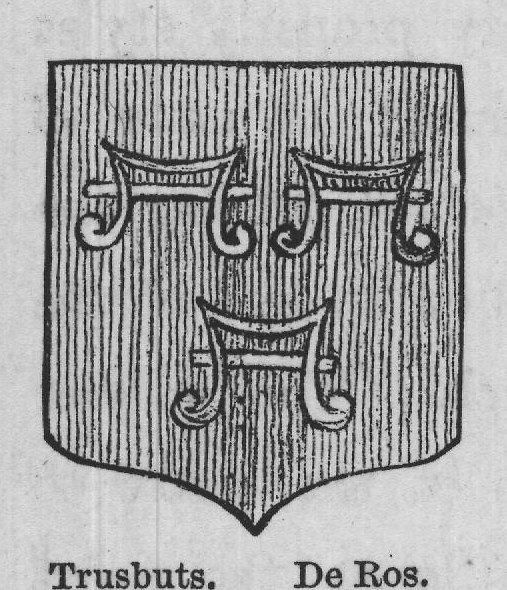
The Sun, in his splendor, was often chosen, especially by families bearing the name of Bright, Day, or Clear. Richard II., during his early and happiest days, used it as a badge. But in the melancholy days that closed his reign, he used the "Sun behind a cloud." It appears in both ways upon the sculptured mantle covering the effigy on his tomb in Westminster Abbey. Stars also shine out on the shields of Great Britain. On that of Lord Sutherland there are three, surrounded by the tressure of Scotland, an heirloom from the days of Robert I. For If we leave the ornaments that have been taken from life and from the heavens, we still find multitudes of objects adorning the shield, many of which are full of significance to their owners. instance, the Water Bougets, or water-bottles, whose acquaintance we made on the coat-of-arms belonging to the Bouchiers. This device represents bottles made of skins, and slung across the shoulder. It is thought that during the Holy Wars, when forced to cross burning wastes of desert land, where water could not be found, the thirsty Crusaders carried their supply in these capacious vessels. The first English family bearing the charge is supposed to have been the Trusbuts the heiress of which married a De Ros, and her husband, according to the prevalent custom, dropped his arms in assuming hers, but kept his own name.