Home › Classes of Arms. - Orders of Knighthood › Classes of Arms. - Orders of Knighthood
Classes of Arms. - Orders of Knighthood
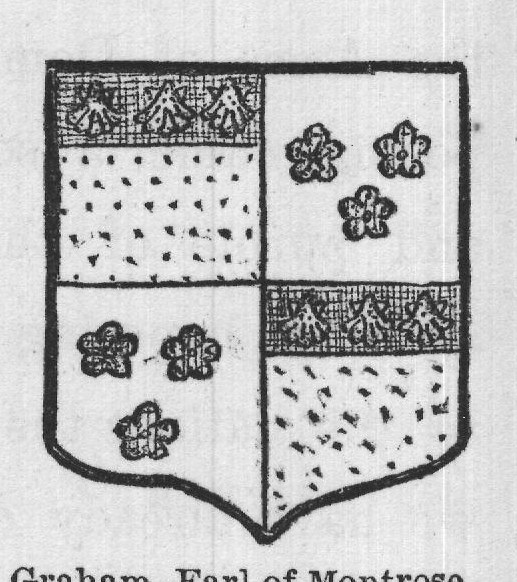
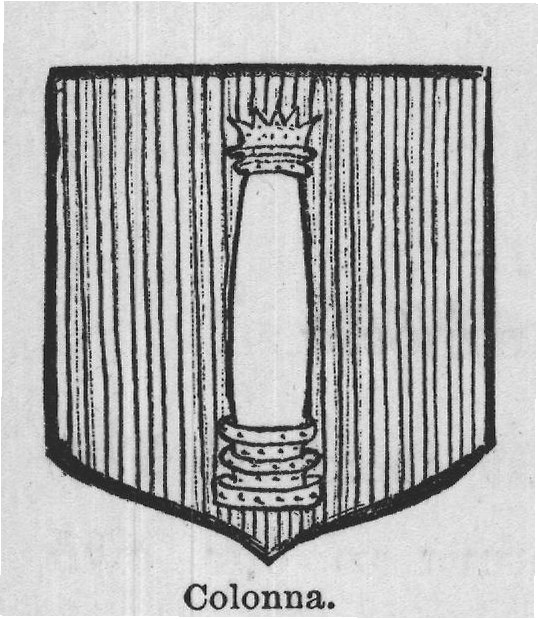
AND now, having seen for ourselves the last abode of what still remains of Heraldry, I think we can return to our own country, and sort out the different varieties of coats-of-arms which we find commonly used in England. There are several of these families of coats-of-arms; one we have already referred to, which a herald calls Assumptive Arms; by that I mean, arms that people selected for themselves, as in the early days of Heraldry, during the wars of the Crusades, to commemorate certain gallant exploits. ** ** These Assumptive Arms, when carried for many generations from father to son without the addition of quarterings from the mother's shield, are called Paternal Arms. Such is the coat-of-arms belonging to the great family of Montrose, who, for unknown reasons, either have never found favor in the sight of heiresses, or have preferred to select their brides where the glitter of ducats gave no added lustre to their charms. Besides these, we find Allusive Graham, Earl of Montrose. Arms, arms that have been chosen because of some resemblance between their names and natural objects. The shield of the princely House of Colonna, in Italy, is one of these. In the centre D of the escutcheon a white column with a golden base and crown is seen. This was given to the family by the Emperor Louis of Bavaria, to show his gratitude to Stefano Colonna, who being at that time chief senator of Rome, crowned Louis in the Capitol, contrary to the express wish of the Pope.
Colonna.
In England such families are very numerous.
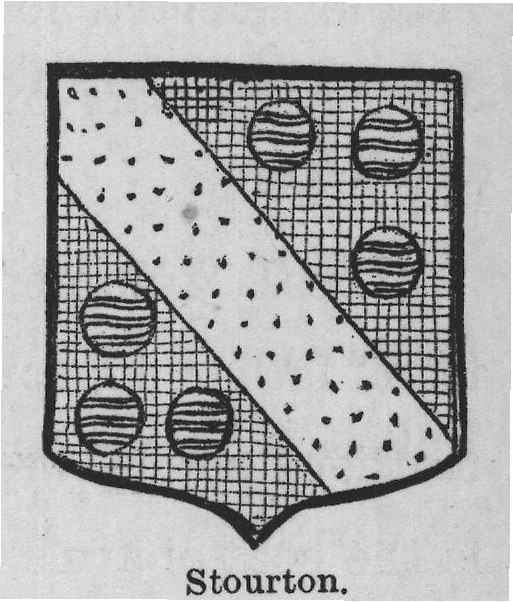
We will find, for instance, the Colts, who show a skittish little foal upon their shield; the Trees, whose escutcheon is bright with the vivid green of a tree in full foliage; the Foresters, too, who display bugles upon theirs; and the family of Stourton, whose property lies on either side of the little river Stour. Upon their shield the Stour is a wavy band that passes diagonally across the shield, on either side of which are little circles, indicating the springs by which the estate is largely watered.
Stourton.
Grandest of all are those escutcheons called the Arms of Dominion. This is rather an imposing name, a sort of "ermine of the judges and purple of the kings" affair. And it is quite as imposing as it sounds. Such shields are those belonging to the nations themselves. The one borne by our American people we have already described, but there is a history connected with those assumed by every nation on the earth. The escutcheon displayed by England has passed through many changes, and it was not until the first year of the century that the Lilies of France disappeared from one of her quarters. This pretended sovereignty died a natural death with the in-coming of the practical and truthloving nineteenth century. Then there are what are called the Arms of Community, by which are meant such coats-of-arms as are displayed by cities, counties, etc.; for instance, those of Glasgow, on which a tree is seen, with a bird resting on a branch, and beneath the tree a salmon, having in its mouth a golden ring. The story is that the wife of the governor of the town, having lost her wedding ring in crossing the Clyde, suffered much from the reproaches of her husband, who, as she was very beautiful, refused to believe her tale of the manner of its loss. In much grief she sought the aid of Kentigern, Bishop of Glasgow. Listening to her story of woe his heart was touched, and he promised to besiege the Throne of Grace with earnest prayers until the jewel should be recovered. These prayers were answered; a salmon drawn from the Clyde was found by its astonished captor to have a ring caught in its gills. The story of the fisherman soon spread abroad, and, reaching the ears of the offended magnate as well as those of his disconsolate wife, the family jar at last was ended. - The arms of the city of Worcester are adorned with little pears a lasting memorial of a visit from the English Queen. When Elizabeth, during one of her magnificent "Progresses," or journeys, through her dominions, stopped for a day or two at Worcester, that city, to show its appreciation of the high honor, and its love of Her Majesty, carefully transplanted a full-grown pear-tree, whose branches were laden with ripe fruit, into the central square of the town. Elizabeth approved of this loyal demonstration, and when her beruffled and bepetticoated Highness withdrew, she gave the city the right to display pears as an augmentation upon its shield.
The city of London bears a cross of St. George upon its shield, with a little sword filling the upper right-hand corner. This sword, as it first appeared upon the city's coat-of-arms, represented that of St.