Home › Classes of Arms. - Orders of Knighthood › Classes of Arms. - Orders of Knighthood: Audley
Classes of Arms. - Orders of Knighthood: Audley
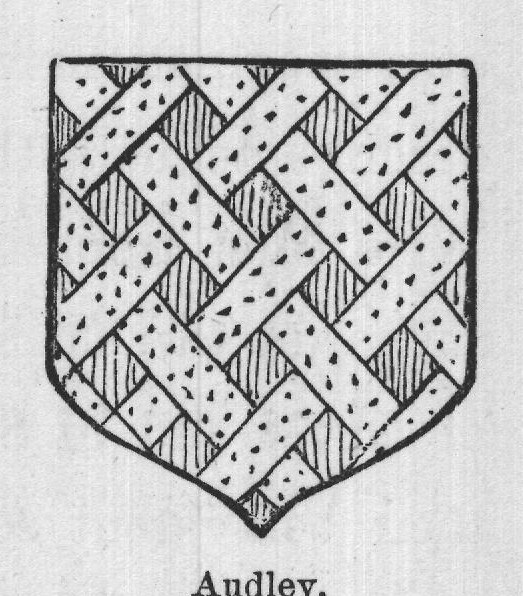
Another instance was when Lord Audley conferred such arms on four of his retainers after the great battle of Poictiers. As soon as victory fairly settled upon the banners of the Black Prince, that noble leader called for Lord Audley, and, throwing his arms about his neck, exclaimed, in the presence of many of his officers, "Sir James, both I myself and all others acknowledge you, in the business of the day, to have been the best doer in arms; wherefore, with intent to furnish you the better to pursue the wars, I retain you forever my knight, with five hundred marks yearly revenue, which I shall assign you out of my inheritance in England." At that time this was considered a magnificent estate, and the noble lord appreciated it. But, though highly flattered, the noble knight remembered that much of his success was due to the valiant behavior of his four squires, Delves, Mackworth, Hawkeston and Furlthurst; so, inspired by the conduct of the prince, he, with an outburst of generous feeling, divided the entire gift amongst them, and with it gave permission to bear his own arms, slightly altered. The prince heard of this, and, determining that Audley should not go unrewarded, immediately insisted upon the knight accepting another annuity of six hundred marks.
Audley.
His arms were red, with a network of gold, and those of his stout-hearted esquires, borne by their descendants during many generations, bore arms in which the fret of gold on a background of red was conspicuous.
Arms of Alliance were such as were brought into families by marriage with a wealthy heiress.
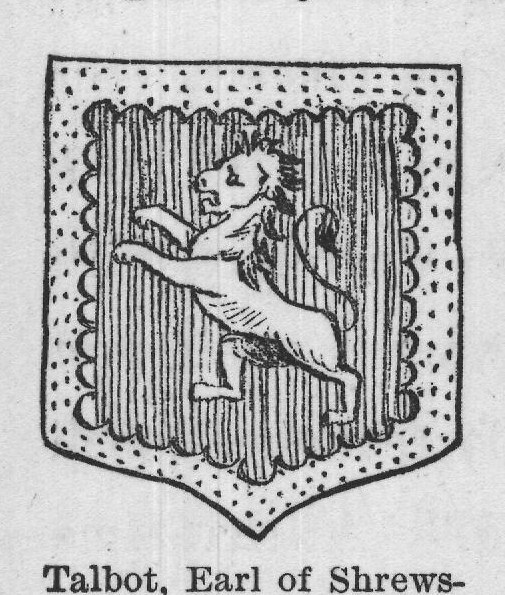
If you look at the shield now displayed by the Earl of Shrewsbury, you will see upon a scarlet background, a fine little golden lion, rampant, or standing gayly on one of his little hind legs. This was the result of one of the early Talbots, Gilbert by name, falling desperately in love with Gwendoline, the heiress of the wealthy Prince Rhys of Wales. His own coat-of-arms was a shield covered with diagonal bars of silver and gold, but, marrying this lady, he adopted her shield, as you now see it.
Talbot, Earl of Shrewsbury.
Then come the arms that are called Attributive, or, as we would say, "make believe" coatof-arms, such as never existed at all. Some of the old romancing heraldists loved to add all the glory they could to their beloved science, and so felt that the worthy old warriors of the Bible, as well as the early heroes of Greece, ought to be honored with coats-of-arms, and proceeded to demand of their own imaginations what seemed best for each. Consequently, they describe to us with calm assurance the very arms, not only of the Wise Men from the East (poor Melchior being unkindly left to shiver in the shadow of neglect), but they can show us also those of David and of Samson, and even those of our first parents and their belligerent son. Adam's escutcheon, they assure us, was at first of a bright red color. Eve's shield was small and white, and as she was an heiress (!) it was placed in the centre of her husband's escutcheon. But when, to our eternal grief, they sinned and were driven out of Paradise, they had to change their insignia, and now we behold Adam's shield still red, but with a garland of fig leaves around the border, and Eve's little white escutcheon is now silver, with a small green apple in its centre.
Abel put his father's arms on two quarters of his shield, and those of his mother on the remaining two. Cain, after he slew his
A brother, wished to change his coat to escape death at the hands of his fellow-beings; therefore some worthy heraldist informs us God mercifully put a mark upon it!
Samson bore a red shield with a lion lying down in the midst of a circle of black bees; while David had a blue shield with a gold harp ornamenting the centre thereof. Alexander the Great is credited with a shield that it is possible might have astonished the supposed possessor, could he have seen it. It is declared to be of red, with a golden chair in the centre, and in this chair a golden lion, sitting at his ease, amusing his leonine self with a grand battleaxe of silver. But we will not forget that we live in the nineteenth century; and practical Americans, at least, cannot really be expected to put perfect faith in all such surprising and unbiblical tales. We will simply agree to believe that it was in the eleventh century that coats-of-arms became a positive adjunct to the European mode of life.
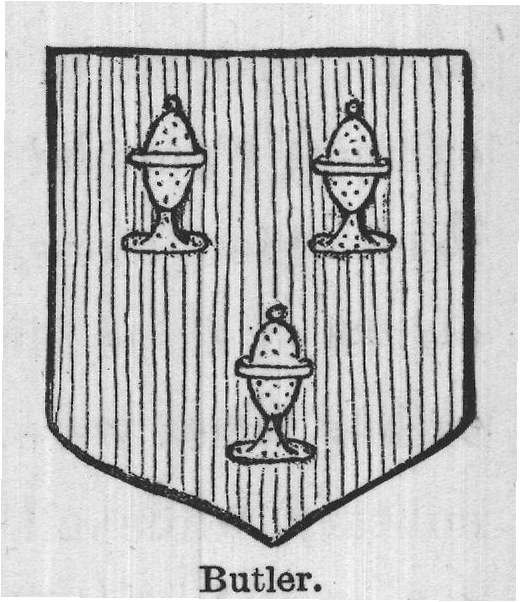
Butler.
Last of all there are the Arms of Office, such as the coat-of-arms displayed by the Duke of Ormond, whose ancestor was appointed by Henry III. of England as butler, or Comptroller, of all the king's wines carried into Ireland. His descendants were to hold the office after him through all generations. Their shield displayed three covered cups, as indicative of their duties.
The The great and royal House of Stuart sprang from the High Stewards of Scotland, and from this office took their name. little Scotch laddies are expected never to forget this when they read of the royal Jameses and Charleses who reigned for so long a time in England.