Home › Classes of Arms. - Orders of Knighthood › Classes of Arms. - Orders of Knighthood: Tyler
Classes of Arms. - Orders of Knighthood: Tyler
Paul, who is the patron saint of the city; but when Walworth, the Mayor of London, knocked Wat Tyler down, it was changed to the Mayor's rapier - a memorial of his gallant defence of the City of London. king. This was during the reign of Richard the Second. The peasants of Essex and Kent, after much provocation, had risen in revolt against the government, and, headed by Wat Tyler, forced an entrance into London. At Smithfield, by his own invitation, the boyish King Richard, then only sixteen, accompanied by the Mayor of London and a small retinue of knights, met the mob, whose hands had just been reddened by the blood of the Archbishop of Canterbury and of the Treasurer of England. Wat Tyler, who headed the insurgents, suddenly caught sight of the king approaching, and instantly spurred forward to meet him, addressing him with insolent curtness: "Sir King, seest thou all people yonder?" "Yea, truly," was the quick reply, "why sayest thou so?" cause," answered Tyler, "they be all at my command, and have sworn to me their faith and troth to do all that I would have them." The king, to pacify the enraged rioters, then promised to ease matters for the peasants, and peace seemed about to settle upon all, the rioters themselves beginning to break up, when Tyler, inflamed by his passion and intoxicated by his novel position as a leader of a "Be- CLASSES OF ARMS. - ORDERS OF KNIGHTHOOD. strong faction, picked a sudden quarrel with one of the king's knights, and would have run upon him with his sword had he not been prevented. High words ensued, and the Mayor of London drew his dagger. In the mêlée that followed, the king's person was threatened; quick as thought the Mayor sprang upon Tyler, dangerously wounding him. At this Tyler shouted to his followers, "Kill! Kill!" and Walworth the Mayor, rushing once more upon him, ran his dagger through his body, pinning him to the earth. With yells and execrations the rabble started to fall upon the king and his little company, exclaiming, "Our captain is dead, we are betrayed!" But King Richard, boy as he was, rode fearlessly for ward alone to meet them, calling out, "What say ye, my masters →→ What are ye doing? Tyler was a traitor, I am your king, and I will be your captain and guide." At this opportune moment a party of a thousand armed London citizens, led by a knight, appeared upon the scene. This, added to many conciliatory promises of the king - promises, however, which were never kept - succeeded in quelling the riot, and the mob vanished to its several homes. The dagger of Walworth, it is supposed, then took the place, in the city arms, of what was in earlier days the long sword of the Apostle. Walworth and Philpot, a former Mayor, who also did gallant service at this time, were rewarded with augmentations of a similar kind to their shields, and had large grants of land, with considerable money, given to them.
This Mayor Walworth is said to have been the first tradesman knighted in England.
And as we happen to be thinking of London just this moment, I would like to ask you if, amidst all the Burtons, Nortons, Farnhams, Gordons, etc., you ever met any one bearing the name of London?
There is an odd distich which runs this way: - "In 'ford,' in 'ham,' in 'ley,' in 'ton,' The most of English surnames run."
Half of these and many similar endings mean a village or town. Those living in them probably found subsistence difficult to obtain during the time of dissension and strife in the early English days, and, as a necessity, many of them gradually drifted into the great busy capital. Once settled in London, with good wages and plenty of work, it was rarely that they returned to their early homes. They became known, however, by the name of their birthplace such names as Addington, Hamilton, Dunham, Burnham, and numberless others. The coats-of-arms belonging to the great Bishoprics also belong to this class of Community Arms. A very curious one is that of the Bishopric or See of Chichester. It recalls the old fabulous tales of Prester John, that wonderful myth of a king, the stories of whose magnificent court and remarkable Christian faith made all Christendom gape during the Middle Ages. Upon the shield of this See is a representation of the king, sitting comfortably enough, albeit his seat is but a tombstone, but holding a sharp sword in a most distressing fashion between his teeth. He wears a hood, and has a book in one hand. This Prester John was a mythical person, but one whom the credulous folk of the Middle Ages firmly believed Bishop of Chichester.
CLASSES OF ARMS. - ORDERS OF KNIGHTHOOD. existed as a mighty potentate in the far East. Many descriptions of the marvels of his kingdom were brought to Europe by travellers, who themselves had only heard these tales. in distant lands. Each report was an improvement upon a former one, until the descriptions of his kingdom equalled those given in the Arabian Nights. The coast line of this wonderful country was said to be jagged with huge blocks of adamant, which, acting like magnets, attracted all ships that chanced to approach. The forests were filled with parrots, who, "plenty as geese," flew screaming through the trees. As for the pebble-stones, nothing but jewels were washed upon the shores, many of them quite large enough to allow platters, dishes, and cups to be cut from them; indeed, so many strange and marvellous things were contained in this unknown land that life would not be long enough to write them down on paper. Prester John himself was called a "Christian," and was declared to believe "well in the Father, the Son, and the Holy Ghost," but still somewhat heathenish in lesser details of our faith. His dominions were described as being enormous in their extent, containing no less than seventy-two provinces, each large enough to command the entire attention of a separate subordinate king, and so huge was his army that no less than three hundred and thirty thousand men guarded his standards.
These standards consisted of three crosses of gold, very fine, very large, and very high, and all bejewelled with the precious stones. But, notwithstanding the unequalled splendor of his kingdom, Prester John was no stay-at-home monarch; he travelled occasionally, and I believe it was Columbus who thought he saw, rambling about upon one of the West Indian Islands, the revered person of this famous man. This is the story that we are told clings to the strange figure adorning the arms of Chichester See, but now and then a priestly critic has been found, who declares that this so-called "Prester John" is in reality a representation of the Apostle Paul, the sharp sword symbolizing the Word of God, "which is sharper than a two-edged sword."
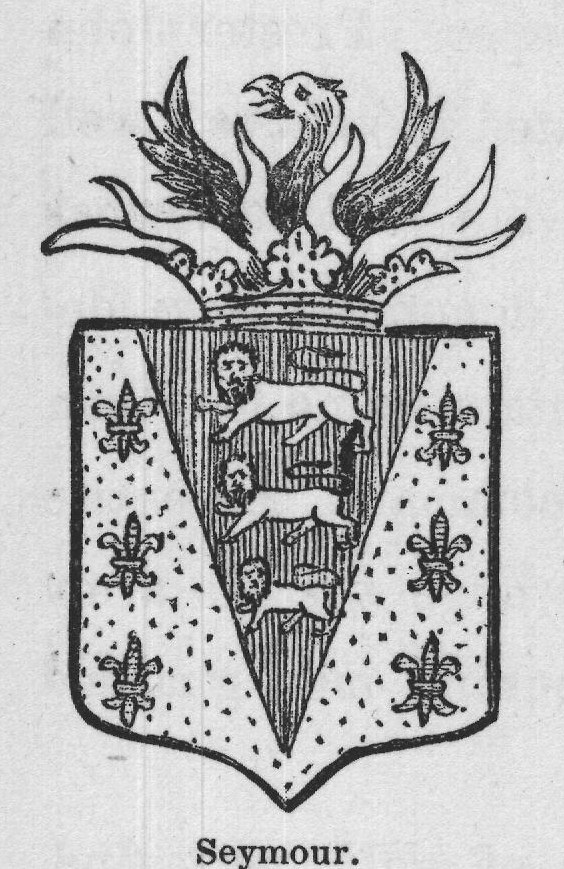
There were also Arms of Concession. These were given or conceded to a subject either by the sovereign or by a powerful baron. Henry VIII. gave to his well beloved Jane Seymour the quartering that now appears on the shield of the Duke of Somerset, whose ancestors were her brothers. The early demise of the affections of the many-wived Bluff King Hal was anticipated by her own early vanishing from worldly scenes. But just as her gracious and lovely spirit was starting on its homeward journey, she blessed the king by giving him a little son. The writers of her day declare her to have been not only the most beautiful of all the wives of the king, but as possessing also the gentlest disposition, and not only did the people mourn her loss, but the king himself, surprised at finding himself robbed of what he, as yet, had not wearied, grieved over his loss to such an extent that be allowed himself to go Seymour. wifeless during the long term of two entire years. The crest that was assumed by her family after her death was a phenix rising from its ashes, illustrative of her death.