Home › An Early Seventeenth Century Dutch Merchant Ship
An Early Seventeenth Century Dutch Merchant Ship
IT IS not to be wondered at that the Dutch owe much of their prosperity to the sea. Their country, once largely a part of the ocean's bed, cradled a people given practically no choice by nature in the direction of its destiny. And the sea displays a kind and loving heart to those who woo her, even unwillingly, and leads them to fortune, albeit sometimes grudgingly and with many chastenings.
At the beginning of the 17th Century the people of the Netherlands were busy reaping the harvest of their maritime enterprise, and all were anxious to have some share in the new world. The story of Henry Hudson's voyage and ascent of the river bearing his name needs no repetition. And the name of his vessel is almost as familiar as his own.
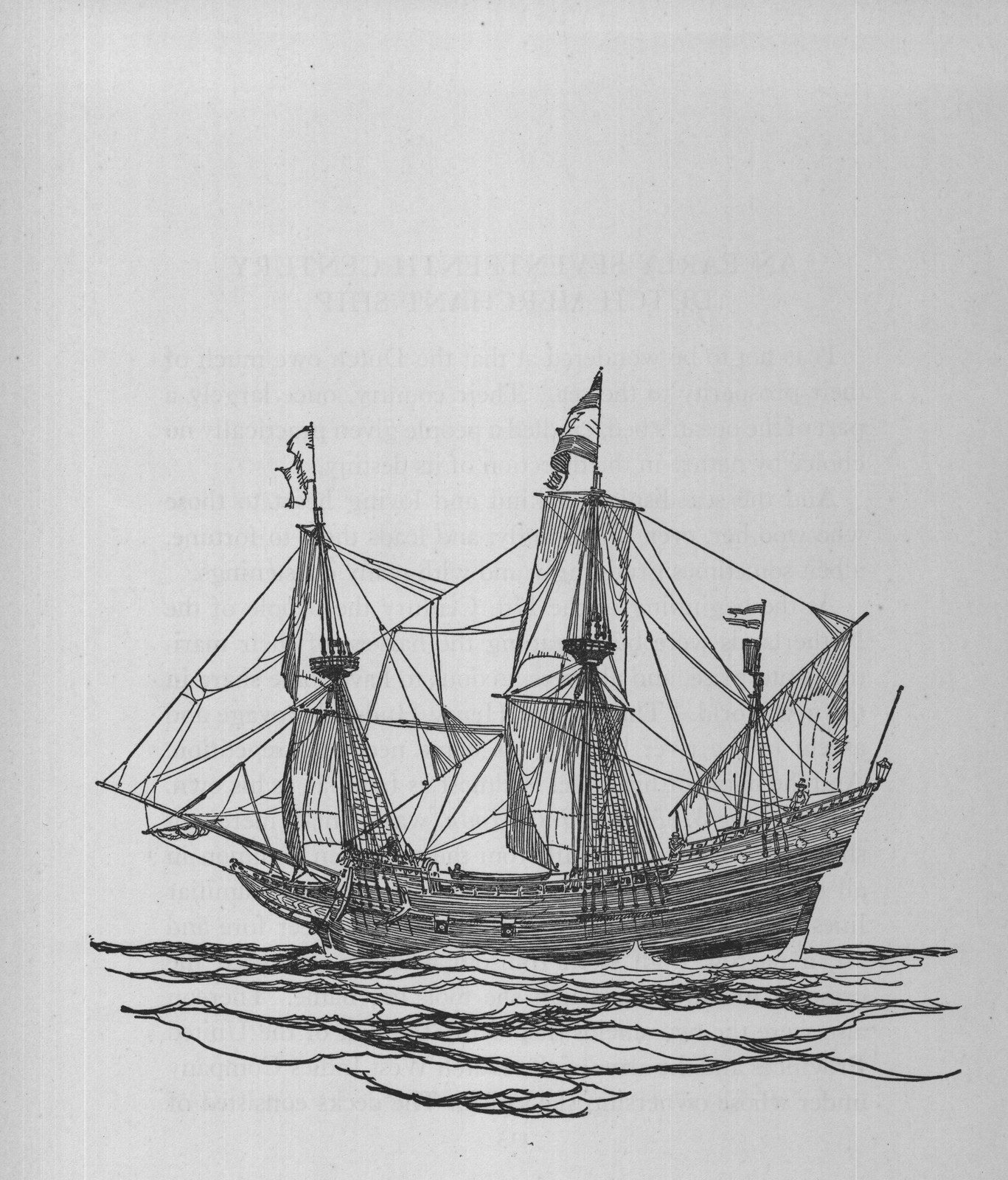
De Halbe Moen, or Half Moon, was a small merchant ship differing hardly at all from the type then common in all north European countries. She exhibited the familiar lines of the late 16th Century ships: a steep sheer fore and aft, a narrow high stern transom whereon appeared the crescent moon, from which she took her name. Thereon also were the two shields displaying the lion of the United Provinces and the arms of the Dutch West Indies Company under whose ownership she sailed. The decks consisted of a short and rather steep forecastle, a waist of practically equal dimensions in length and breadth, encumbered with a ship's boat and other indispensable dunnage, a low half-deck above which appeared the rounded hood of the steerage or position of the helmsman, and above that, up the steep ascent of the half-deck (which in most of the Dutch ships followed the line of the sheer), a diminutive poop cabin. The rigging was simple but adequate. Chains secured the lower deadeyes to the vessel's side, the chain wales being set rather low. The bowsprit was furnished with a jack staff, the immature precursor of the spritsail topmast. Rather ineffective backstays leading to the stays and crane lines were still in use. The fore and main masts bore courses with bonnets and the high narrow topsails of the period, without reef points. The continental form of jeer with the high drisse and ram's head was conspicuous, while the knave-line was still employed to circumvent the knavish tendency of the large jeer-tackle block to cable-lay. It will be recalled that a piece of cordage named a nave line in a nearly similar position was later employed to overhaul the old-fashioned trusses upon the lower yards.
Three hundred years are but a short time in the history of the civilized world, but witness what the magic of the sea has wrought in the destiny of those favoured by her! Holland has indeed lost nearly all her holdings in the western continent, but she is still far from poor and she owes practically all her wealth and prosperity directly to her maritime commerce.