Home › A Thirteenth Century English Warship
A Thirteenth Century English Warship
NO CONCRETE example of a north European ship of this period is known to have been preserved as have several Scandinavian vessels of a few hundred years earlier. Obviously the chances of the preservation of such a craft are all against us. Christianity gradually banished the pagan rites which surrounded a chieftain in his last resting place with his late earthly possessions. So archaeology owes much to paganism. The date upon which to base a pictorial representation of a ship of the time of the Crusades must therefore of necessity be documentary. By this term is meant representations of ships as seen by the eyes of the early artists, whatever may be the media through which they have expressed themselves.
Fortunately some data exist to furnish us with a fair, if not perfect, idea of how the ship of the 13th Century looked.
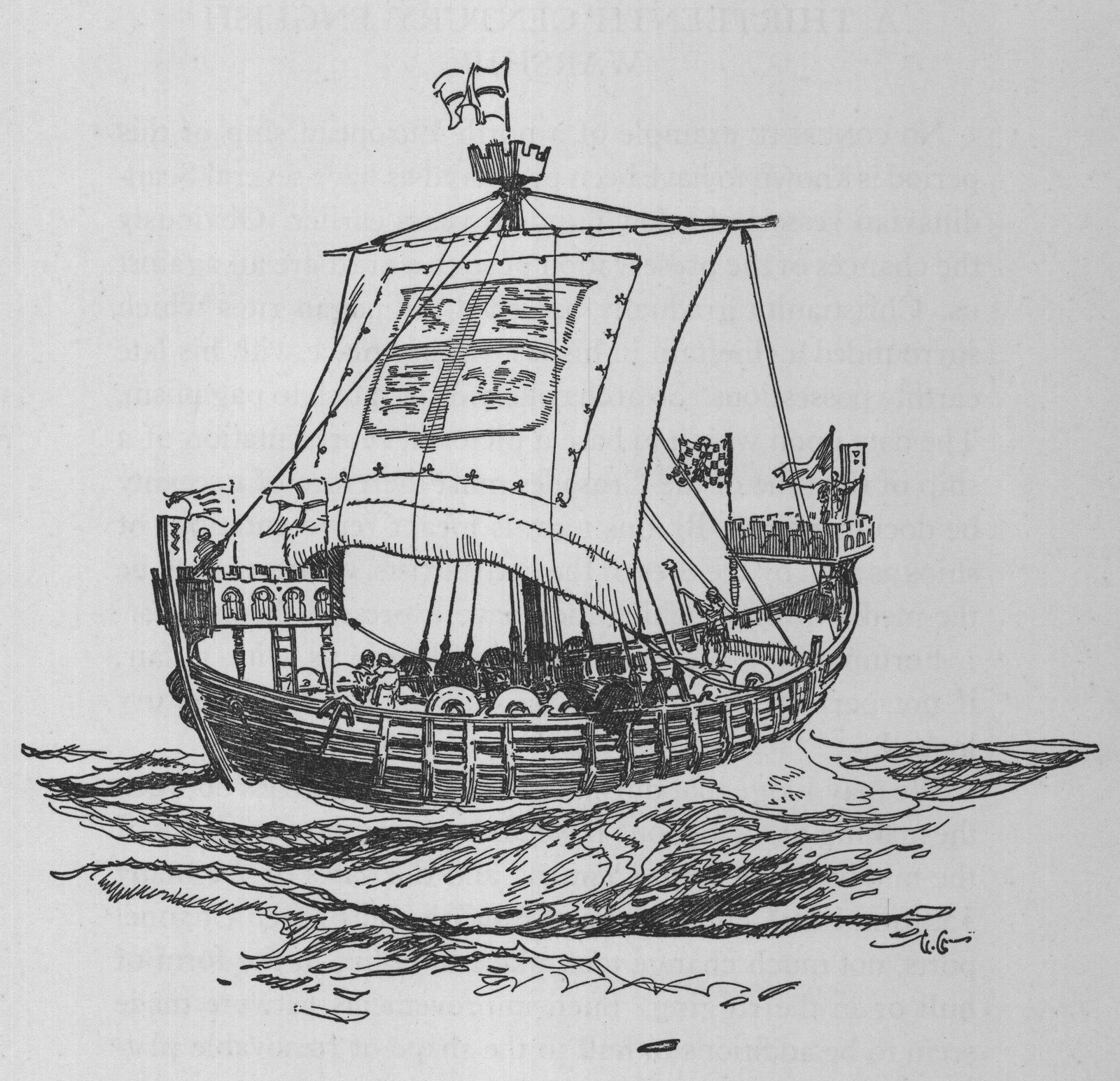
We may judge that during two or three centuries between the making of the famous Bayeaux tapestry showing ships of the middle of the 11th Century, and the dates of the many 13th and 14th Century seals of English and French Channel ports, not much change took place in either in the form of hull or in the rigging. Such improvements as were made seem to be additions to hull in the shape of removable platforms fore and aft. These ultimately became permanent parts of the ship's structure.
But if we cannot with conviction say that we are wholly satisfied with such facts as we possess about these ships, it is our privilege on the other hand to supply from our imagination any attributes with which we may wish to endow them, conformably with other facts applicable to this romantic age. Let us weave around them romances of voyages to the Holy Land, of encounters with strange and unbelievably greater ships of the land-locked central sea, and with pirates in swift-sailing craft along the north African coast. Let us people their waists with men-at-arms in leather jerkins, the after castle with knights in armour, and the forecastle with archers and seamen. The military top, square or round, bristles with darts while the crane hoists up molten lead, stones, and fire-brands to cast down on decks of the enemy. Or suppose that a princess goes by sea to join her future princely husband. The ship is bedecked with fair golden sail and the cloths about the bulwarks bear the lady's colours. The pavese (row of shields) about the sides is bright with the arms of the two families about to be joined together. The lady and her maidens work with their needles or bobbins on the after castle under a gaily striped awning, or pace softly along the deck in the shade of the huge billowing sail, while a minstrel chants his master's praise or beguiles the tedium of the voyage with recitations such as the Romaunt de la Rose, the Lai du Petit Oiselet, and the Chanson de Rollon.