Home › The Monuments of Rameses The › The Monuments of Rameses The: Diodorus
The Monuments of Rameses The: Diodorus
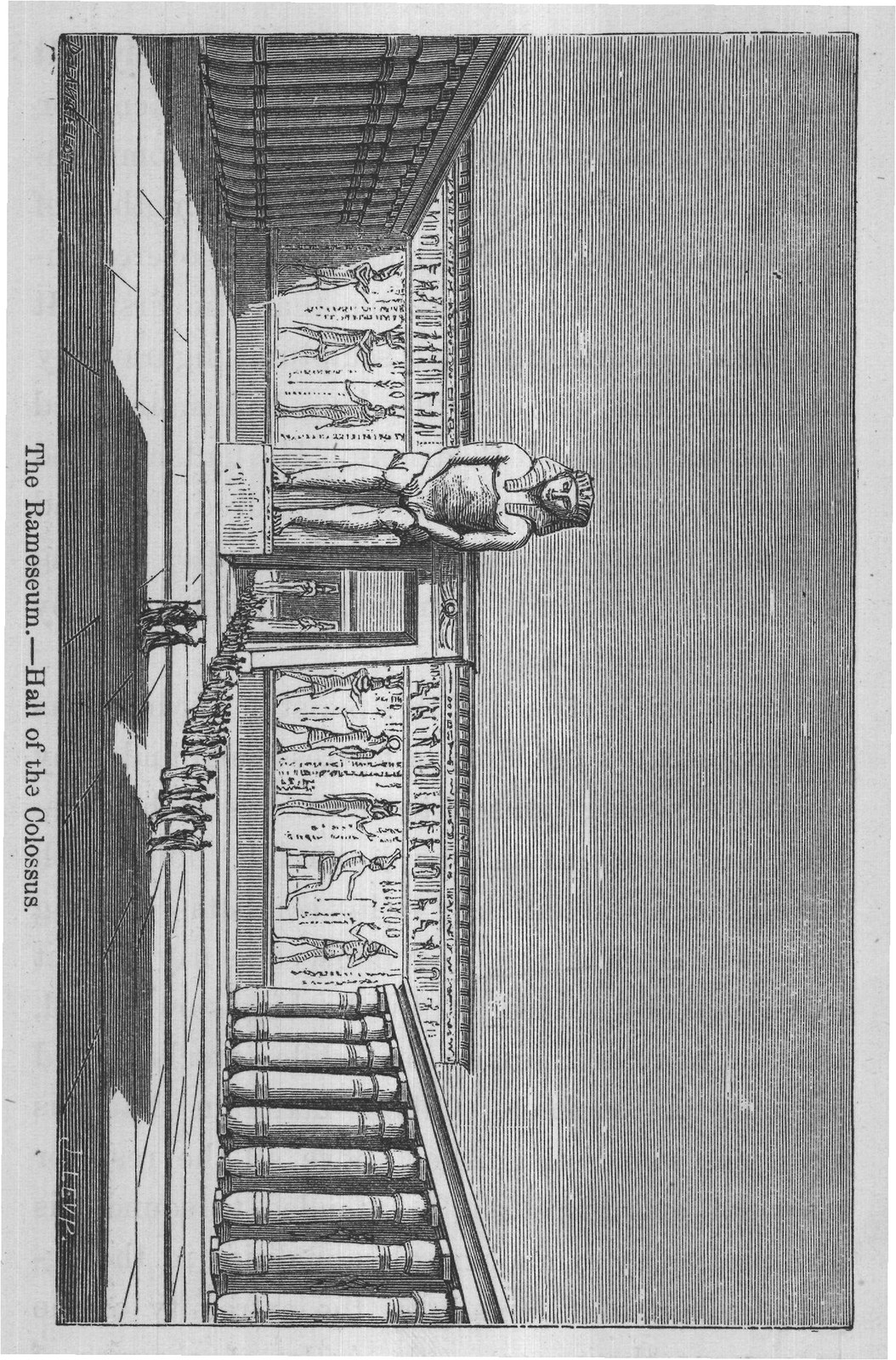
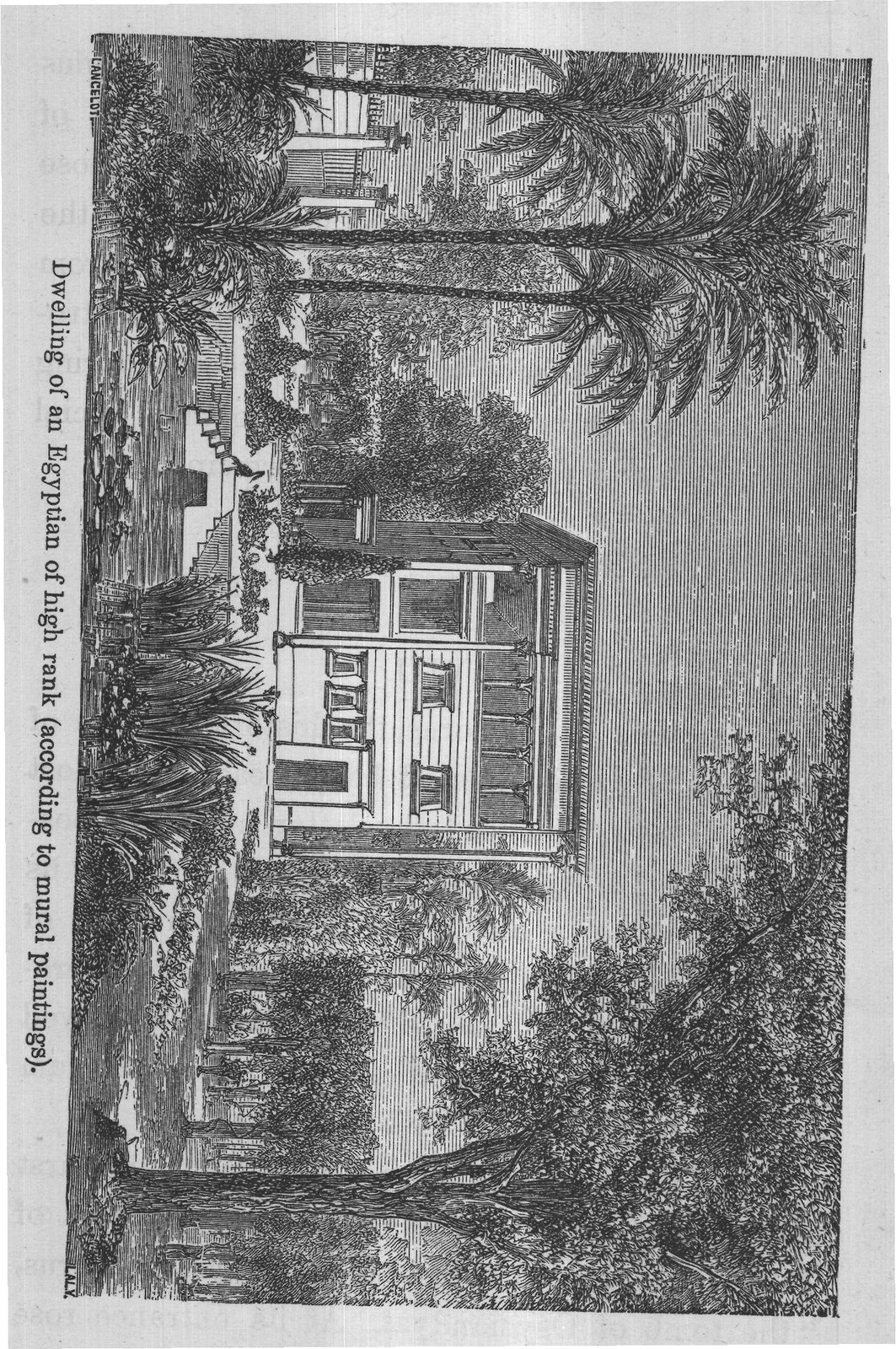
In the time of Diodorus, the historical sense of this grand Egyptian period had already been lost to the Greeks, if, indeed, the latter had ever possessed it. The historian of Stagira has left us a description of a monument in the metropolis of the Pharaohs, which had remained an indecipherable enigma until the day when Champollion proved the identity of that monument with the Rameseum on the left bank of the Thebes. "At the distance of ten stadii from the first tombs, where, according to tradition, the Queens of Thebes are buried, there stood," says Diodorus, "the tomb of Osymandyas. At its entrance rose a pylon in marbled stone; its breadth was two ple- L'ANCELOT Dwelling of an Egyptian of high rank (according to mural paintings). uræ and its height forty-five cubits. After having passed it, one entered a square peristyle, each side of which measured four plethræ. It was not sustained by columns, but by animals carved in solid blocks of stone sixteen cubits in height, and carved in the ancient style. The entire ceiling, consisting of a single stone, was studded with golden stars upon a field of azure. At the end of this peristyle there was a second entrance and a pylon like the former one, but adorned with variegated carvings of perfect workmanship. Beside this second portico were three statues, each chiselled from a single block of the hard and tinted stone of Syene. One, representing a personage in a sitting posture, was the largest of all the statues in Egypt. The two others, placed near his knees, one on the right and the other on the left, were those of the mother and the daughter, and did not approach the first in size. This piece was not only remarkable for its dimensions, but it was worthy of admiration in regard to its artistic execution and the nature of the stone, which, notwithstanding its vastness, did not revea a single crack or blemish. Upon it could be read the following inscription : I am Osymandyas, King of the Kings; if any should wish to know who I am and where I repose, let him surpass one of my works. There was, also, another monolithic statue representing the mother of this king separately. It was twenty cubits in height, with three diadems or its head to indicate that the personage commemorated had been the daughter, wife and mother of kings. After the second pylon was discovered another peristyle more remarkable than the first. It was adorned with different sculptures, figuratively illustrating the war that this king had maintained against the revolted Bactrians. He had marched against them at the head of four hundred thousand foot and twenty thousand horsemen, after having divided his army into four bodies, commanded by the princes, his sons. "Upon the first wall of this peristyle Osymandyas was represented besieging a fortress surrounded by a river, exposing himself to the blows of his enemies, and accompanied by a terrible lion which served him as an auxiliary in his combats. Among those who explain these carvings, some say that it was a real lion, tamed, fed by the king's own hand, and taught to accompany him while attacking and pursuing his enemies. Others maintain that this king, who was distinguished above all the rest for his valor and his strength, intended to sound his own praises by symbolizing his qualities in the figure of a lion.... Finally, at the extremity of the monument, there was, in the midst of a series of ELEVP.
The Rameseum. - Hall of the Colossus. apartments, the second library designated by the inscription: The office of the soul."
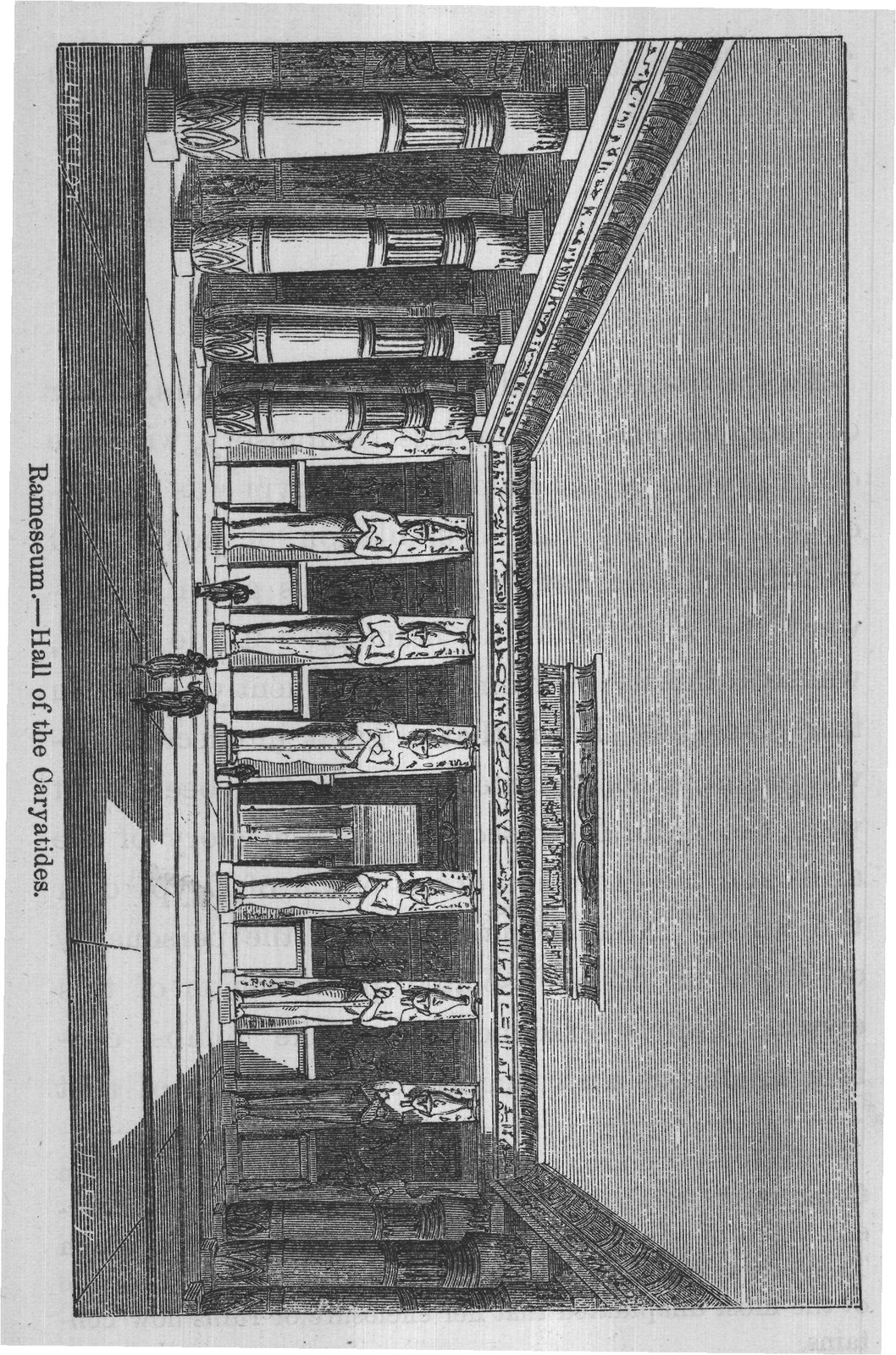
Volney had declared, as early as the beginning of the present century, with the intuition of genius, that all these details too clearly pointed to Sesostris to admit of any one seeing in the name given by the Greek historian anything but the epithetic title of that monarch. Twenty years later, Champollion, applying the description of Diodorus to the ruins of the Ramescum, put together from its fragments, shattered as they may be, the pretended tomb of the Osymandyas. Excepting in dimensions, exaggerated as ever by classic antiquity, he rediscovered every particular: the double pylons; the court of the colossus; the enormous fragments of the latter, which formerly must have measured thirteen yards in height; the hall of the caryatides; the galleries, the colonnades giving access to the interior apartments, and even the library with its ultramarine blue vault studded with golden stars, and decorated with an astronomical picture. Moreover, he was enabled to detect in the mural paintings, a majestic concordance with the poem of Penta-ur, and to decipher in several legends dedicated to the great deity Ammon-Ra, these characteristic words: the habitation of Rameses Mei-Amoun in the Oph of Thebes."* IX.
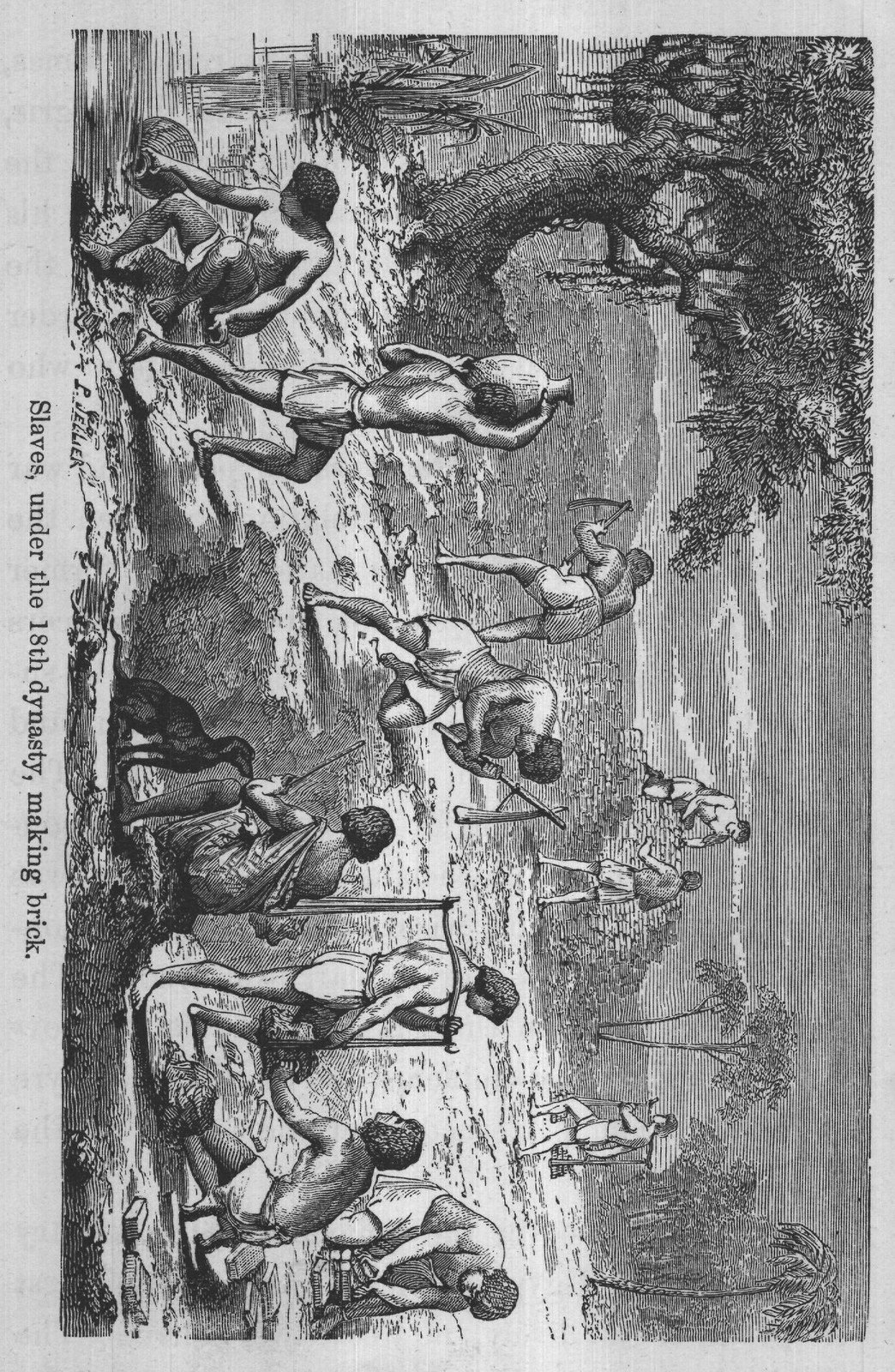
To the distant expeditions of her warriors, to her communications, more or less compulsory, with the other groups of the human race, Egypt was indebted for not only an accumulation of power and wealth, but for a more active impetus given her toward the arts, trade and industry. M. de Rougé, whose authority we cannot too frequently invoke in this place, has shown that a great intellectual development, a sort of literary cycle, had been, as it were, the natural consequence of the glory of the arms and the extension of the power of Egypt over the world. Neither the poem nor the personality of Penta-ur is an isolated phenomenon of this epoch. Papyri exhumed from the tombs contain numerous and remarkable fragments of that * The restored sketches published by the great Egyptian Commission puts it in our power to offer our readers different views of this monument, the finest, perhaps, of which Thebes was so proud at the period of her greatness, and one of the most dilapidated that her enclosure of ruius now contains. Rameseum. Hall of the Caryatides. literature which was in a flourishing condition at the court of the Pharaohs more than fifteen hundred years before our era. They have even preserved for us the names of the Egyptian authors who lived in the vicinity of Rameses, or of his immediate successors, and whose theological, philosophical historical, romantic or poetical compositions propagated and multiplied by the bureaux of calligraphy, or, in other words, copying offices, of the period, were not without their echoes among their contemporaries, nor without influence upon the general current of the human mind. This rising movement of intelligence upon the borders of the Nile seems to correspond in time with those achievements of a similar nature that, on the banks of the Indus and the upper Ganges, distinguished the heroic age of the Aryan tribes that used the Sanscrit tongue. From that time forth, anterior Asia also undoubtedly had her writers and her artists. But Egyptian domination ruled in this region during too long a lapse of centuries not to leave the imprint of the conquerors deeply stamped upon its manners, institutions, and religious notions. Thus, the style of the most ancient cuneiform inscriptions differs but little from that of the carved hieroglyphics and the papyri of the Egyptians. Still more, a stele found among the ruins of a Theban temple, a veritable ex voto of those remote times, exhibits to us a sovereign from beyond the Tigris, the father-in-law and vassal of a Pharaoh of the twentieth dynasty sending a solemn embassy to his son-in-law to obtain the temporary cession or the loan of an Egyptian idol of great repute in order that it might exorcise one of his daughters who was possessed of an evil spirit. "Four centuries of intercourse in peace and war had multiplied the intimate relations between the Egyptians and the Asiatic nation. The former made journeys to Mesopotamia: these were officers sent by the prince to govern the provinces, to superintend the stations established and command the garrisons posted in the fortified places. The Asiatic came to Egypt, far as it was, either to consult the Egyptian physicians whose learning was already famous, -the wizards, probably, who contended with Moses, or to carry on trade. The metal cups found in the ruins of Assyria are covered with Egyptian emblems, and the Kings of Tyre wore a diadem patterned after the pschent of the Pharaohs. "We also discover the influence of the literary forms usual in Egypt among a people whose first steps excite a lively interest everywhere. The Bible shows us, at this epoch, the sons of Jacob, of PJELLIER Slaves, under the 18th dynasty, making brick. whom Divine protection had made a new nation, exhausting their strength in constructing in the Delta a city to which the holy book gives the name of Rameses. "Frequently mentioned in our papyri, the place there bears the name of Rameses Mei-Amoun, and the scroll-boxes (even a statue) of the great conqueror have been found among its ruins. Rameses II., then, was the persecutor of the Israelite family whose increasing number became a subject of alarm for his policy. This king could not banish the remembrance that, upon several occasions, the wandering tribes of Asia, filling up lower Egypt by their incursions, had driven out the Pharaohs. "It was then that Moses, having been rescued by the daughter of the sovereign, was reared in the palace and instructed in all the lore of Egypt.