Home › Egypt Before the Time Of › Egypt Before the Time Of: Egyptian
Egypt Before the Time Of: Egyptian
The isolation of this portion of the basin in which it dwelt constituted the strong point of Egyptian society during the period of its development. With few exceptions the migrations of tribes and races that then wandered to the four quarters of the earth, swept past, either above or below it. Herein lay the secret of the form that it assumed; of the pro longed existence that was accorded it, and, let us hasten to add, of its weakness when the hour of its downfall had arrived.
V.
ALL who have devoted any time to observation of the territory and history of Egypt, from Herodotus to Champollion, were under the impression that the Nile, as it has brought soil and fertility to Egypt, had likewise brought it men and civilization, and that the latter descended with it from the south to the north.
A contrary opinion prevails, at present, among the learned in Egyptian matters. Many of them, those especially who are somewhat under the influence of German philosophy, affirm that the earliest settlers and earliest civilization commenced their work in the basin of the Nile, on the north, and that they ascended, instead of descending, the river.
This difference of opinion is more apparent than real, since it has reference, fundamentally, only to the line followed by the migrations between the point of departure and the point of arrival, and in both hypotheses, the primitive cradle of the Egyptians and of their instructors must be sought for in Asia.
Among the mummies which the Egyptian catacombs and places of burial daily yield to our examination, modern anatomists think that they are able to distinguish three separate classes: the first comprising the ancestors of the Copts properly sostyled, the form of whose crania recalls the shape of the heads of the statuary and the sphinxes of Thebes; the second bears some analogy to the Hindoo type, and the third seems to be akin to the Nubian tribes, and the same savants connect it, as well as the Copts, with the Berber race.
All who still cherish a disciple's remembrance of the eminent men who were the preceptors, so to speak, of those who to-day are the masters of historical science, -of the Volneys, the Heerens and the Ecksteins-will, very justly, be astonished when they miss from among the tribes set down as the ancestors of the ancient Egyptians, the Cushites or Negroes who have left their indelible stamp upon the religions notions of the people. For our part, since we have but little faith in the expression human races, but a great deal in the modifications of the family of man effected by the combined action of physical and moral surroundings; by the influence of climate; of the rules of health observed, and the institutions maintained, and by the emanations of soil and sun, we shall confine ourselves to another source of information. We shall, upon this much debated subject, question the tombs of the Pharaohs excavated in the Libyan chain to the westward of Thebes, during the lifetime of the princes whose last resting-places they became.
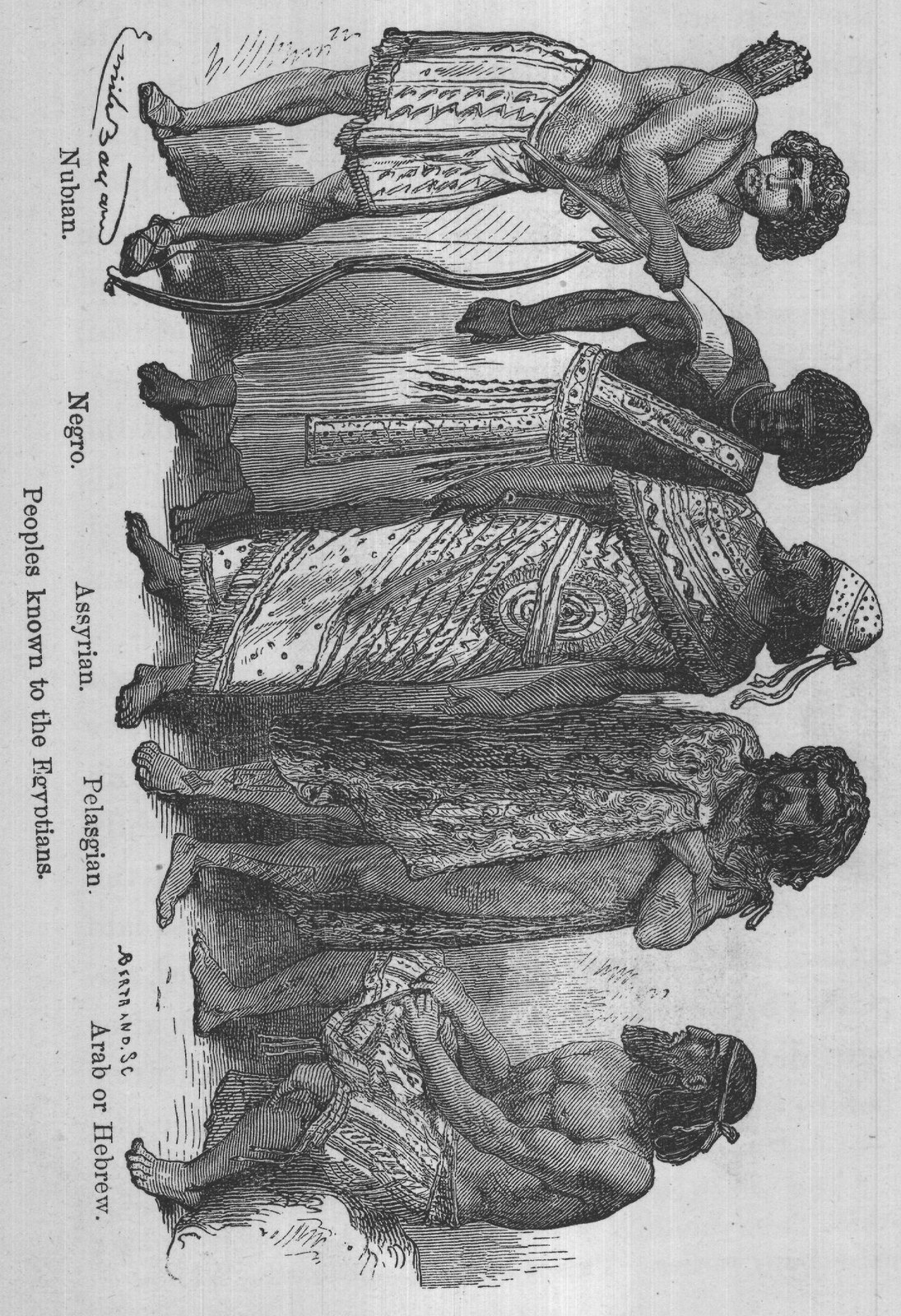
The perfection of the adornment and the finish of the workmanship on each of them are in proportion to the duration of the reign of the guest whom they were to receive. But upon the walls of all of them where time had admitted the finishing stroke, dating from the nineteenth dynasty, the mysterious artist has carved and painted the images of the principal fractions of the human race known in his time.
Conducted, one and all, by Horus, the pastoral god of the nations, they are generally arranged in four groups corresponding with the four divisions of the world then known. The group farthest away from the god consists of savages of lofty stature, with light or sandy hair, blue eyes, and straight or slightly rounded features. Tattooed and covered with the spoils of the aurochs and the bear, just as those late comers in old Europe, the Gauls and the Cimbri, appeared to the affrighted Greeks and Romans, in after ages, did the ancient Pelasgi appear fifteen centuries before the Christian Era, to the erudite and culti- * The nineteenth only. The geographical knowledge which these paintings pre-suppose does not appear to have these paintings pre-suppose does not appear to have existed any earlier . This is a good point to establish. 22- Arab or Hebrew. ayam Negro.
Nubian.
Assyrian.
Peoples known to the Egyptians.
Pelasgian.
BERTRAND.Sc Arab or Hebrew. vated Egyptians. The latter called them Tamhus.
In the group that precedes them, are strikingly observable all the characteristics of the negro type in its most degraded varieties, and to these legend gives the name of Nuhazis.
In advance of them, again, are the representatives of Asia. Their yellow and tawny complexions; their aquiline or beaked noses; their black beards, sharp and pointed on some, ample and curly on others; their costumes of varied hue and fashion, indicate members of the Aramæan branches :
Arabs, Hebrews and Assyrians. On some walls, Medes and Ionians figure among these sons of Shem. All of them are comprised in the general denomination of Aamus. Lastly, standing close to the heathen divinity, and, as it were, under his special protection, are men of dark red skins and tall slender figure, with gentle and regular countenances, clear cut eyes, straight noses and open facial angle, wearing their hair in plaits, and dressed in white garments. The name of Rut-n-Rom-the germ, or the race of man-with which they are specially honored, sufficiently point out the dwellers on the banks of the sacred river, -in other words, the Egyptians.
The typical characteristics here associated with them, identical on all the monuments and verified upon thousands of mummies of different epochs, are not found among the Copts, their mongrel descendants. Amid the confused mixture of all the nations that have succeeded each other in Egypt, the Copts have retained the idiom, better than the blood, of the old race.* The latter, whose presence may be traced at numerous points on the African continent, is met with again, in all its original purity, in two nations who dwell in the basin of the Nile, but at a wide distance from each other, the Abyssinians of the upper plains, and the Barabras of lower Nubia, sheltered as they have been, the latter by poverty, the former by the natural strength of their soil, from the invasions of conquerors, and from the current of the migrations which, in the lapse of ages, has passed between them and isolated them, leaving them divided and far apart, yet kindred boughs of a parent trunk that has ceased to exist. * Champollion's Letters on Egypt and Nubia. Larrey's Memoirs, in the Description of Egypt. Caillaud's Journey to Meroe and the White Nile. Trémeaux's Journey to Nubia, etc.
VI.