Home › Egypt Before the Time Of › Egypt Before the Time Of: Nile
Egypt Before the Time Of: Nile
Srx degrees of latitude separate this point from the one where almost immediately under the tropic circle, the Nile, traversing the granitic rocks of Syene and of Phile, penetrates the Egyptian territory. Beyond, toward the South, extends Nubia.
In this space of more than four hundred and fifty miles in length, by a breadth of nearly twenty, the brilliant glow of the sky, the freshness of the waters, the fertility of the plain and the aridity of its borders; the extreme pettiness of all the traces that modern man has left of his presence, and the colossal seal of the antique generations, contrasts of every kind, in a word, seem to be accumulated, to strike the beholder with prolonged astonishment.
Here the geologist may recognize, as he does in the Delta, a conquest won by the dry land over the sea, -a gulf filled up, since the last great astronomical revolution of our globe, by deposits of clay that the lapse of ages had heaped there after it had been washed down, each spring, from the abrupt slopes of Abyssinia and from those other mountains, unknown until yesterday, but suspected, for two thousand years, to be in existence, which, away beyond the Equator, conceal the long-sought-for sources of the Nile.
Here, too, the antiquary and the poet may contemplate the most gigantic efforts of plastic art that any race has left behind it: temples, palaces, tombs, obelisks and colossal figures half ruined and buried beneath the sand; crypts cut out in the solid rock; catacombs; cities of the dead perpetuating in the very entrails of the desert mountains, those ruins which were the cities of the living!a long avenue of fragments and remains dating back to an epoch whereof history lacked the annals more than twenty centuries ago, but which the correlation of the monuments, the religious notions and the institutions of an entire people with the surroundings in the midst of which it grew, seem to characterize so peculiarly that no other epoch could comprehend or explain its fundamental meaning and creative idea, much less successfully attempt to take them for a model.
III.
IT was reserved for the generation that is dying out to penetrate, and not in vain, the depths of these enigmatical ruins; to disentomb from them the past, and to restore to it the real aspect that once it wore, along with a part of its lost chronology. Thanks to the acquisitions of modern science, for whose progress the genius and the blood of France have helped to clear the way; thanks to the unhoped-for deciphering of those monumental inscriptions through which the Egyptians of forty centuries ago seem still to converse with the men of our own time, the historian can at length present to them upon their sepulchres testimony more certain and reliable than classic antiquity, in the days of its decline, could offer in their behalf.
Although the idea of again securing the thread, a hundred times broken, of Egyptian tradition, must be once for all abandoned, we have it in our power to reconstruct the most brilliant part of it almost to perfection. The period that it covers flourished in times which nations the most jealous of their antiquity do not, in their authentic records, pretend to have attained.
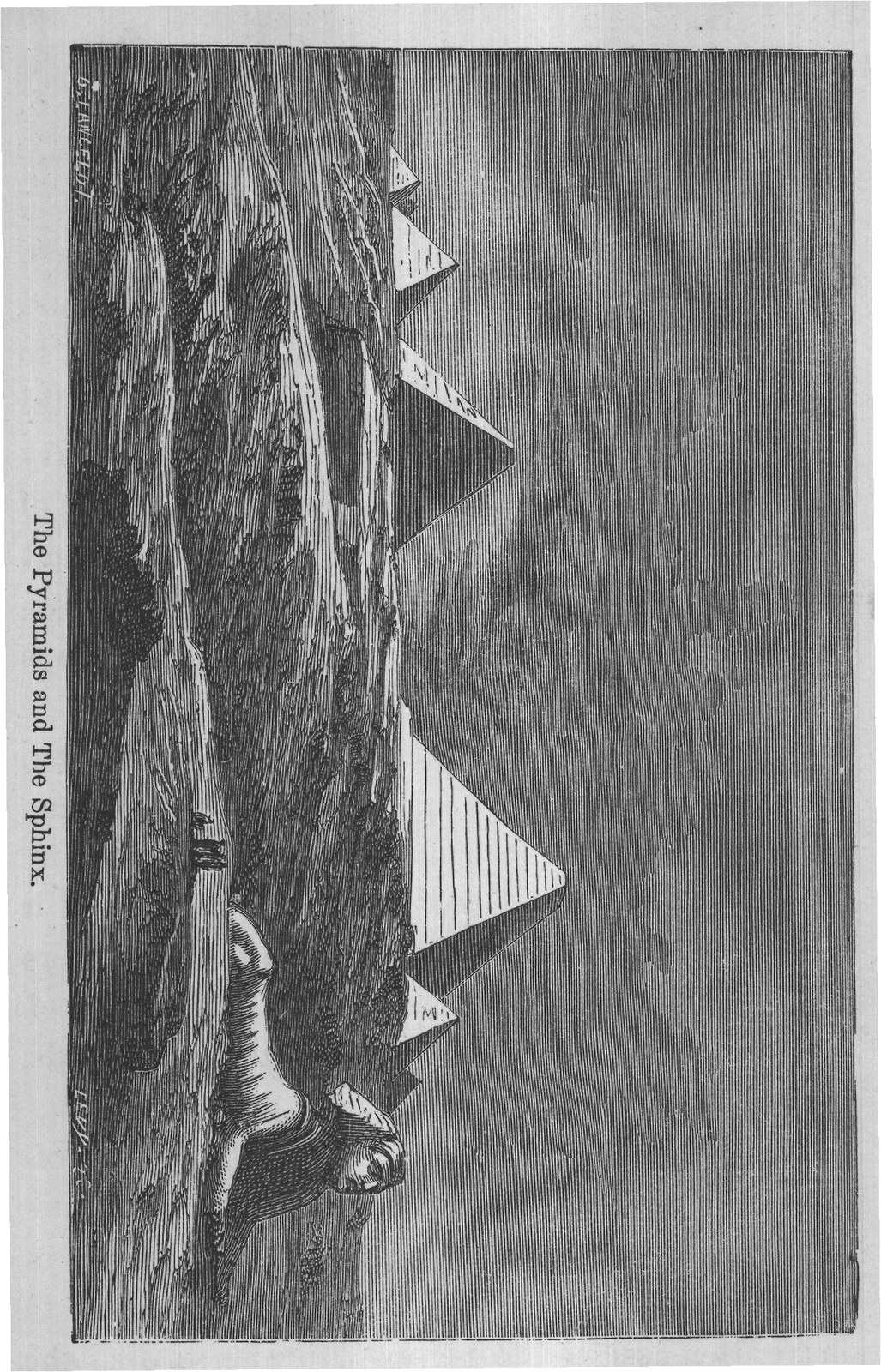
Henceforth, enabled to appreciate the weight of Egypt in the balance of the world, historical criticism is called upon, also, to judge of the manner in which she has fulfilled the functions that seemed to have been assigned to her by Providence, viz., the protection of nascent civilization against the native barbarism of the wandering tribes that hung around D.LANCELOT The Pyramids and The Sphinx. its outskirts, and the initiation of the savage races of the Mediterranean valley into the peaceful mysteries of agriculture and industry. In fine, it is easy to make out how the empire must have perished, and its colossal model have disappeared from the Earth, on the day when humanity ceased to be split up into a few hostile groups, separated as much by space as by animosity; and when the vital energy of social communities, the exclusive privilege, at first, of castes and classes restricted in number, began to be distributed among all the members of the social body.
IV.
THE lofty plateau of equatorial Africa that extends beyond the fifteenth degree of north latitude in Abyssinia and the twelfth in the Wadai, seems to recede, between those two extreme points, as far southward as some distance beyond the Equator, whence it sinks towards the North, in a vast concave depression, of which the Nile occupies the lowest part. Issuing from the only source worthy of it, a sort of fresh water sea covering the highest levels of this table-land, the great African river that, to use the expression of Herodotus, has created Egypt, descends by a series of cataracts into the plains of the Baris, the Djirs and the Donkas, which are dotted with lakes and streamlets, and then into the country where the Shillooks have taken the place of the old Automoli or refugees.* The water sheds on its left, pour into its tide during this journey a great number of tributaries which are still unnamed in history. On the other hand, the Abyssinian mountain mass sends to it, on its right bank, some powerful affluents of which two at least, the Abawi and the Taccaze, were know to the earliest geographers under the names Astapus and Astaboras.
A characteristic trait of this river, and one that at first sight distinguishes it on the map of the globe, is the rectilinear direction of its basin. The 30th meridian eastward of Paris, one of the three that traverse the great sheet of water know as Lake Nyanza, crosses one of the mouths of the Delta at the distance of a thousand leagues from there, and during the interval the Nile, that seems to entwine * Herodotus gives this name to the Egyptians who abandoned their country, under the reign of Psammeticus, in consequence of the intrusion of foreigners into public office, and of Greek and Ionian condottieri into the ranks of the army. itself around it like the sacred urœus around the antique caduceus, intersects it eight times at least with its windings, without, in any instance, receding more than forty leagues from it in its farthest divergence. But in other respects, it alone among the great rivers of the world is not swollen by any affluent in the last third of its course, which it pursues in solitary grandeur for the distance of four hundred leagues, between two deserts whose sands, cut oft from the rains of the tropics, greedily absorb its waters without yielding it, in return, the tribute of the feeblest rivulet or torrent.