Home › Egypt Before the Time Of › Egypt Before the Time Of: Manetho
Egypt Before the Time Of: Manetho
SHOULD the logic of induction lead us, more than once, in the course of this recital, to admit extracts from Manetho among the material upon which historical conclusions are based, it must not, for that reason, be inferred that we are inclined to accord to the remaining works of that old annalist, and especially to his lists of kings and dynasties, analogous authority.
It is not for us to inquire whether that Egyptian priest, entrusted with the task of collecting in the Greek language all the national traditions stored away among the sacerdotal archives of his country, was or was not equal to his mission. Of the three volumes that composed his work, a few fragments, drowned in the compilations of later periods, and lists of kings revised, corrected and abridged by the monastic zeal of the early Christians, being all, un. fortunately, that have come down to us, it would be unjust to hold the author responsible for all the contradictions of dates, facts and figures as well as the double applications that these different fragments contain. But, when we consider the complete discordance that exists between these documents of common origin and those whence Herodotus had drawn his facts two centuries earlier, and weigh the conflicting views whereby they have strayed from the ancient source that should have supplied them, and which, surviving in our day under the name of the Old Chronicles, gives only four hundred and forty-three years to the fifteen earliest dynasties to which Manetho assigns forty or fifty centuries, we must agree with one of the most judicious investigations of antiquity, that it is improbable that an Egyptian priest compiling with all the prejudices of his caste in a foreign tongue, and in behalf of a king whom he regarded as of barbarian origin, the traditions of an expiring nationality scattered on monuments of diverse and often rival purport, should be specially endowed with that spirit of criticism in whose default history relapses into legend, and which was almost entirely wanting in the ancients.* At the close of this work will be found a faithful synopsis of Manetho's lists, such as they emanated from the hands of Julius Africanus, Eusebius and Syncellus: such, too, as Champollion and his successors thought they could make them by correcting the figures according to the monumental inscriptions. We have also reserved the right to range together a certain number of facts, the synchronism * Volney's Researches in arcient History. of which is well-nigh certain, and may serve to establish some rallying points upon the floating canvas of Egyptian chronology, and prepare for it a framework beyond which it cannot very easily escape. VII.
IT is not consistent with the plan of our book to extend this chronological study any farther. Such as it is, it must suffice the reader for a basis whereon to form his own opinion of the matter, and to choose between the system that would push back into the night of ages the development of the Egyp tian nationality, and the one that, relying upon the study of social facts, and upon the nature of man, holds that the more the torch of history gains in clearness, the more concise should chronology become and ancient times approach our own. The eternal aspiration of the human mind toward a felicity which the present denies it, and which it could not ask of the future, so long as it was unaware of its own progressive faculties, was undoubtedly the source of the mania that impelled all communities to antedate their origin and throw it back into a past that was all the more regretted that its depths were the more obscure. In those days, nations, as in more recent times families, gauged their nobility not by deeds but by the duration of their existence. Hence, for historians jealous as to the origin of their country, arose the necessity of multiplying generations and centuries, and of ranging in series, one after the other, successions of dynasties and parallel epochs, along with contemporaneous men and facts. Hence, too, for Manetho, in particular, the necessity of conforming his annals to the fables credited by the puerile vanity of the priestly order, and of spreading out the real traditions of his country in a chaos without proportion, name or limit.
Serious history, then, cannot carry these traditions farther back than the period where they cease to be controlled by positive synchronic data. The first point of all is the appearance of Argus upon the stage of the world. From astronomical data calculated first by Bailly and Colebrooke, afterwards adopted by Lahsen and Wilson, and finally put beyond all doubt by Laplace, this event, which has furnished roots to the genealogical tree of ancient Egypt, may go back thirty centuries before our era, but no farther.
This opinion, we know, will be taxed as heretical and even blasphemous by those who approach the realm of history not in order to extract therefrom fruitful lessons and hopes for the future, but that they may, in the presence of dusty remains and extravagant legends, give themselves up to the ecstatic admiration of an old idolatry as aimless as it was artificial and out of date. To have Memphis built by Menes, 5800 years before our era, upon the filled-up bed of the Nile diverted from its course; to believe piously in the books of anatomy written by Athoth, the son and successor of the first-named dynastic founder; to unreservedly admit the authenticity of the ancestral images carried before the kings at religious ceremonies, * and the filiation of the three hundred and forty-five Pi-Romist mentioned by Herodotus; to rear the Pyramids of Gizeh in the time of the brothers Supphi * At Rome, also, in many public and private ceremonies, there were exhibited along with the images of ancestors those of the gods to which the Roman patricians pretended to trace their origin. But have modern historians ever come to the conclusion, from the presence of the images of Mars and Venus at the funeral rites of Julius or Martius, that those fetiches of the primitive clans of Latium ever had a real personal existence ? Assuredly not. Yet this is what Egyptian investigators do in our day, in regard to Menes and many mythical personages of ancient Egypt. † This word is equivalent to "the man superior to all others a brave and virtuous person an excellent man." Herodotus. Euterpe, ch. 143. or Chuffu, of the fourth dynasty, forty or fifty centuries before Christ; and to put back the origin of the grand hydraulic and architectural monuments of Fayoum fifteen hundred years anterior to Thothmes III, to Seti I, to Rameses Mei-Amoun; to cause the conquest of Asia, two thousand five hundred years before the Saviour, by an Osymandyas and a Sesortasen, personages of whom the heroes of the eighteenth and nineteenth dynasties would be merely feeble imitators, -all this was, for a long time in France, and is still in Germany, a source of pleasure even to grave adepts in science, that it would be perilous to disturb by calm discussion.
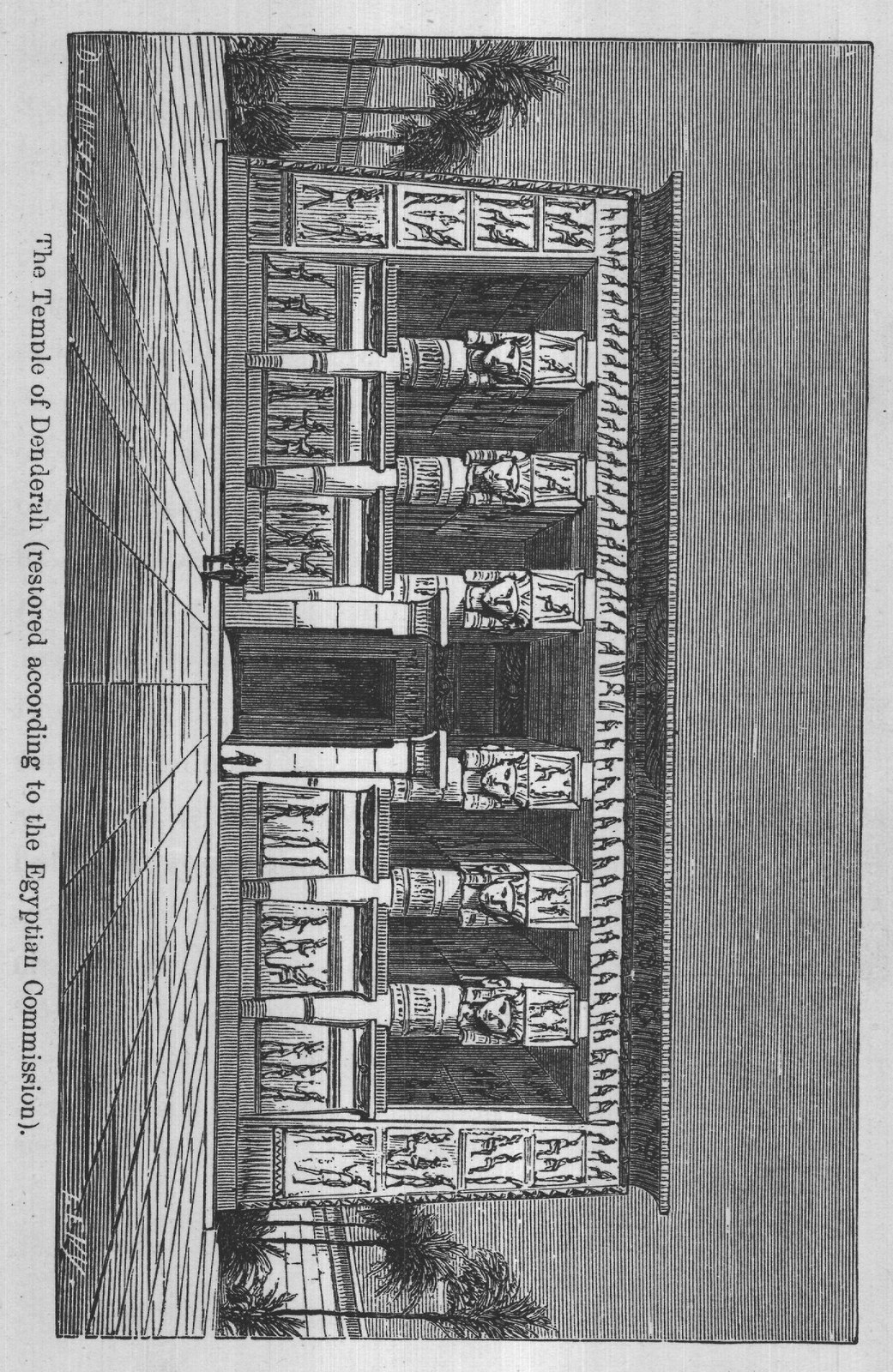
Therefore, we shall not attempt the task, confident as we are, that, ere long, there will become of those mythical legends, what recently became of the series of centuries that our fathers so generously accorded to the temples of Esneh and Denderah-centuries which we had to reduce from sixty-four and from thirty-eight to seventeen or eighteen at the utmost.* * We know that this pretended antiquity was the basis given by Dupuy to his system in his "Origin of Religious Worship." See Appendix II.
The Temple of Denderah (restored according to the Egyptian Commission). AMA VIII.
NEVERTHELESS, we cannot close this dissertation, which has been too far prolonged, already, for the plan of our book, without reminding those who "do not see what delight there is in shutting themselves up for four thousand years with nations in their infancy and tyrants in decay "* the avowal wrung by Herodotus from the very priesthood of Memphis : "That in the time of Menes, the first mortal King of Egypt, the entire country below the Thebaic nome was nothing but a marsh." But, in regard to the philological identity of the name Menes with that of Manu, given in the Sanscrit tongue, to the spirits proceeding out of Brahma and especially entrusted by him with the charge of giving laws to the Earth, this avowal leaves nothing to the name in question and to the legends therewith connected but the consistency of a myth symbolizing the energetic force of nature in the earliest times, the same being subsequently imported from the banks of the Indus to those of the Nile, at an unknown period by a method of transmission identical with that which has borne the name of Jemshid (Yima * Chateaubriand. Introduction to his Journey to Ame rica.
Tchaeto), step by step, from the valleys of the Jaxartes and the Tarim, to the high plains of Media and Persia. In fine, we must ascertain for our readers the result of the researches that modern geology has been making with regard to the beds of clay successively deposited by the periodical inundations of the Egyptian river, and according to which we must not date farther back than some thirty centuries before Christ the appearance of the first human monuments on the primitive soil of Thebes.* When a trench is dug or any excavation made in the valley of the Nile, there is, invariably, found a layer of vegetable earth from 20 to 24 feet in depth, the result of the river's annual deposit. This layer rests directly upon a bed of sea sand. Very minute calculations led the engineers of the great French expedition to Egypt to estimate at 126 millimètres, or about .4134 of a foot, per century, the elevation of this alluvial soil. At a later date, Mr. Lebas, the engineer upon whom devolved the task of conveying the obelisk of Luxor to Paris, and the English savant Wilkinson, came to conclusions almost iden-. tical, on the same subject, by methods of research different in character but equally exact in detail.
Eight metres, 261 feet, the great est thickness, divided * Description of Egypt. Girard's Mémoire on Drainage. by 126 millimetres, or .4134 of a foot, gives us no more than 6350 years of days equal in length to those of our time. Egyptian history, as Manetho and the epigraphists understand it, is not restrained within these narrow limits. What, then, are we to do, unless we bring down to a date much later than Menes and the kings who built the Pyramids, the period when the Egyptians neither employed nor knew any years of longer term than four months. "The proof of this," admits one of the most ardent champions of the high antiquity of Egypt, "is that, later, when the year consisted of twelve months, three seasons were designated, each comprising four months, which were indicated hieroglyphicaily by the word ter, and by a sign that may mean a season or a year, indifferently."* The lower course of the old Egyptian Nile is, therefore, geologically speaking, one of the most recently formed of the ancient continent, and, if geology be not a vain word, three thousand, aye, four thousand years anterior to Rameses, -five thousand years at most, if the heaping up of the lower deposits are to be, likewise, taken into account, -the soil of Egypt was still oscillating between the billows of the sea, and the rays of the sun. † * Dr. H. de Brugsch, History of Egypt from the earliest period of its existence (Leipzig, 1859, p. 26.) + See Appendix III.
Hence, the city of This or Thinis, from which the chief of the first Egyptian dynasty was said to have come, was not founded until long afterward.
IX.
NINE or ten centuries later, that is to say after a longer lapse of time than was allotted to any nation of classic antiquity for its birth, development and death, the population of the valley of the Nile is dimly seen attempting a form of civilization of which historians make known to us only the decline.
Subdivided into several groups whereof Beheni in Nubia, Thebes, Heracleopolis, and Memphis, sometimes independent, sometimes tributary cities, but always rivals of each other, were the chief centres, the different populations referred to had for a common bond: I. Their social organization, founded on the system of castes, the result of successive immigrations and conquests.
II. Their religous creed, arising like their castes from the superposition of different races upon the same soil; a synthetic derivation from the monstrous superstitions of the Cushites, of Semitic Sabaism and Aryan naturalism, it presented, in the individual manifestations of divine power, traces of its triple origin; but, multiplying those manifestations according to the place and the interest of the moment, and upon each rung of the ladder that connects the phenomena of Earth with the invisible world, it could but terminate for the multitude in the grossest fetichism, and, for thinking men, athwart the mystery of the initiations, in those mystical metaphysics of which the Alexandrian school has transmitted only vague echoes to us.
III. Their language, issuing from the same commingled sources, and retaining traces of its origin, yet differing importantly from nome to nome, from metroplis to metropolis, and particularly, from the Thebais to the Delta, but for which, however, the priests had, in the long run, discovered in the numberless array of their fetiches, animate or inanimate, tangible symbols, a graphic representation and a consecrated alphabet whereof every temple had the key.
IV. A method of burial singular, but imperatively required by a long and cruel experience of the periodical inundations of the river, and of the poisonous effluvia arising from the contact of the waters with the organic remains hidden beneath the soil.
V. Their sedentary life; industrial and agricultural habits, derived, perforce, like social manners and customs, from the imperious exigencies of their dwelling place and the odd shape of its narrow and elongated territorial surface; at the same time, too, from their jealous attachment to the soil, their hatred and contempt for the stranger, and especially, for the wandering tribes of the frontiers, an impure race whose insolent rapacity and greedy herds defiled the earth and impaired its fertility. What was there wanting to tribes who inhabited the banks of the Nile, at this period of their existence, to form a nation ? - One of those catastrophes which bring communities closer together and combine them, as they do individuals a partnership of perils, struggles, sufferings, reverses and triumphs gone through, side by side. Providence brought this about.
X.