Home › Honorable Ordinaries. - Sub-Ordinaries › Honorable Ordinaries. - Sub-Ordinaries: Bezants
Honorable Ordinaries. - Sub-Ordinaries: Bezants
The yellow ones are called Bezants, from some little coins of Constantinople that the Cru- Portugal. saders frequently brought home with them. The elder of England's two famous Pitts, Lord Chatham, was allowed to place three Bezants, or pieces of money, upon his shield, from the fact that he had been so prominently connected with the Treasury.
Pitt, Earl of Chatham.
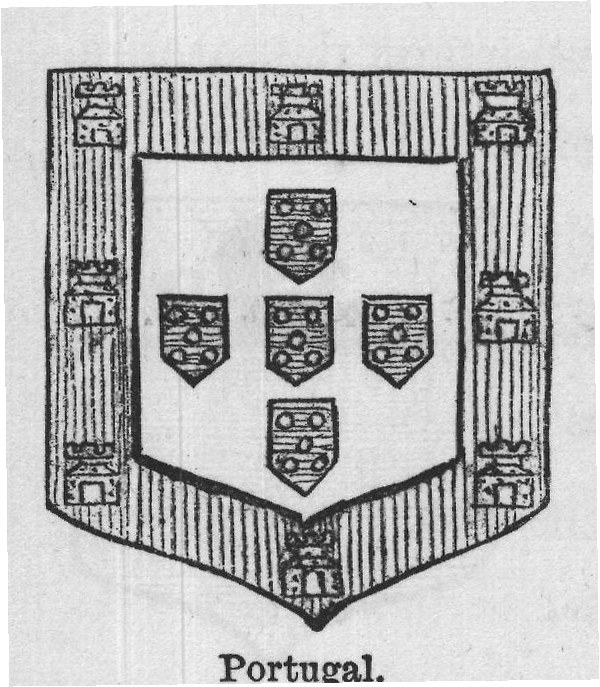
Bezants appear upon the Portuguese royal coat-of-arms, and for the reason told in the following story. In the twelfth century, when the English and French soldiers, fired with holy zeal, were on HONORABLE ORDINARIES - - SUB-ORDINARIES. their way towards Palestine to carry on a second crusade against the infidel, they stopped in Spain, and there found Count Alfonso waging a most unequal warfare with five Moorish kings. These great potentates had brought into the field no less than two hundred thousand men! The Count welcomed the arrival of the northern knights; but, notwithstanding the confidence he had in the prowess of these timely allies, grave misgivings as to the result of a great battle in which he was about to engage filled him with apprehension. It was not surprising, therefore, that the night before the conflict he sat gloomily meditating upon the dark prospect that lay before him, and at last, falling upon his knees, permitted his disturbed spirit to seek aid in the repeating of some prayers. He held his Bible open in his hand, and as desperation had well nigh driven hope from his heart, he mechanically turned the pages, not noticing chapter or verse, until, his glance chancing to fall upon the name of "Gideon," he found himself in the midst of that stirring narrative of the defeat of the Midianites. Such an omen could not fail to encourage him, and just at that auspicious moment a holy monk, or hermit, entered his tent, and, blessing him, bade him, in God's name, go forth in the morning, when he heard the bells ring for mass, and to turn his face towards the east. This he did, and there in a halo of clouds he beheld the body of the crucified Lord, who promised him not only victory, but a crown, and the assurance that for sixteen generations his children should sit upon the Portuguese throne. Alfonso, never doubting the celestial vision, immediately went out to meet his troops, who saluted him as king; then, mounted on a white charger, that, according to Spanish custom, caracoled most bravely, he led the "enthusiastic troops to a most brilliant victory, and Portugal became a kingdom. King Alfonso, overjoyed at his triumph, changed the coat-ofarms inherited from his father to that now belonging to the kingdom, - five shields disposed crosswise on a white shield, in memory of the Lord's five wounds, and charged each shield with five bezants, in commemoration of the five See of Worcester.
Moorish kings who were slain in the Camp d'Ourique.
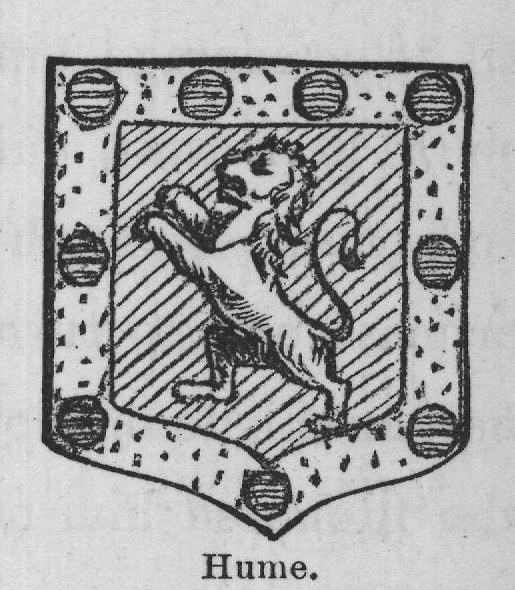
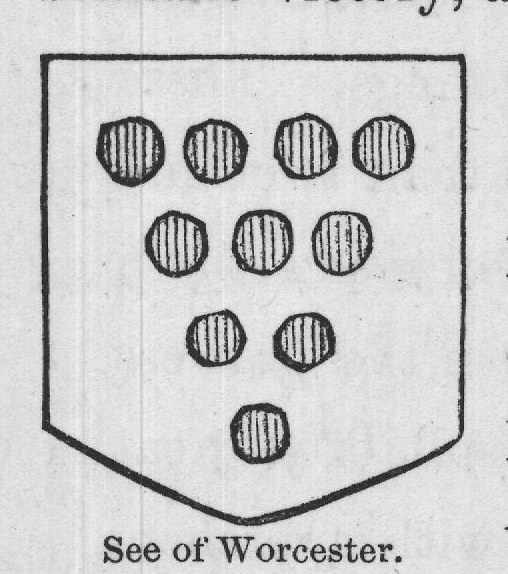
The little red roundels are called Torteaux, and mean little cakes. In the arms of the Bishopric of Worcester some of the worthy "wearers of the cloth" think they mean the Communion Bread. Then there are others that are purple, and green, and blue. The black ones are called by several names, sometimes Pellets, sometimes Ogresses. Some think that all these little objects represent the apples of the Tree of Knowledge of Good and Evil. But what do these little dots with wavy lines of blue and silver mean? You would never guess, so I will tell you that they are intended to look like fountains or springs. David Hume, who wrote a long history of England, had a coat-of-arms on which was a silver lion, surrounded by a golden bordure, sprinkled with nine of these little wells, or fountains. His family were called the Humes of Nine Wells, there being a cluster of just that number of springs on their estate, bursting forth from a small hill that fronted the family mansion; and for this reason the wells or fountains were put upon his shield.
Hume.
Occasionally the representation of a river is seen upon a shield, as on the coat-of-arms belonging to the Earls of Portsmouth, whose family name is Wallop. Formerly it was Welhop, a name given to two parishes, in the centre of which is a spring, gushing from a hop or hill, which gradually grows in size until it is quite a river. The wavy bend that crosses the shield is supposed to indicate the river.
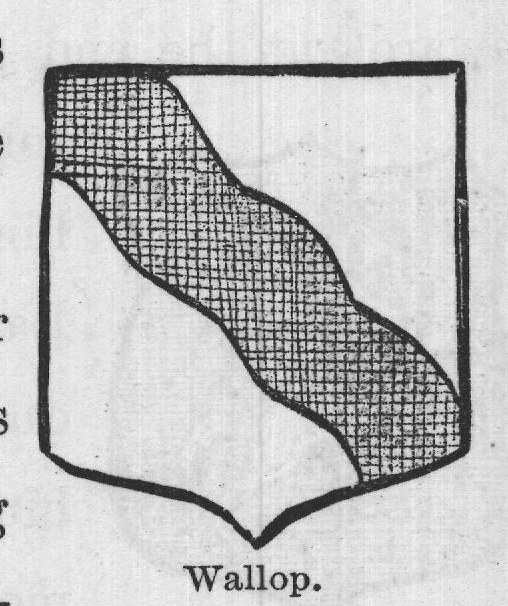
Wallop.
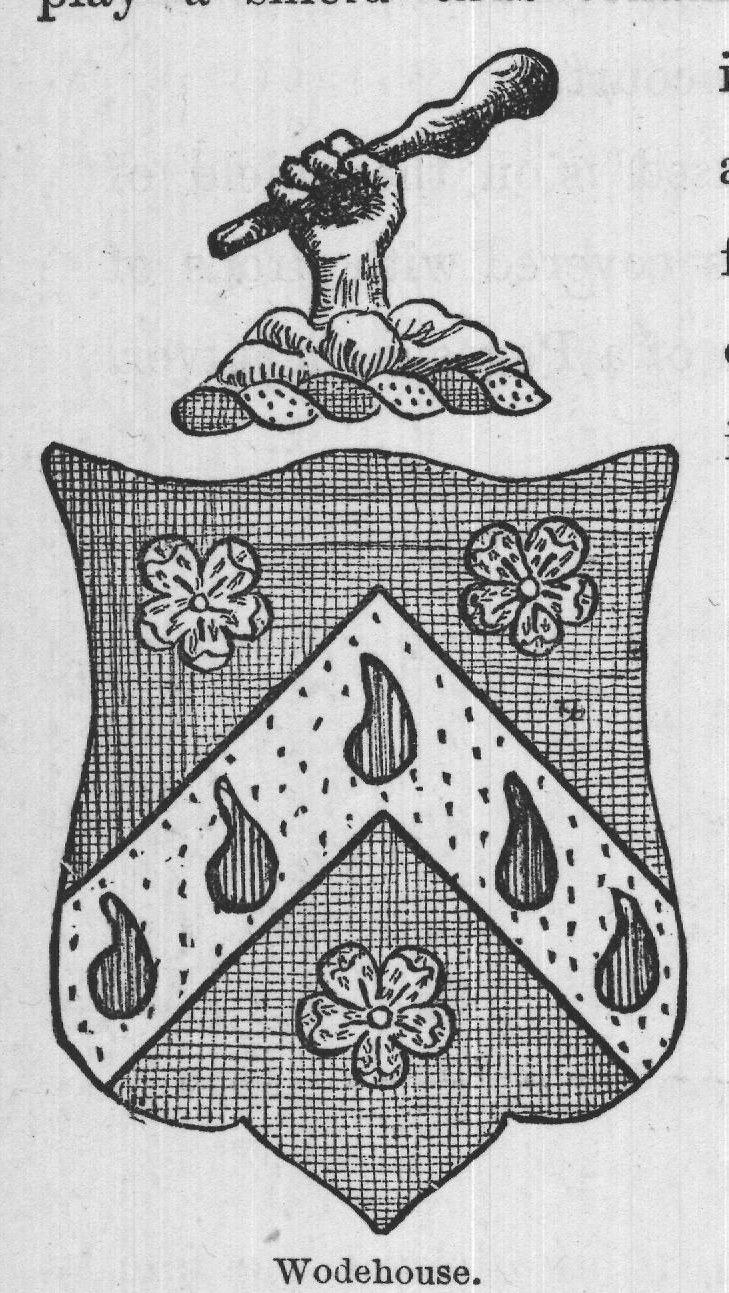
Another queer-shaped object is the Goutte, or drop. It varies in color according as it represents blood, tears, or pitch. The Duke of Anjou, King of Sicily, is supposed to have been the first to display a shield thus ornamented. He lost the sovereignty of that island, and soon after his loss appeared at a tournament bearing a shield of mournful black, - over which were sprinkled drops of water to represent tears, indicating his grief and his loss. Wodehouse.
Occasionally when besieging a fortress, and trying to scale or undermine its walls, the soldiers would be unpleasantly surprised with showers of boiling pitch. Should they, at such times, prove themselves valiant and successful, they were allowed to spot their shields with drops of black, to prove their bravery during such a trying ordeal.
This is one of the legends that hang about the glories of the victory at Agincourt, where the English defeated a force that was four times their number. John Wodehouse was a soldier, and one of the equerries that attended Henry V. in this battle. So heartily did he fight for his king that day that the monarch's attention was called to him in a very marked way, and, when distributing the rewards at the end of the contest, he highly honored the worthy soldier by giving him a large annuity, and raising him to the rank of Steward of the rich Duchy of Lancaster, which yielded him a salary that was quite a fortune in itself; and then assigned him as a crest the hand and club, with its motto, "Frappez fort," or, "Strike home." The blood drops or gouttes, on the chevron, were also Drayton. added as memorials of those he shed at Agincourt.
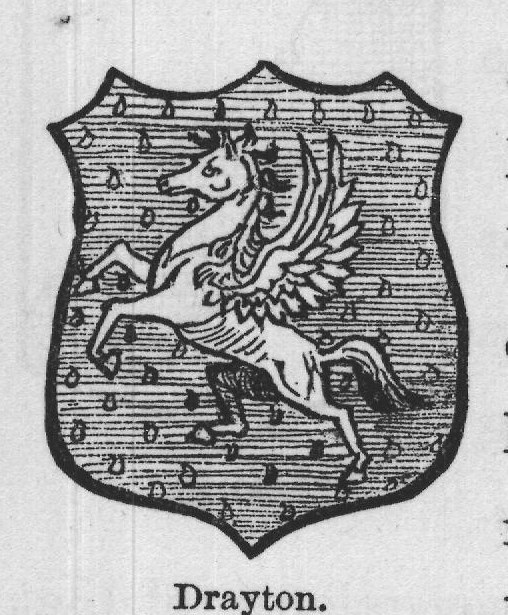
Another instance where gouttes were used is on the shield of Drayton, the poet, where the blue shield is covered with drops of water. Upon the shield is a representation of a Pegasus, in silver.