Home › Debasement of Knights. - Tournaments › Debasement of Knights. - Tournaments
Debasement of Knights. - Tournaments
ANOTHER shield on which you see an honorable augmentation was one of earlier date. It was during the time that Robert Bruce was the idol of his nation that this prized gift of a part of the royal arms was given to a daring knight, who, at the risk of his own life, rescued an imperilled sovereign. All day long the battle of Methven had been raging, and late in the afternoon the Bruce, seeing that where the fighting was the most severe his men were beginning to waver, spurred to rally them by his magical presence. The ranks of the enemy closed around him, and the dashing leader found himself most unexpectedly a captive. Loud were Seton. the shouts of the victors, and in scornful derision they called "Who will help the new-made king?" "I," was the fearless answer, and with a mighty effort Sir Christopher Seton cut his way into their very midst, beating down the astounded troopers on every side. He reached and seized his king, and, repelling every effort to detain him, succeeded, though covered with blood, in bringing him back in safety. Robert Bruce was not one to forget so noble a deed of self-sacrifice, and he gave him his own sister as wife. He also permitted the Scottish Tressure to be placed upon his shield. The knight, now so SERVA Hay.
TINY Lane UGUM Strathmore DEBASEMENT OF KNIGHTS. - TOURNAMENTS. closely connected by marriage with him, daily became more dear to the Scottish king, and when the news of the cruel death of "the good Sir Chrystal," in London, reached him, he was overcome with sorrow. The tidings were brought him whilst riding through the open country, near Dumfries; and upon a little hill overlooking the spot where the messenger delivered his melancholy news he ordered a little chapel to be built. He also founded a priory, the monks of which were to offer every day a prayer for the soul of the departed knight. The augmentation can now be seen on the arms of the Setons of Abercorn.
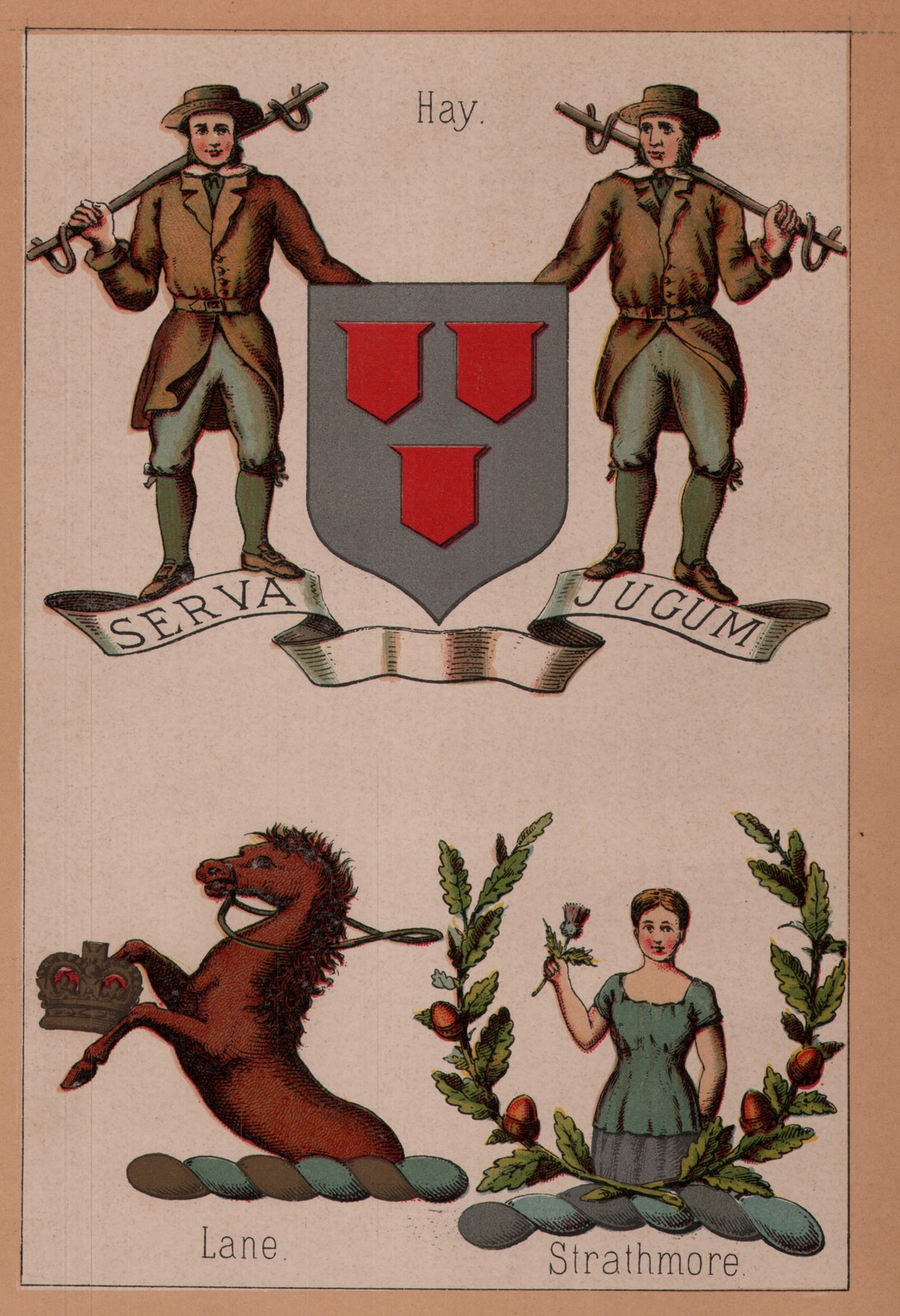
Occasionally, a woman, even in those days, brought glory to her father's name, as in the case of Jane Lane, of Staffordshire. She is connected with the fortunes of poor Charles the Second. This prince, during the course of his chequered career, had now and then an opportunity when he could, without stretching the point too much, bestow a favor upon a loyal subject. One such arose when, hopelessly defeated in the fight at Worcester, he took refuge with a family of Lanes in the neighborhood of the battle-field, whose hearts beat loyally for the luckless king. A lady of this family, whose name was Jane, pitied his forlorn condition, and offered to conduct him to Bristol, from whence he could without much difficulty find his way to the seaboard, and thence set sail for France. This daring proposition the king, after some hesitation, accepted. Staining his face with walnut juice, and with his hair already cropped short, he was, to a very great extent, successfully disguised, but the plucky dame had a suggestion or two still to make as she unfolded her plan of proceedings to him. He was to assume the coarse dress of an ordinary yeoman, and as her attendant accompany her on horseback to Bristol, where she announced it as her intention to pay a visit to some old friends. Thus dressed, and mounted upon hardy ponies, they started on their perilous trip. Many a moment of sudden terror, when the heart leaped to the throat, and the pulse stood still, did they have. An unusual stir in the hedgerow, an unwelcome meeting with wayside passengers, a question asked and the necessity of a natural and ready answer, the need of a perfect control over their features at all times, a careless loitering along the roads under a possible scrutiny, and a flying like the very winds when certain of seclusion - surely the loyal heroism of such a daring heart deserved a kingly recompense! At one time the king's mare cast a shoe, and they were forced to stop at a village blacksmith's to have the animal reshod. As the king stood by his horse he nonchalantly asked what news there was. "Ah," said the smith, "none that I know of, save the good news of beating those rogues the Scots." The king then inquired if none of the English who had joined the Scots had been taken. "Some few, some few," was the answer, "but I don't hear that rogue Charles Stewart has been taken yet." The king was mounting his horse at this moment, and as he rode off, remarked that if that rogue were but taken he deserved hanging more than all the rest. "Sure enough," echoed the stalwart smith, "you speak like an honest man!" Arrived at the house of the friend, to visit whom had been the pretext of the journey, Jane hurried her companion into his bedroom saying that he was "a neighbor's son, whom his father had permitted to ride before her in hopes that he might be the DEBASEMENT OF KNIGHTS. - TOURNAMENTS. sooner relieved from a quartain ague, with which he had been sorely afflicted, and from which he was not yet free." A physician unfortunately happened to be staying in the house and with merciful intent he slipped quietly up to the room of the suffering youth, hoping to be able to relieve the difficulty. The king spied him as he entered the room, and in an instant was under the curtains of the bed, so that when the good doctor approached to feel his pulse, the king lay completely in shadow. Drawing a chair beside the bed, he asked the patient many questions, and then, in perfect ignorance of the identity of the visitor, descended to the parlor to tell Miss Lane what he had done, and to give her an encouraging report of the invalid's condition. He also advised her as to what remedies she should use if another attack appeared. 'Twas evidently best for the king to leave as soon as possible, and this, with many thanks for her kind protection, he did. By a circuitous route he finally succeeded in reaching the English Channel, and passage was secured for him in a vessel bound for France. When once again reinstated in the royal palace in England, he did not forget the devotion of Miss Lane. Amongst many other benefits conferred upon her was the right to bear the arms of England in one corner of her family shield, and with it a motto and crest, the crest being the head of a bay horse, with the royal crown between his forelegs.
Such were some of the varied rewards given to loyal and brave knights by the monarchs whom they served. But there is another side to this pleasing picture. What if a knight should prove a miscreant, should be guilty of treason, should refuse quarter to an enemy who cried for mercy, or be guilty of other foul and unknightly deeds? Then, oh woe worth the day! with his plighted faith broken, and his honor forfeited, the unlucky wight was placed upon a raised platform in full view of all spectators. There he was stripped of all his knightly armor, which was then broken to pieces before his very eyes and thrown a ringing mass at his feet; all but his spurs and shield. The spurs were cast upon a dunghill, and the shield, fastened to the croup of an old worn-out cart-horse, was dragged in the dust through the thoroughfares of the town. Even his guiltless charger had to suffer in the ignominy of his master, and this he did by having his tail cut off. At this point the herald-at-arms called thrice, in stentorian tones, "Who is there?" Three times the name of the degraded knight was given in answer, and the herald-at-arms then exclaimed, "No, it is not so, I see no knight here; I see only a coward, who has been false to his plighted faith!" As he said this, the former knight was dragged from the platform to the ground, placed on a litter, and carried as dead to the nearest church, where he was obliged to listen to the burial service for the dead, as it was read over him. He, having now. quite lost his honor, was regarded henceforth amongst knights as only a corpse. Such a ceremony very rarely occurred, but occasionally a knight has been degraded. Some years ago the banner of one of the knights of Bath was torn down from its proud place with the others of his order, hanging in the Chapel of Henry VII. in Westminster Abbey, and kicked into the street. The knight was named Sir Francis Michel, and, having been found guilty of sundry unknightly practices, was T DEBASEMENT OF KNIGHTS. - TOURNAMENTS. sentenced to a "degradation of honor." He was therefore brought by the Sheriff of London to Westminster Hall, and there, in the presence of the high officers of the College of Arms, the sentence passed by Parliament upon him was read. The lesser officials of the college then hacked off his spurs, took his sword from him, and, raising it high above his head, snapped it in twain, and threw the broken pieces in different directions from him. Then the First Commissioner proclaimed with uplifted voice that "he was no longer knight, but a scoundrel knave." In the time of George the First, one of the great Dukes of Ormond was, after receiving many honors, attainted of treason, and the ceremony of degrading him from his position took place at Windsor Castle. These rare but notable punishments, falling upon unworthy knights, served to keep the standard of knightly duty high, and the prominence of the degradation as given, by its infrequency, intensified the impression received by the beholders. It is said that in early days a penalty was attached to all such knights whose arms having been disgraced, ventured to present themselves at the lists seeking admission. They were seized and set astride, not of a gayly caparisoned steed, but on the barrier fence that surrounded the field, and from this circumstance arose the expression of "riding a fellow on a rail." These were the gala days of tournaments and jousts, as well as the bloody ones of war. All literary ambitions were confined to the monastic orders, and, few nobles being able to either read or write, the ambition of every chivalrous soul was to build up a name for himself, or to increase his fortunes, in battle or on the tournament field. When wars were lacking, tournaments and jousts were instituted by the sovereign as a means by which the martial skill of faithful servitors was kept from deteriorating, and, although personal rancor occasionally gave a sharper edge to the blades of the contestants, still the tilts and jousts were usually made in a friendly spirit, and were regarded chiefly as opportunities in which to display superior military talents and thereby win additional renown. In Germany, where the tournament first originated, the early history of this pastime shows that it was not then the usually harmless, entertaining display of feats of bravery that it became in later years, especially in France. The Germans were a warlike nation, and their men of iron, really almost barbarians, met in the tournament simply to measure their savage strength, and in the violent shocks with which they met each other, and in the headlong manner in which each strove to prove his claim to superior skill and force, many a knight was dashed from his horse and hewn or trampled to death. At one tournament alone, no less than sixty combatants are believed to have bitten the dust. But in more courtly days the tournament broke in most acceptably upon the tedious days of peace, and heralds frequently passed from country to country, announcing the approach of jousts about to be given, and inviting all ambitious knights to present themselves at the proper time. The tournament is not quite the same as a tilt or joust. The latter were simply single hand-to-hand combats, but a tournament might comprise them all. It could also include what is called a passageat-arms, where the attack and defence of a narrow path or military position was simulated.
At these tournaments it was optional with the knights them- DEBASEMENT OF KNIGHTS. - TOURNAMENTS. selves whether the conflict should be one where death alone separated the combatants, or whether it should be simply a display of knightly skill. Was it to be of the more severe form, then the knights touched the shields of those with whom they wished to fight with the point of their lance, otherwise only with the handle. In this latter case blunt-pointed instruments were provided, but even then occasionally death ensued. At first these pastimes were held in the open field, but afterwards lists or barriers were put up, and the space enclosed was limited to about sixty paces one way and forty the other. The ground was levelled and made as perfect as possible for the manœuvres of the knights. Two doors were placed in the barriers, one in the east, and one in the west, and barred to the height of seven feet, or more, so that a horse would be unable to leap over them. Four days before the tournament was to take place, the arms of the knights who wished to take part, and whose right to do so had been thoroughly investigated by the herald, were displayed in the lists. Should any lady, as she passed from one to the other, find the arms of a knight who, for a good reason, she deemed unworthy to appear, she had but to whisper the fact in the ear of All Au- Each thority, and the knight was bidden to remove his arms. champion had his own pavilion, oftentimes most gorgeous in color, and upon it were placed his arms, his banner, and his banderoles, so that the lists must have presented a most brilliant spectacle. The scaffolding and raised seats prepared for the ladies and nobles were rich in hanging tapestries and embroidered clothes of gold and silver, whilst in the most conspicuous place was a canopied dais, intended for the occupancy of the sovereign and his court, or of some beautiful peeress, styled the Queen of Beauty. The splendor of the occasion was increased by the dress of the heralds, whose tabards, or surcoats, were always rich in color and decoration. So dazzling was the sheen of the helmeted knights, so brilliant the gay trappings of their chargers, and so stirring the sound of the trumpets, and the sight of the waving pennons, why, I should not wonder, children, if even your republican principles would, by a most inexcusable weakening, have made their owners infamous on such an occasion. But even if you failed to admire so much sparkle and beauty, I am afraid you could not have resisted a smothered laugh at the appearance the horses presented. The knights themselves were well protected by their chain or plated armor, but how about their steeds? They must be shielded in some way; so when not covered with steel, - and very naturally armor made their movements clumsy and difficult, - their flanks were covered with great bundles of hay or straw, tied together and fastened to the pommel. To protect their breasts, monstrous crescent-shaped bags were filled with straw and placed so as to dangle from the horses' necks. Over these most splendidly embroidered housings or trappings were thrown to conceal the paddings; but even with such ornamental mantles the poor beasts must have presented a strangely developed aspect, as, with their riders on their backs, they half waddled, half pranced into the arena. The knights themselves looked little better, for their helmets alone are said to have often weighed sixteen pounds, but the martially educated boys of that age failed to see anything but grandeur in the scene, and those of you that would not have laughed at it would perhaps DEBASEMENT OF KNIGHTS. - TOURNAMENTS. have felt as young Bayard did, that young chevalier, sans peur et sans reproche. This famous knight, when only about sixteen, felt his heart glow within him at the news of an approaching tournament which was to take place near the castle of his patron, in whose family he was being trained for the knightly career he had chosen. He longed to be one of the contestants, and all dissuasion served but to heighten the desire. Aided by a friend, he succeeded in coaxing a close-fisted old uncle of an abbot into equipping him properly for the tournament, and then, stepping boldly into the lists, he touched the shield of the oldest and best-known knight on the field. In this encounter he acquitted himself so well that he astonished all spectators, and drew forth the admiration of the very king himself, who happened to be present. After the tournaments had closed with a " lances aux dames," and after resting and refreshing themselves, the knights joined the gay company of nobles and ladies who had been spectators during the day, at a grand entertainment, and there, after feasting and dancing, the prizes for the greatest feats of valor were presented to the fortunate knights, either by the Queen of Beauty, or by other fair ladies of the court. Tournaments were usually given by sovereigns upon the occasion of a royal wedding, or at the birth of a long-looked-for heir, but could be given by nobles, and for various causes. In England, tournaments were conducted upon a scale of great magnificence, but the site usually selected for such displays was one the name of which will hardly suggest a gorgeous pageant; and yet the noble Queen of England, as well as the members of her royal family, and the highest peers of her realm, owe much of their 4 stately presence, if not their very existence, to this spot! Perhaps some of you have visited London already, and have walked through the enormous markets which cover the once famous Smithfield. Long years ago this field was dedicated to the pastimes of the day, and in later years many a heroic soul has there received a martyr's crown, forged in the flames of the burning stake.
In England many gorgeous tournaments were held, and during the reign of one of the Edwards, one was given by the king that lasted not less than fifteen days; as for Queen Bess, she fairly intoxicated such of her fortunate subjects as were able to look upon the novel scene, by holding one during the evening, when torchlight was required to take the place of the glare of the midday sun. Her Majesty's grounds surrounding the Palace of Westminster, was the spot selected for the tournament, and to it came the Earl of Essex with twelve knights, all clad in satin white as snow. After him entered, as his opponent, the Earl of Rutland, followed by twelve of his retainers, dressed in blue. Another great tournament was held in London by order of the king, where this time sixty knights were present, accompanied by sixty noble ladies. The tilting was to last two days, and upon the first day selected, it must have been a pretty sight to behold these sixty knights, attached by silver chains to the palfreys of their fair/ escorts, issuing forth from the Tower of London, and parading through Cheapside to the lists in Smithfield. The tilting was to be with blunt lances, and the prizes offered were a rich crown of gold and a massive golden clasp. These were the prizes offered for the knights; those offered for the squires, who were to tilt DEBASEMENT OF KNIGHTS. - TOURNAMENTS. upon the second day, were to be a courser saddled and bridled, and a falcon. Heralds had been sent before to proclaim this tournament in England, Scotland, Hainault, Germany, Flanders, and France, and I know not how many other countries. As the result, many were the knights who appeared before the lists. At the close of each day's tilting, a grand supper was given by the king to all the knights, and dancing made the nights merry. Finally, when the tournament was ended, the king invited his foreign guests to the royal castle at Windsor, and there entertained them with great magnificence. In an old romance of Richard Cœur de Lion, the king is represented as being desirous to ascertain who were the bravest knights in his dominion. For this purpose a tournament was proclaimed, but only English knights were invited to participate. Unknown to all, Richard determined to enter the lists himself, and gain the knowledge he wished by personal experience. Therefore, three times, in different disguises, he challenged certain of the knights who seemed to possess the greatest amount of military address. The armor assumed in his first adventure was black, so was his horse, and the device chosen by him was a raven with his beak open, as if weary from a long flight, and had a bell suspended from its neck. The bird represented patient endurance, and the Church, which it was the highest duty of chivalry to protect, was symbolized by the bell. He next appeared in red armor, and rode upon a bay horse, and this time his device was a red hound, with his tail trailing on the ground. This showed his wrath against the "Paynim hounds" who profaned the Holy Land. In his third appearance he was mounted on a snow-white charger, his armor also was white, and a red cross appeared on his right shoulder; the crest of his helmet was a dove, the well known symbol of the Holy Ghost. How he succeeded in his first joust we are not told; but "in his second disguise the king attacked Sir Thomas De Moulton, who, provoked by his repeated assaults, dealt him so desperate a blow that Richard thought it prudent to retire quickly to the wood." In his third enterprise he encountered a knight who proved himself to be one of equal prowess with himself. When the tournament was ended, the king disclosed himself to these knights, explaining the motive that had prompted him to enter the lists, and desired the nobles to bind themselves by a solemn oath to be his true and faithful brothers-in-arms, and to accompany him on a secret expedition to Palestine. In Scotland the spot usually selected for these military sports was under the Castle Rock at Stirling. The king, as well as his nobles, frequently took part in the game. A high rock overlooking the lists is even now styled 'Ladies' Rock,' it being the place where, dressed in gala attire, the ladies of the court sat to view the proceedings. But the tournament which, of all others, probably threw the greatest glamour of romance about this popular pastime, is that about which so much has been written and sung-the Field of the Cloth-of- Gold. This was the outgrowth of an idea of Cardinal Wolsey then at the very height of his power, who hoped by means of this to accomplish a political end he had in view. He was extremely desirous that Henry the Eighth of England and the courtly Francis the First of France should meet and discuss certain matters of much importance. matters of much importance. To do this he planned a tournament, to be held near the little town of Guisne in France. DEBASEMENT OF KNIGHTS. - TOURNAMENTS.
Both monarchs approving of the project, invitations were sent out through the length and breadth of Europe. The very flower of all European nobility took part. No less than twentyeight hundred tents were put up for the use of such spectators as came from England alone; but even this protection, in addition to that which the small town, then belonging to England, afforded the visitors, such multitudes flocked thither, not only of barons, knights, and squires, but citizens, peasants, Jews, pedlers, and rogues, that they considered themselves fortunate if but a bundle of straw could be secured, on which to lay their heads. Many of the courtiers, so we are told, who accompanied the sovereigns, endeavored to rival their masters in sumptuous equipments. To such an extent did they carry their efforts "that many bore thither their mills, their forests, and their meadows on their backs," fairly impoverishing themselves by their desire to shine beyond all others at the great pageant. The lordly pavilion occupied by King Henry was one of Oriental magnificence. In its construction he employed nearly a hundred of the most skilful workmen from Flanders and Holland. It was built of wood, a hundred and twenty-eight feet square, with an entrance gate on one side, in front of which was a superbly gilded fountain, surmounted by a statue of Bacchus. From various pipes at its base issued forth all kinds of wine. Its motto, written in letters of gold, was, "Make good cheer who will." On the other side of the entrance was a column supported by four lions, and on its apex was a flying Cupid armed with bows and arrows. Then in front of the palace was a monstrous figure of a savage, wearing the arms of his race, and carrying the blunt motto chosen by Henry the Eighth : "He whom I back wins." The inside of this pavilion was hung with tapestry of the very richest design, and the mass of silken and jewelled embroidery used as additional decoration made it gorgeous in the extreme.
Francis the First erected a tent whose outside was hung with cloth-of-gold, this giving the name to the tournament. Inside it represented a sphere, with a ground of blue velvet, studded with stars like the nightly firmament. At each angle of this pavilion was a similar, though smaller one, also richly decorated. As to the ladies who brought their beauty to the scene, one worthy old chronicler, after a long and wearisome description of the daily tilts, declares that "to tell the apparel of the ladies, their rich attire, their sumptuous jewels, their varied beauties, and their goodly behavior from day to day since the first meeting - I assure you ten men's wits can scarce declare it."