Home › Decorations Taken from Other Sources › Decorations Taken from Other Sources: France
Decorations Taken from Other Sources: France
But so long as there are Frenchmen left to "charge for the golden lilies upon them with the lance," so long will France continue to give the lie direct to any envious Briton "who, behind his skulking leopard shield," denies the heavenly gift to France! For many years this coat-of-arms of France was quartered upon the English shield, and it was not until even so late as the birthyear of this century - when the arms of England, Ireland, and Scotland were finally united -- that the right to wear the French arms was resigned.
The fleur-de-lys has been considered an emblem of the Trinity; and this, perhaps, was the reason why it was afterwards used, and still continues to be, as an ornament in the crowns of almost all Christian sovereigns.
The Planta Genista, too, must not be forgotton, as the name of one of England's most famous royal families was found in this little plant.
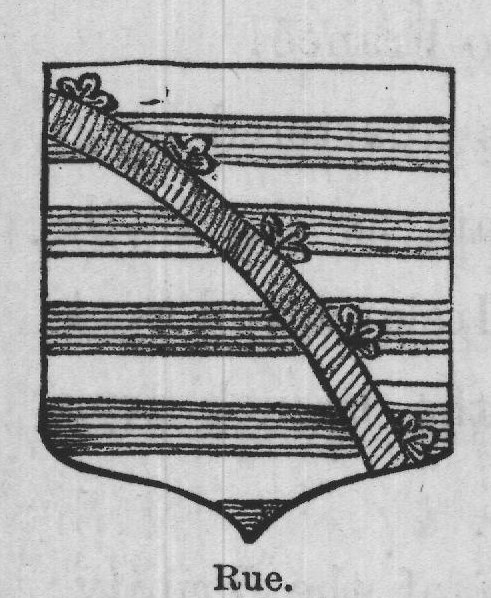
The father of Henry II. of England was Geoffrey of Anjou, a devout Catholic and a brave knight, - but, being mortal, he did not always "resist the devil" as he should have done, and, listening to his evil counsels, the good Geoffrey found his conscience growing to be a terrible companion during wakeful nights. The crime which caused these burnings and prickings within him finally became so heinous in his sight that, making birches of green broom, he would ever and anon severely flagellate himself with them. Then, that all men might see how sincere his contrition was, he placed a branch of it in his helmet and wore it for his crest. His son Henry, honoring the Christian spirit displayed by his father, adopted it for his device; and thus originated the line of kings known as "Plantagenets." Another blossom favored by royalty is rue. Upon the coat-ofarms belonging to the Prince of Wales is a small inescutcheon belonging to Saxony. Over this inescutcheon is thrown a wreath of the plant called rue. How it came to be there, we are told, was through the goodness of Frederic Barbarossa. When this powerful individual conferred upon Bernard the dukedom of Anhalt, the duke begged the emperor to place some mark upon his shield that Rue. would distinguish it from that of his predecessors. So Frederic, being in a friendly mood, took a wreath of rue that rested on his head, and dropped it over the shield. From that time it became part of the arms of Anhalt, and is borne by the Prince of Wales as an inescutcheon upon his arms.
The flower chosen by Scotland is the Thistle. The Danes were a constant nightmare to the Scots of early days. Just when they were least expected did they suddenly appear before some exposed seaboard fortress or helpless town, pillage and burn it, and then, with their booty, and promises of speedy return, vanish across the stormy seas that separated the countries. It was during the reign of King Malcolm I. of Scotland, in the remote days of the eleventh century, that a band of these bold marauders stealthily dragged their boats up the rocky shore of eastern Scotland, and, hiding themselves in the caverns and grottos, awaited a favorable night for a sudden attack upon a large and well provisioned fortress in the neighborhood. Such a night soon came. There was no moon, and heavy clouds hid the stars. The band were quietly collected together by the chief, and the path leading to the object of their visit was swiftly and silently traversed. Then, armed with scaling-ladders, and their weapons ready for use, they felt as though they could almost raise the cry of the victor.
The moat alone remained for them to swim across, and not a guard appeared to be awake; the whole garrison lay in tranquil rest, and the invaders crept cautiously down from the bank into the moat, ready to softly plunge into the water the moment the first cool drops should lap their naked, unrighteous legs. So secure! quiet! But where was the water? Another cautious step downward, then another; - in an instant their own involuntary yell -- SO aroused the whole garrison every sentinel was at his post - t - lights were swung hither and thither, and with the burrs of the thistles, which filled the waterless moat, sticking and stinging in their feet, and showers of arrows galling them in front, the Danes were driven back to their boats, with as much slaughter as the darkness would permit.
The motto of the Knights of the Thistle is supposed to allude to this, "Nemo me impune lacessit" - "No one injures me with impunity." These are the flowers that kings and queens have delighted to honor. But there are other favored blossoms that Dame Heraldry has gathered for her adornment; such as the primrose, which, if not the darling of the throne, is at least a favorite with some of England's noble lords. Just now it has a certain queer odor, that suggests political caucuses, stormy electioneering processions, and visions of campaigns where lovely, audacious woman wins votes without number for aspiring candidates, as a return for lavishly scattered smiles and coaxing words of witchery. Another modest little flower calls our attention also in a peculiar way to itself, nodding as it does in the crest of a worthy Frenchman, whom Louis XVI. was proud to own as a subject. But, though worn by a Frenchman, it is a flower whose good points are daily discussed, not only by the polite of the earth, but by every strapping inhabitant on the green isle of Erin.
C If it were the stomachs, and not the hearts of all good Irishmen, that were to discriminate between the merits of the Blessed Shamrock, sacred to the memory of good St. Patrick, and the little potatoblossom, I very much doubt if the leaf would hold its own against the claims of the flower as the badge of Ireland. This year (1886), in the little French town of Montdidier, is to be held the centenary celebration of its introduction by Parmentier into France. Long after Sir Walter Raleigh had brought it to Great Britain, this Frenchman, M. Parmentier, tried to popularize the plant in France. But the Catholic clergy despised it as a proffered gift from heretical England, and the peasantry conceived the idea that leprosy was the sure result of too much indulgence in eating it. The courtly fops of the day made it the butt of many jokes, and it finally even became treason to plant it in French soil! But Parmentier, who was an insignificant apothecary in the king's employ, contrived to keep one of the plants alive in a pot in his room, and occasionally was so bold as to sport one of its blossoms in his button-hole. The king, happening to observe this one day, was curious to know the name of the singular-looking flower. He questioned the druggist, who, recognizing this as the supreme moment for his pet hobby, poured fourth such a stream of eloquence in praise of its many merits that the king issued orders for a royal potato-banquet, to which all the leading Parisian scientists should be bidden. They, with himself, should discuss the merits, by taste, of this much maligned and much praised tuber. The result was an instantaneous introduction of the vegetable upon all the tables of the epicurean fashionable of Paris. The king had pronounced it "good," and not a courtier was to be found who dared to differ from his sovereign upon that point. But the fear of "leprosy," and whatever other kindred notions the common folk had attached to the plant, were not so easily banished. Poor Parmentier, in his zeal, became "so thin that there was nothing left of him but just his bones and skin." Finally, he decided to purchase a large tract of land. This he planted with a plentiful supply of potatoes, and as the plants matured, and the day approached for the gathering-in of the harvest, he secured a body of gendarmes, and stationed them around the field. There they stood, from the moment that the sky began to redden in the east, until the sun sank behind the low hills in the west, bayonets pointed, and with grim countenances frowning at the over-curious crowd that gaped and gazed at the singular proceedings.
Parmentier's theory and the old proverb upon stolen pleasures १ being the sweetest needed but the night to be realized. No sooner had the shades of evening made recognition impossible, than the inquisitive and covetous crowd relieved the enclosure of every potato to be found in the soil. The plant became immensely popular, and the king honored his persistent subject by bestowing a title upon him, and also by permitting him to assume as his crest the flower for which he had made so protracted a contest. Trees, also, appeared upon the shield. The old oak upon the coatof-arms belonging to the Carlos family at one time hid a king, and we will have to relate how it did so.
The battle of Worcester had been fought, and the royal cause was not the victorious one as the sun began to sink in the western sky. King Charles II. strove to rally his troops, but the effort was so fruitless that he soon saw that, unless he chose to fall a prisoner into the hands of the rebels, he must fly with his retreating troops. This he did, hoping to reach the safe side of the border between England and Scotland. But daylight vanished, and his guide became confused; so a halt was called, and the Earl of Derby suggested to the king that, as they were on the edge of Staffordshire, they might find safety in Boscobel House, which belonged to a most loyal family, of the name of Gifford. He, the noble earl, had been before this obliged to test the hospitality of the noble old mansion whose name, Bosco Bello, was given it on account of the dense and beautiful woods which surrounded it. One of the Giffords was found, and separating himself, with half a dozen friends, from the army, they hurried thither, stopping for a short time on their way at an old house, once used as a sort of monastery by the Cistercian nuns, and called The Whiteladies, on account of the dress worn by the household. Here he rubbed soot over his face and hands, changed his clothing from that of his royal station to the common every-day dress of a house-servant, and would gladly have tarried long enough to refresh himself, but a scout brought in the unwelcome tidings that rebel troops were quartered not more than three miles distant. So, in a pouring rain, which even the densest portion of the forest through which it was necessary to go could not prevent saturating them to the skin, they tried to reach Wales; but, notwithstanding the forced night-and-day marches, they found every ford and every highway so guarded that escape, for the time being, was impossible. Now, foot-sore and heart-sore, and, altogether, in a most pitiable condition, they retraced their steps to the friendly shelter of Boscobel. Here they found Colonel Careless, who had been fighting in the king's ranks. He persuaded the king, after strengthening himself with a simple lunch of milk, bread, and cheese, to go back into the woods, as being a place of greater safety, and there, selecting a thick-leaved oak, the king, with Colonel Careless, concealed himself in it; while the Penderells, who were servants of the house, brought them such provisions as they could get, and a cushion for the head of the homeless monarch to rest upon. So careful and kind was the honest colonel that when, finally, they succeeded, two or three nights later, in making their way to the house of Colonel Lane, the king changed his name to Carlos, as being more like his own, and granted him a representation of the oak tree which had so perfectly concealed them, with a fesse across it, on which three crowns are placed.
In connection with this tree is a little incident told about the first coin of New England, which has been called the "Pine Tree Shilling." These coins were issued from a New England mint in 1651. When Charles II. heard that his enterprising colonists had started a mint all of their own, without asking or receiving his royal permission, this impecunious monarch was thrown into high dudgeon. Sir Charles Temple, a good friend of the colonists, tried to appease the king's wrath, assuring him that the struggling Puritans had thought it no harm to coin money for their own usage; and taking a few of the shillings from his pocket, showed them to the king. He looked at them, and noticing the tree stamped upon them, inquired what it was. "That," was the adroit reply, "is the Royal Oak that saved your Majesty's life." The king looked more closely at them, listening the while to such explanations as the friendly heart of Sir Charles could suggest; and then putting the coins, I have no doubt, into his own shrunken pockets, remarked, good-humoredly, that "those colonists were a parcel of honest dogs, after all!" The Wheat Sheaf is a very common device upon the shield of many families in the neighborhood of Chester. Old Ranulphe de Blondville, the first Earl of Chester, having adopted it, the family gradually growing in power and wealth, many other families became attached by feudal alliance to it, and assumed the device, with slight alterations. The Duke of Westminster, whose noble country-seat of Eton Hall, not far from Chester, is so well known to all travelling Americans, shows the sheaf upon his shield, he being a descendant of the famous Grosvenor.
Leaves of plants are also not despised, the trefoil and the cinquefoil often appearing as small charges - but especially does the leaf unfold itself upon such coats-of-arms as those belonging to the Levesons and the Hazelriggs.
DFCORATIONS TAKEN FROM OTHER SOURCES.