Home › The Pink
The Pink
THE word "pink" is another instance of a name applied to several quite different kinds of hulls and rigs at different epochs. The origin of the pink, like that of so many of the old types of vessels, is lost in the mists of the past. To a certain extent, naval archaeology is like palaeontology. Here and there, literally dug up by the student of marine science like fossil bones buried in the clays and drift of remote ages, are found representations of these old ships, and it is the work of many days and many minds to piece together these bits of evidence of the past, to assign to them their family, class, and specie, and eventually to reconstruct their entire origin and development. As often happens with fossil remains, many links are missing, so that we can only speculate as to how certain types came into being. The upper portion of the pink's stern was drawn out more or less behind the body of the vessel proper and usually terminated in a much restricted quadrilateral transom. Below, the planking curved sharply to the stern post. This form of stern gave rise to the expression "pink-sterned." A hull having this form of stern was not necessarily a pink, but without it, the vessel certainly was not a pink.
However diversely the name may have been applied, Lescallier, edition of l'an VI (1795), gives a definite representation of a vessel bearing the name with the following concrete verbal description: "Pinque (pink) Mediterranean merchant vessel having two masts a calcet (i. e., with the galley form of masthead (See Note 8, Appendix.)). And on each one of them an antenna or lateen yard, with a very small mizzen away aft. This vessel resembles, in its rigging, a xebec with lateen sails. But the hull is different in that the pink has a much less straight sheer, its bow is fuller and its underbody less fine, being constructed to carry merchandise. Besides, the pinks are not propelled by oars and rarely carry cannon." He adds that the Spaniards and Neapolitans in their merchant marine employ many pinks, their size ranging from two hundred to three hundred tons. While he does not mention the characteristic stern, his picture shows it plainly enough.
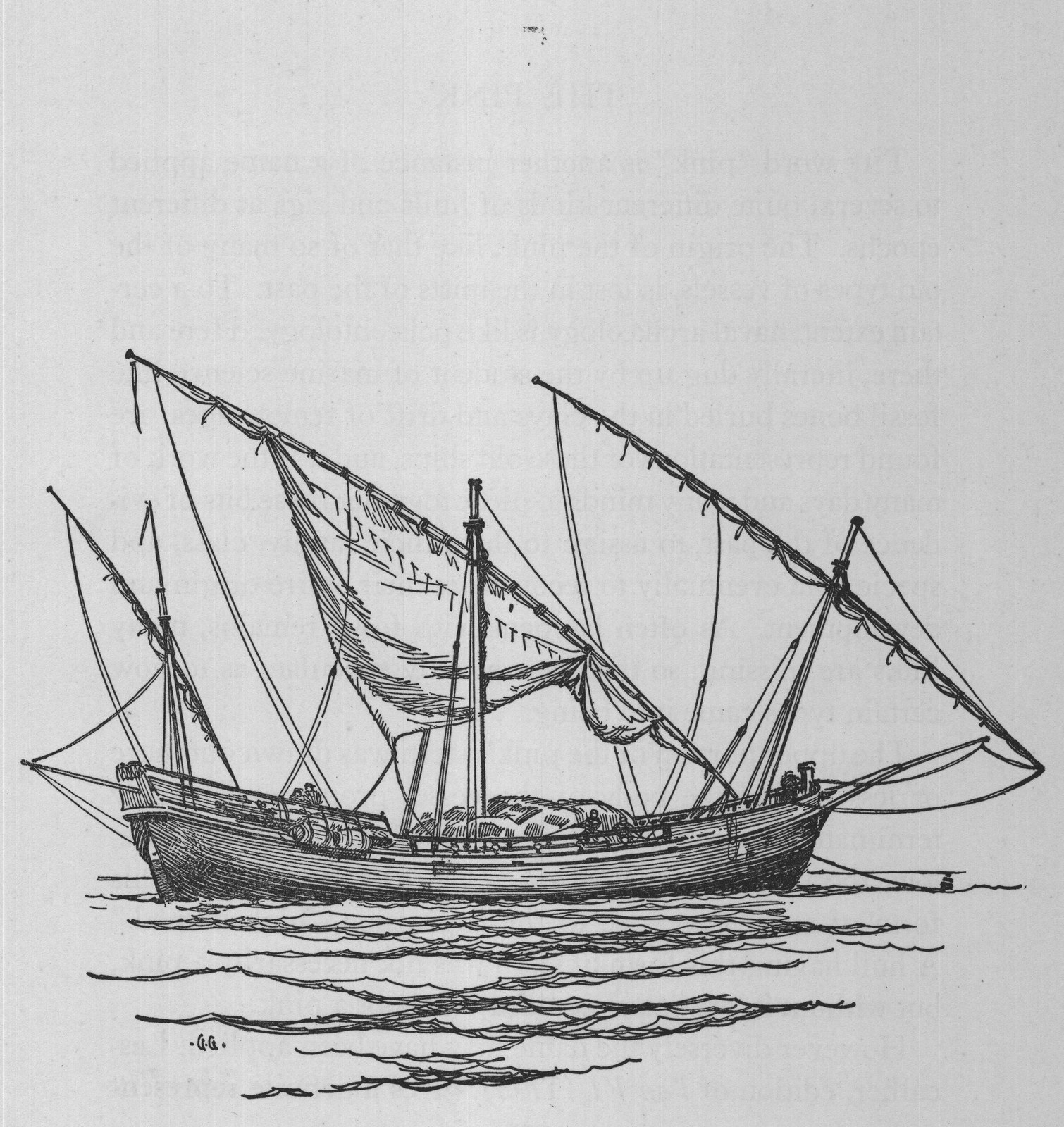
Other representations said to be also of pinks show them as differing entirely from the above-quoted description.
The mists of the past shape themselves into definite forms. Emerging like clouds, these old ships, themselves larger or smaller clouds of sunlit canvas, when the broad light of efficient and naturalistic artists in clear-cut fashion limn their shapes for us, sail on, slowly or swiftly, as their destiny bears them, passing again into the obscurity of oblivion over the changeless ocean of time that knows them no more.