Home › The Monuments of Rameses The › The Monuments of Rameses The: Nile
The Monuments of Rameses The: Nile
ONE hundred and fifty leagues of navigation, ascending the windings of the Nile, over the richest soil and the most densely inhabited territory on record in all time, along a double line of towns and cities led from the city of Phtah to that of Ammon.
In latitude 25° 34', the Nile, which, after entering Egypt, directs its course between the north and the northwest, suddenly doubles on itself and runs for many scores of miles toward the east-northeast, as though it would break its way through toward the nearest sea. In this space, the valley of the river, scooped out in a wide oval like an immense amphitheatre between its two parallel chains, presents one of those sites which seem predestined by nature to receive great communities of men.
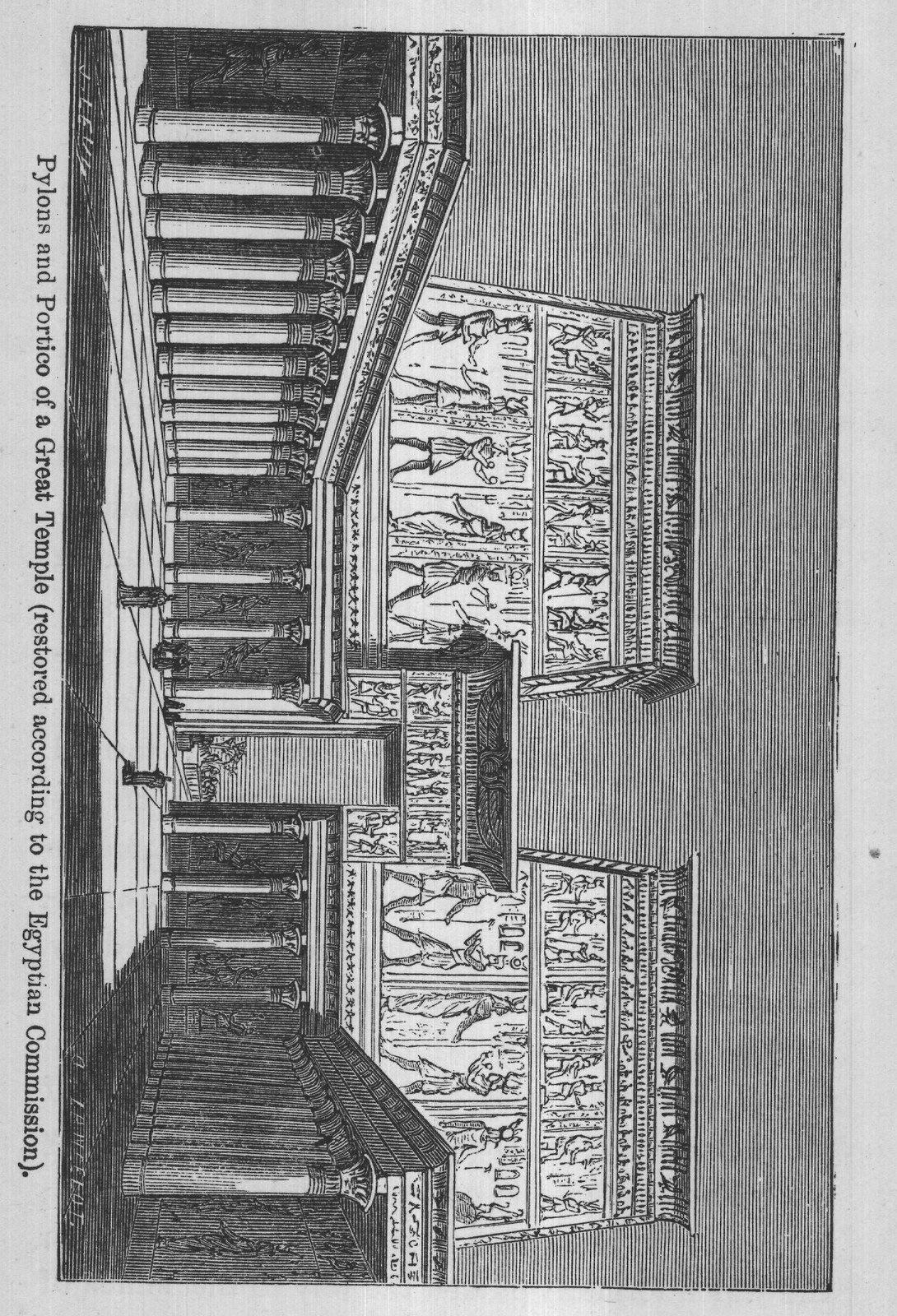
This is the point at which the lines of traffic from Africa and Arabia, of the more direct routes of the Soudan by the Oases, and of the Habesh by the Nubian tablelands, converge; it is the debouching centre of the wadys that lead to the Red Sea, and which formerly guided the way to the mines of gold, copper and emeralds in the land of the Trog- 7 Pylons and Portico of a Great Temple (restored according to the Egyptian Commission). lodytes: it was there that "No-Ammon was seated between the canals, having for ramparts the waters of waters." "There this instructress of the nations rested in her strength upon Ethiopia as also upon Egypt, and had the sons of Libya and those of Phut the boundless for her champions.”* There her scattered members lie to-day.
V.
WHEN, coming up from the North, the traveller has reached the projecting angle of the Libyan range which crosses the Theban plain upon that. side, he suddenly beholds unrolled before him one of the grandest spectacles that man can gaze upon here below.