Home › Rameses II › Rameses II: Mei-Amoun
Rameses II: Mei-Amoun
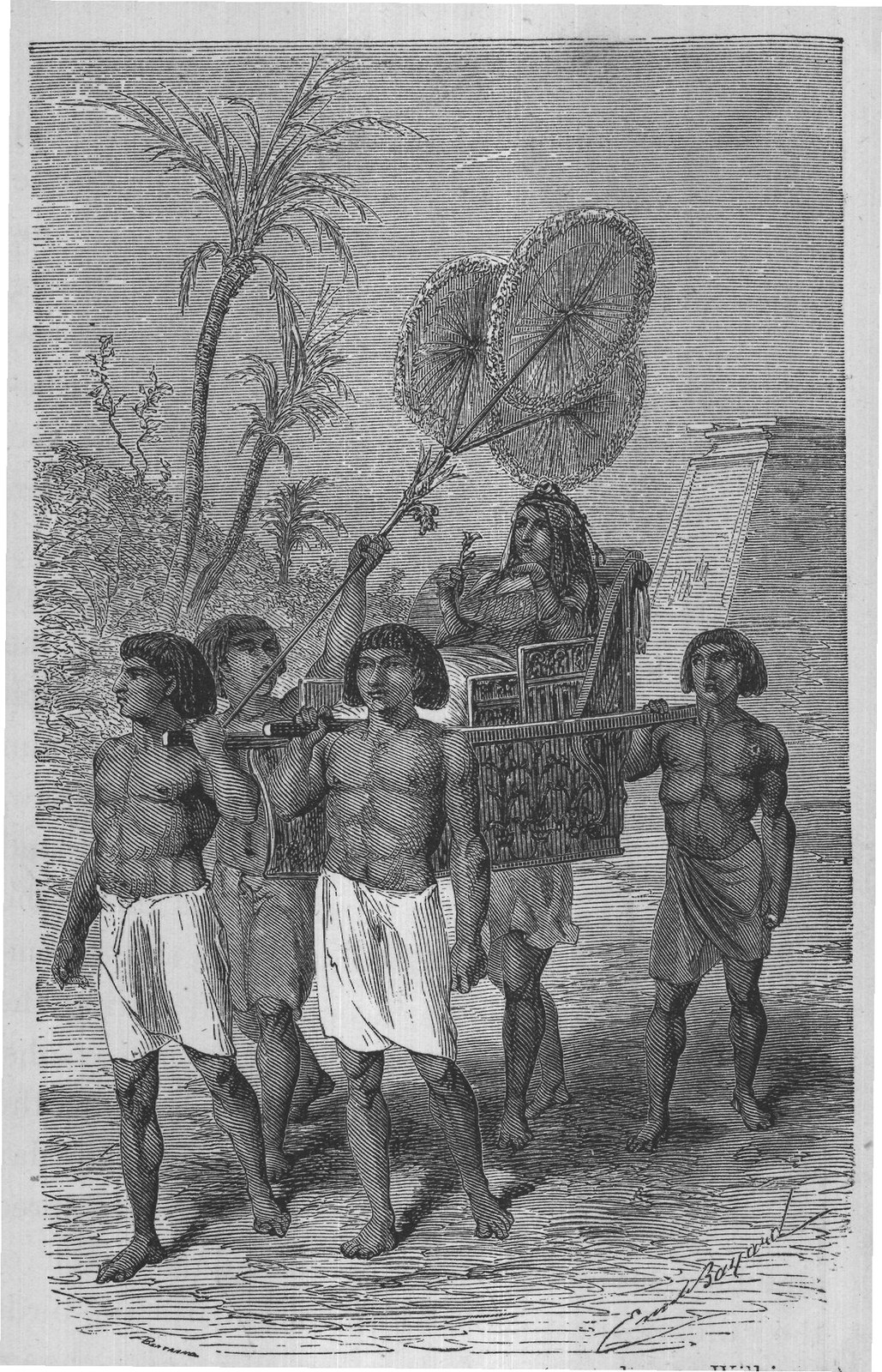
The Queen Nofre-Ari, the youthful companion of Mei-Amoun when he too was young, robed like him in rich and almost transparent tissues, of which India even then possessed the secret, and like him displaying about her black waving masses of hair, and in the many ornaments of her neck, her arms and her naked feet all that was most precious among the pearls and corals of the Erythrean seas and the emeralds of the Troglodytes, accumulated during the lapse of centuries in the treasury of the Pharaohs, followed her spouse in an elegant palanquin, the elastic hammock of which, constructed of fine flax and gold, seemed suspended to stalks of rose-colored and blue lotus. Above it, a broad dais woven of the rainbow-hued spoils of the most brilliant birds of the Tropics, threw forth coruscating, ever-changing shades and tints. Behind the Queen came on, in two parallel lines, An Egyptian Princess in her palanquin (according to Wilkinson). the princes and princesses of the blood, the vassal kings, and the dignitaries of the priesthood and the army. Detachments of the latter, regularly drawn up in line by platoons under their respective officers and standards, terminated the procession which even the long avenue of sphinxes and rams,* leading from the banks of the river to the main entrance of the temple, could not wholly contain. V.
In front of the sacred edifice of which the granite depths resounded with solemn and mysterious murmurs, the military music ceased, and the royal pageant halted.
The brazen gates, placed between two large pylons, gave passage to a long succession of priestly choirs advancing to the presence of Mei-Amoun; these were the local ecclesiastics of all the great temples in the Empire, and all the peculiar creeds of different places which time, conquest and the policy of legislators had made part of the system subordinate to Theban divinity. They brought the * Colossal stone statues of rams were used like the sphinxes to adorn the avenues of the temples. benedictions of their gods to the new son whom Ammon on that day adopted; nay more, they brought the gods themselves. Baris or barks sustained on the shoulders of groups of eighteen or twenty-four priests, according to the importance of the divine personage represented on the prow or the poop of each one of them, contained small naos or tabernacles carefully veiled with a thick tissue of silver and gold. There, hidden from the sight of every profane eye, were supposed to be stationed those renowned gods descended from the Vedic Aria upon the land of Kemi at successive and unknown epochs, viz: Ph-t-ah or Agny, meaning fire; Ph-Ra;* Jom; † Sevek; Asiri; § and those other local conceptions, half monster and half myth, which the pontiff teachers of Ethiopia had engrafted upon the coarse fetiches of the Cushites, the original inhabitants of the valley of the Nile, and which were all associated in divine families or households analogous to the great initial triad of Thebes.
As each bari filed along in its place in the proces- * An equivalent of Re, Ra, Ri, La, El, the Sun. † Om, Aom, Homa, the god of the Cap I Siva. & Asura. These were the Indian deities and titles with which the analogy of the Egyptian gods and goddesses is thus indicated. sion, in front of Mei-Amoun the priests who carried it mingled praises of the King in their hymns, attributing to him all the virtues of which their particular deity was, more especially, the type, the inspiration or the symbol: some extolled his sense of justice and his magnanimity; others his hatred of falsehood and his love for the good; these sang laudations of his wisdom and his prudence and their control over his passions, and those his strength and courage in overcoming his enemies.* VI.