Home › Egypt Before the Time Of › Egypt Before the Time Of: Phile
Egypt Before the Time Of: Phile
LA ANCELOT LALY The Temples of Phile (restored according to the Egyptian Commission). XII.
A DEEP ravine with steep declivities; a river in it studded with a labyrinth of small islands and sharp projections of dark granite constantly embrowned by the dash and the foam of the waves, marks the passage of this mountain chain across the Nile, and constitutes the phenomenon of the cataracts of Syene, so strangely exaggerated by classic antiquity, A little higher up than these rapids rises the Island of Phile where Egyptian mythology placed the tomb of Asiri, and where, in fact, seemed to terminate, with Egypt itself, the furrow of fertility which the river opens from that point to the sea.
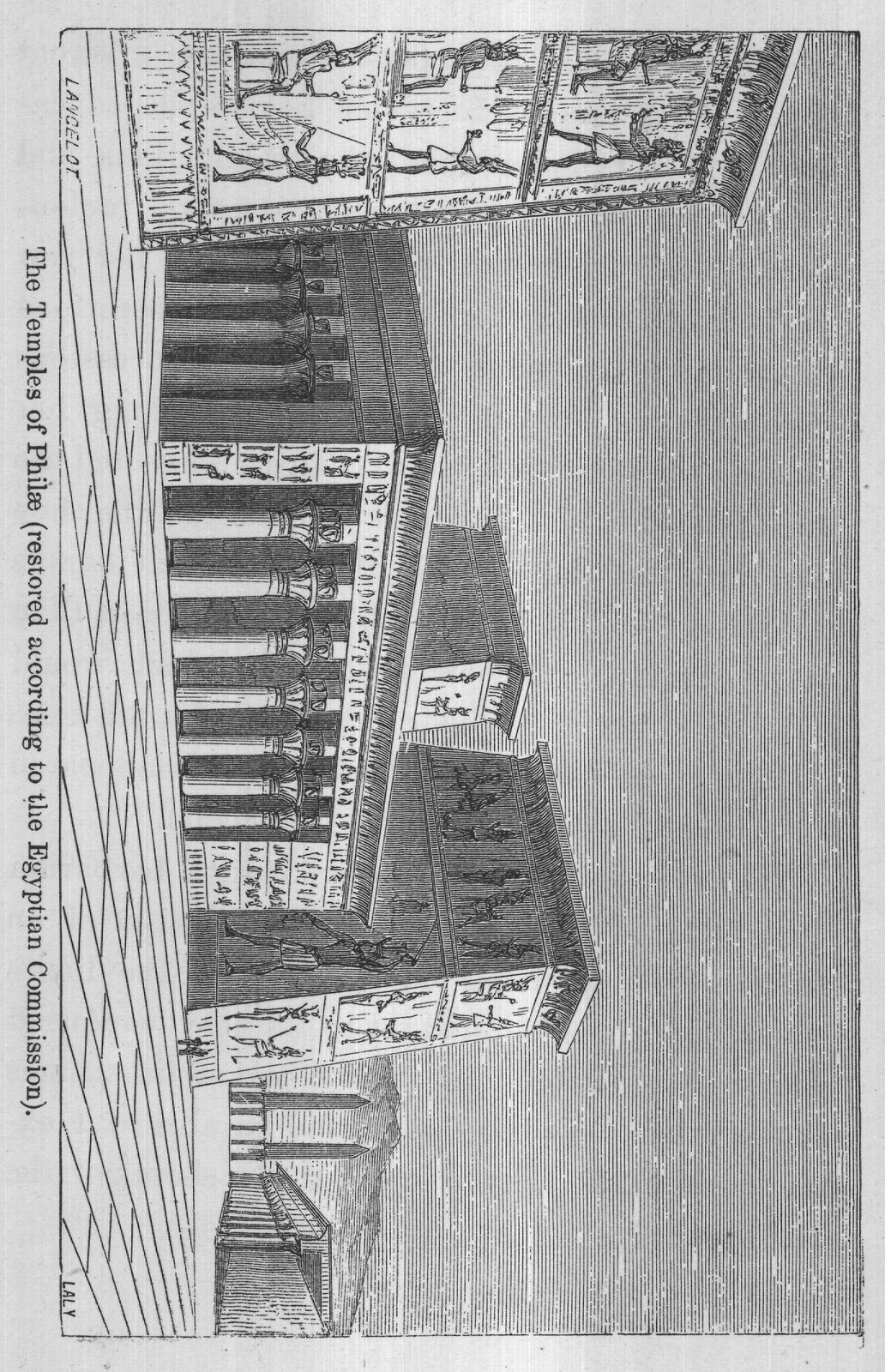
Upon both banks of the Nile, enormous masses of brown freestone and granite, of sombre and calcined hue, confused and upturned at their base, rise, like the chosen scene where Nephtis and Typhon, the gods of the desert and of chaos, had triumphed, and shutting in the horizon of the mysterious isle on all sides, contrast, in the most startling manner, with the white pylons and the regular colonnades that cover its surface. From this point to the Island of Say in Middle Nubia, this heap of rocks stamped with the seal of desolation, ascends the valley of the Nile, and encloses it with its abrupt acclivities, in such manner as to leave it only the aspect of a mountain torrent which at certain points is but a stone's throw across. A steep path painfully winds along its rugged slopes, and below, at their foot, are seen some narrow furrows of barley and dourah, with occasional clumps of date trees indicating a thin strip of cultivable land, which, a hundred times intercepted by jutting ridges of rock rarely attains more than 355 feet in breadth, and supports hardly one hundred thousand inhabitants, upon a surface of more than one hundred and fifty leagues in longitudinal extent. XIII.
YET, this poor country, this region of stones, as the Arabs call it, in their energetic idiom, -the Batn or Dar-el-hazhar, was the salvation of rich and fertile Egypt, in the days of Hycsos rule. It gave refuge behind its granite frontier to all the vanquished who had been fortunate enough to escape the sword or the yoke of the invaders. It offered them, in the jagged recesses of its rocks, temples for their gods, palaces for their princes, and rallying places for their warriors. All drank in from its rude hospitality the energy that they lacked, and little by little, it changed to thoughts of vengeance and the hope of return, the regrets they had bestowed on their lost country. The very insufficiency of the Nubian soil to support their number, augmented as it was, each day by fresh fugitives, strengthened their resolution. In order to subsist, they were forced to venture upon marauding expeditions into the country that they had not been able to defend. They had to creep stealthily toward it, through the wilderness, and, exposed to constant peril, to snatch away by dint of arms, a portion of the fruits and harvests that it lavished on the stranger. This Bedouin existence perforce accustomed the military caste to danger, and they were recruited by all who had a heart or an arm at the service of their destitution or their resentment. Partial successes developed courage and confidence; allies came to the Egyptians, undoubtedly, from the depths of Ethiopia, and, very probably, from the coasts of India; their expeditions, as they multiplied, became more regular in form and assumed a more general character; their warfare, from being clandestine and fitful became open and continual, until, finally, it took permanent foothold in all the passes that descend from the south into Egypt, recovering ground, step by step, from the Hycsos. Holy work! in which many generations were consumed and which was transmitted from father to son, for more than two hundred years.
The chieftains who, by reason of their descent from the ancient kings, or through services rendered to the common cause, were summoned to direct this great struggle, shared all its vicissitudes. At first mere chiefs of bands roving among the rocks and over the deserts, then sovereigns of Nubia and the Thebais, victory and national consent made them, successively, masters of the Heptanomis and of the lower course of the great river. There are many names, now the subject of dispute between authorities skilled in Egyptian lore who refer them back to still earlier times, which we think belong to the period and range that we are just describing. At length, when Ahmes, the founder of the eighteenth dynasty, uniting all the native forces of the Nile valley, entered Memphis in triumph, drove all the strangers beyond the river to their entrenched camp at Wara, and afterwards expelled them even from that; and when Amenoph, his son, completed their explusion from the territory of Kemi by fresh victories on the roads leading to Asia, these princes may have thought of reconstructing only the past, but, in reality, they set up a totally unknown order of things and ideas.
Upon the ruins of the old principalities of Thebes, Memphis and Fayoum, trampled out by the feet of the Hycsos, worn away and jumbled together by two centuries and a half of battles, they laid what was the real foundation of Egyptian nationality, the true groundwork of a new empire whose strong and stable unity was long to remain without a counterpart in the future, as it was without one in the past.
XIV.
SUCH were, for Egypt, the final consequences of her first struggle with the men of the north. History, which faithfully credits nations with the tears and the blood that similar crises cost them, and which does not always have the opportunity, as it has in this instance, to correctly estimate their prolific results, must record these with eagerness.
It is to this period of general revival, that we must also refer a fact, the date of which the ancients, failing to discover its origin in the historical ages of Egypt, have pushed back into the night of time, so as to do honor to Menes, a veritable sphinx to whom they committed the keeping of all the problems that they deemed impenetrable. We allude to the reform which substituted the warrior for the priestly caste, at the head of the hierarchy, and which withdrew the kings from the shadow of the temples and the tutelage of the clerical order, to centralize all power in them, and to make them, for a long series of generations, the representatives of all the energies of society.
In the system of the old legendary writers this reform can be explained only by some violent revulsion, or by a usurpation of rights revolting against rights acquired. In our opinion, it proceeded from the grand onward sweep of human affairs; it was ordained by the inflexible logic of events. The latter, in creating new duties, naturally displaced the rights of various classes, and, naturally also, bestowed the greatest share of privilege upon those who undertook the greatest share of responsibility.
Such were the men who, in the presence of the victorious stranger, covered with their bosoms and their swords the last asylums of their families and their gods, and repurchased a country for them at the price of their blood. Such men were preferred to those who, seeking refuge in the depths of their sanctuaries, had offered nothing to the cause but sterile appeals and vain speculations on the enigma of the world. common XV.
THE vital sap so superabundant in all nations in a state of social renovation, was with the Egyptians when they had become, in their turn, the conquerors of the Hycsos, in proportion to the time and the sacrifices that victory had cost them.
It developed, afterward, for centuries, from generation to generation, revealing itself, on all sides in striking displays; - at home by gigantic achievements of art or of public utility; outside, by incessant effort to expand in the most opposite directions the boundaries of the Empire, until the latter, at length, overflowed upon the world in civilizing colonies and in warlike expeditions which by ideas or by the sword, by trade or conquest, fertilized the soil where other races were to spring up and grow great in their turn.
If we are to believe the testimony deduced from the monuments, most of the sovereigns who, at that time, reigned in Egypt, had to contend not only against the barbarians of the north and of the south; to repel fresh attacks of the Hycsos, who could not make up their minds to abandon forever the grand prize that their fathers had won, and to hurl them back into the heart of Asia; but they had, also, to restore the majesty of the altar and the throne by re-erecting the temples and palaces destroyed by time and invasion, and to re-open by agriculture and by canals that should distribute the fertilizing properties of the Nile, sources of Egypt's territorial wealth. "In no country," wrote the last and the greatest of Egypt's conquerors, on this subject, " in no country has the administration so much influence over public prosperity. If the administration be good, the canals are well dug, well kept, the rules for irrigation are properly executed, the flooding is more complete. If the administration be bad, corrupt or weak, the principles of the system by which the country is watered are violated by seditions factions or by the interests of particular persons or localities; the canals are choked with mud: the dykes are poorly kept, and the entire nation suffers. Other governments have no control over the snow or the rain that falls in this province or in that, but in Egypt, it has a direct influence over the extent and character of the Nile inundations, which take the place of the showers and drifts that fall elsewhere." * Numerous attestations deduced from publi * Napoleon. Memoirs Dictated at St. Helena: Campaign in Egypt. monuments, and even from the tombs of private persons, agree in bearing witness that the sons and grandsons of Ahmes did not fall short of their mission as warriors and administrators. Among them, three Amenophs and four Thothmes held sway in Nubia and Syria. Thothmes III., the most celebrated of all, extended the frontiers of the empire as far as the borders of the Tigris to the eastern limits of Mesopotamia.
It is to this period of success and development that Egypt owed an acquisition more valuable for her, and more durable, too, than the annexation of territories distant from her natural frontiers. This was the possession of the horse and its healthful domestication on the borders of the Nile.* Strange as it may appear in view of the extreme antiquity ascribed to Egyptian civilization, it cannot be denied that the noblest conquest that man ever made remained unknown in Egypt until the seventeenth century preceding our era; and this fact alone suffices to annihilate any system of history tending to assign to Egypt any activity beyond the borders of the valley of the Nile earlier than the eighteenth dynasty. "The lists of the contributions exacted by * Dr. H. Brugsch. History of Egypt p. 25.