Speculation and the Credit System
While the country was agitated by the movements of the nullifiers, the President himself produced equal excitement by beginning a series of acts in his warfare upon the United States Bank which were denounced as high-handed and tyrannical. In his annual message in December, 1832, the President recommended Congress to authorize the removal from that institution of the government moneys deposited in it, and to sell the stock of the bank owned by the United States. Congress refused to do so. After the adjournment of that body, the President took the responsibility of ordering Mr.Duane, the Secretary of the Treasury, to withdraw the public funds (amounting to about $10,000,000) from the bank, and deposit them in certain State banks. The Secretary refused, when the President removed him from office, and put in his place R. B. Taney, then the Attorney-General and afterward Chief-Justice, who obeyed his superior. The removal of the funds began in October, 1833, and a large portion of them were drawn out in the course of four months; the remainder, by the end of nine months. This transaction produced great public excitement and much commercial distress. The amount of loans of the bank was over $60,000,000 on the first of October, when the removal was begun; and so intricate were the relations of that institution with the business of the country, that when the functions of the bank were paralyzed, all commercial operations felt a deadening shock. This fact confirmed the opinion of the President that it was a dangerous institution, and he refused to listen favorably to all prayers for a modification of his measures, or for action for relief made by numerous committees of merchants, manufacturers and mechanics, who waited upon him. To all of them he said, in substance: "The government can give no relief nor provide a remedy; the banks are the occasion of the evils which exist, and those who have suffered by trading largely on borrowed capital ought to break; you have no one to blame but yourselves." The State banks received the government funds on deposit, and loaned them freely. The panic subsided; confidence was gradually restored, and apparent general prosperity returned.
The appearance was deceptive. Speculation was stimulated by the freedom with which the banks loaned the public funds, and the credit system was enormously expanded. Trade was brisk; the shipping interest was prosperous; prices ruled high; luxury abounded, and nobody seemed to perceive the under-current of disaster that was surely wasting the foundations of the absured credit system and the real prosperity of the nation. It collapsed at the touch of the Ithurial spear of Necessity. A failure of the grain crop of England caused a large demand for corn to pay for food products abroad. The Bank of England, seeing exchanges running high and higher against that country, contracted its loans and admonished houses who were giving long and extensive credits to the Americans, by the use of money borrowed from the bank, to curtail that hazardous business. At about the same time the famous "Specie Circular" went out from our Treasury Department (July, 1836), directing all collectors of the public revenue to receive nothing but coin. From the parlor of the Bank of England and from the Treasury of the United States went forth the unwelcome fiat, Pay up! American houses in London failed for many millions; and every bank in the United States suspended specie payments in 1837, but resumed in 1839. Then the United States Bank, chartered by the legislature of Pennsylvania, fell into hopeless ruin, and with it went down a very large number of the State banks of the country. A general bankrupt law, passed in 1841, relieved of debt almost forty thousand persons, whose liabilities amounted in the aggregate to about $441,000,000.
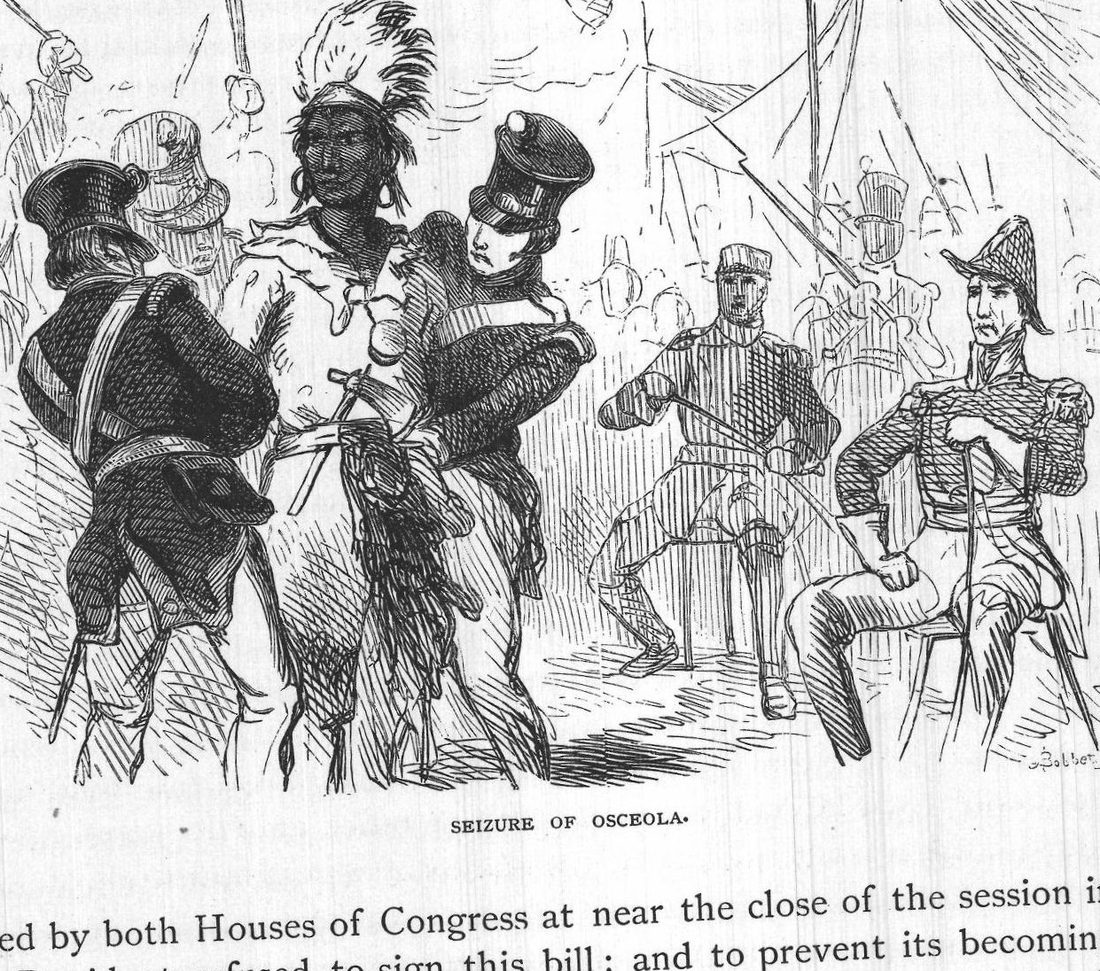
These financial troubles were preceded by the breaking out of war with the Seminole Indians in East Florida, a consequence of an attempt to remove them, by force, to the wilderness west of the Mississippi River. Led by Micanopy, their principal sachem and chief, they began a most distressing warfare upon the frontier settlements of Florida, in which Osceola, a chief superior in ability to Micanopy (for he possessed the cunning of Tecumtha and the heroism of a Metacomet), was an active leader for awhile, for he had private wrongs to revenge.
In the spring of 1832, some of the Seminole chiefs, in council, agreed to leave Florida, and made a treaty to that effect. Other chiefs (among whom was Osceola) and the great body of the nation resolved to stay, declaring that the treaty was not binding upon them. At length, in 1834, General Wiley Thompson was sent to Florida with troops to prepare for a forcible removal of the Indians. Osceola stirred up the nation to resistance. One day his insolent bearing and offensive words in the presence of Thompson caused that general to put the chief in irons and in a prison for a day. Osceola's wounded pride called for vengeance, and it was fearfully wrought during a war that lasted about seven years. By bravery, skill, strategies and treachery, he over-matched the United States troops sent against him and commanded by some of the best officers in the service.