United States Bank
In his first annual message, President Jackson took strong ground against a renewal of the charter of the United States Bank, which would expire in 1836. As we have observed, that charter was never renewed by Congress. The discussions on the subject, for several years, kept the commercial community in a state of feverish excitement. It was occasionally varied by some contra-excitement, like that of the "Black Hawk War" in 1832. At that time the region now known as the State of Wisconsin was an almost unbroken wilderness. Several Indian tribes inhabited it; and these, led by Black Hawk, a fierce Sac chief, made war upon the frontier settlers of Illinois in April, 1832. After some skirmishes with United States troops and the militia of Illinois, the Indians were driven beyond the Mississippi, and their leader, made captive, was taken to eastern cities, that he might be impressed with the folly of contending with a nation so numerous and strong.
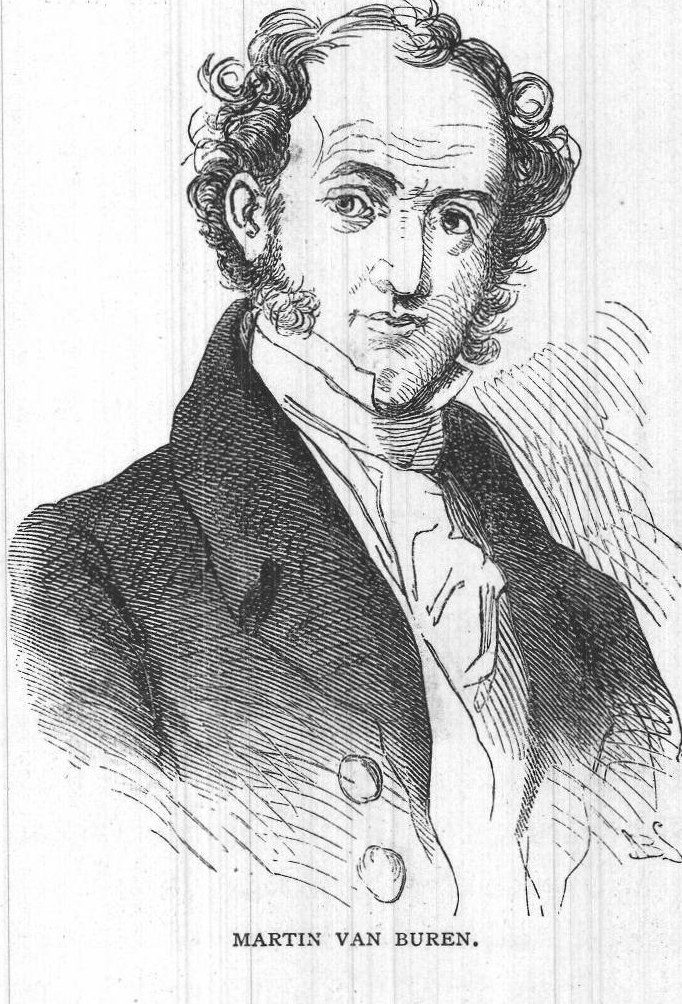
Now began a conflict which shook the republic to its very centre. The doctrine of State sovereignty, or State supremacy, formulated in the first constitution of the republic known as the Articles of Confederation, and discarded in the second constitution, yet prevailed, especially in South Carolina, where John C. Calhoun was its most earnest exponent. The discontents alluded to growing out of the tariff acts, and crystallized by the alchemy of this doctrine, assumed the concrete form of incipient rebellion against the national government when, in the spring of 1832, an act of Congress was passed imposing additional duties on imported textile fabrics. A State convention of delegates was held in South Carolina in November following, at which it was declared that the tariff acts were unconstitutional and therefore null and void; and it was resolved that no duties should be collected in the port of Charleston by the national government. It was also proclaimed that any attempt to enforce the law would be resisted by the people in arms, and would cause the secession of South Carolina from the Union. The State Legislature that met soon afterward passed laws in support of this declaration, and military preparations were made for that purpose. Civil war seemed to be inevitable, but the President met the exigency with his usual promptness and vigor. On the 10th of December he issued a proclamation (written by Louis McLane, Secretary of the Treasury), in which he denied the right of any State to nullify an act of the national government, and warned those engaged in the movement in South Carolina that the laws of the United States would be enforced by military power, if necessary. The "nullifiers" yielded to necessity for the moment, but their zeal and determination were not abated. Great anxiety filled the public mind for a time, until Henry Clay, one of the most earnest promoters of the American System, appeared as a pacificator, by offering a bill (February 12, 1833) which provided for a gradual reduction of the obnoxious duties during the next ten years. This compromise was accepted by both parties, and the bill became a law in March. Discord ceased, and the dark cloud gave way to sunshine. President Jackson had been re-elected to the Chief Magistracy in the autumn of 1832, with Martin Van Buren as Vice-President. The latter had been Secretary of State, and was appointed by the President, during the recess of Congress, to succeed Mr. McLane as minister to England. The Senate afterward refused to ratify the appointment, and Van Buren was recalled. This act was regarded as a gratuitous indignity offered to the administration. Its friends made use of it to create sympathy for the rejected minister, and he was elected to preside over the body which had declared him to be unfit to represent the republic at the British court. The result completely alienated Calhoun from the administration.