Difficulties with the Barbary Powers
When news of these proceeding reached the United States, it excited much indignation. The navy, the strong right-arm of the government, which had enabled commerce, under its protection, to sell to foreign nations during the difficulties with France, the surplus products of our republic to the amount of $200,000,000, and to import sufficient to yield a revenue to the government of more than $23,000,000, was then paralyzed by the exercise of unwise economy on the part of the government, which had authorized the sale of all the naval vessels excepting thirteen frigates. Yet these were decreed sufficient to meet the immediate demands for the protection of American commerce in the Mediterranean Sea.
In the spring of 1801, President Jefferson, in anticipation of trouble with the Barbary powers, ordered Commodore Dale to go with a squadron, composed of the frigates President, Philadelphia, Essex and Enterprise, to cruise off the North African coasts. Dale reached Gibraltar on the first of July, and found that Tripoli had lately declared war against the United States, and its corsairs were out upon the sea. His presence effectually restrained the pirates, and made them quite circumspect. The next year a larger squadron, composed of the frigates Chesapeake, Constitution, New York, John Adams, Adams, and Enterprise, commanded by Commodore Richard V. Morris, were sent to the same waters, one after another, from February to September. The harbor of Tripoli was blockaded in May, and not long afterward the Chesapeake, Lieutenant Chauncey acting-captain, had a severe fight with a flotilla of Tripolitan gun-boats. These, as well as some cavalry on shore, were severely handled by this frigate. Finally, in 1803, the whole squadron appeared off the coasts of the Barbary powers, and effectually protected American commerce from the corsairs, for awhile. But Morris's cruise was not regarded as an efficient one. A court of inquiry decided that he had not "discovered due diligence and activity in annoying the enemy," and the President dismissed him from the service, without trial.
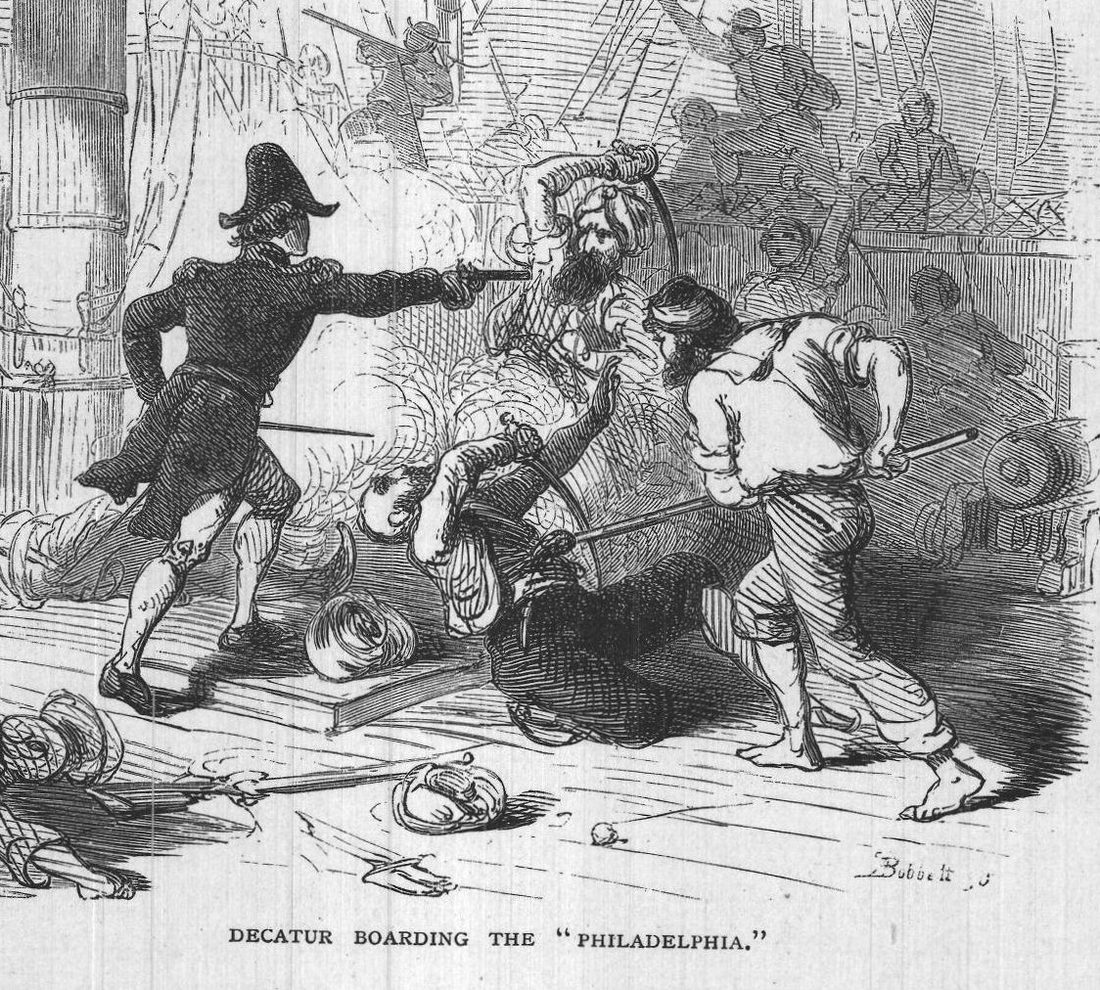
In August, 1803, Commodore Preble, in command of a squadron, sailed for the Mediterranean in the frigate Constitution. After settling some difficulties with the Emperor of Morocco, whose corsairs were on the sea, he appeared with his vessels before the harbor of Tripoli, where a serious disaster occurred. The frigate Philadelphia, commanded by Captain Bainbridge, while reconnoitering the harbor, struck a rock and was captured by the Tripolitans. Her officers were made prisoners-of-war, and her crew were made slaves. When the news reached Preble at Malta, a plan was devised for the destruction of the Philadelphia before her captors could make her ready for sea. Lieutenant Decatur, with seventy-four volunteers--ardent and gallant young men like himself--sailed from Syracuse in a small vessel called a "ketch," named the Intrepid. She entered the harbor of Tripoli on the evening of the 3rd of February, 1804, in the disguise of a vessel in distress, and was moored alongside the Philadelphia. Decatur and his men were concealed below, when suddenly they burst from the hatches like a destructive flame, leaped on board the Philadelphia, and after a desperate fight, killed or drove into the sea her turbaned occupants. Then they set her on fire and escaped by the light, under cover of a heavy cannonade from the American squadron, and followed by shots from the castle, vessels at anchor in the harbor, and batteries on shore. Yet not one of Decatur's men was harmed. Before a favoring breeze they sailed to Syracuse, where they were greeted with joy by the American squadron there. The scene of the burning vessel was magnificent. As the guns of the Philadelphia were heated, they were discharged, giving a grand feu de joie for the victory.
This bold act alarmed the Bashaw, and subsequent events made him very discreet. In August following, Preble, with his squadron, opened a heavy bombardment upon his town, castle, shore-batteries, and flotilla of gun-boats, no less than four times, between the 3d and the 28th. In one of these engagements Decatur again distinguished himself. In command of a gun-boat, he laid her alongside one of the largest of the Tripolitan vessels, boarded her, and made her a prize. Then he boarded another, when he had a desperate personal encounter with her powerful captain. The struggle was brief but fearful. Decatur killed his antagonist, and the vessel was captured. Finally, on the 28th of August, Preble, with his flag-ship, the Constitution, entered the harbor, when her great guns opened a heavy fire upon the town, the castle, the batteries on shore and the camps of twenty-five thousand land troops, and the flotilla in the harbor. She silenced the Tripolitan guns, sunk a Tunisian vessel-of-war, damaged a Spanish one, severely bruised the enemy's galleys and gun-boats, and then withdrew without a man hurt.