President Jefferson, his Policy and his Cabinet
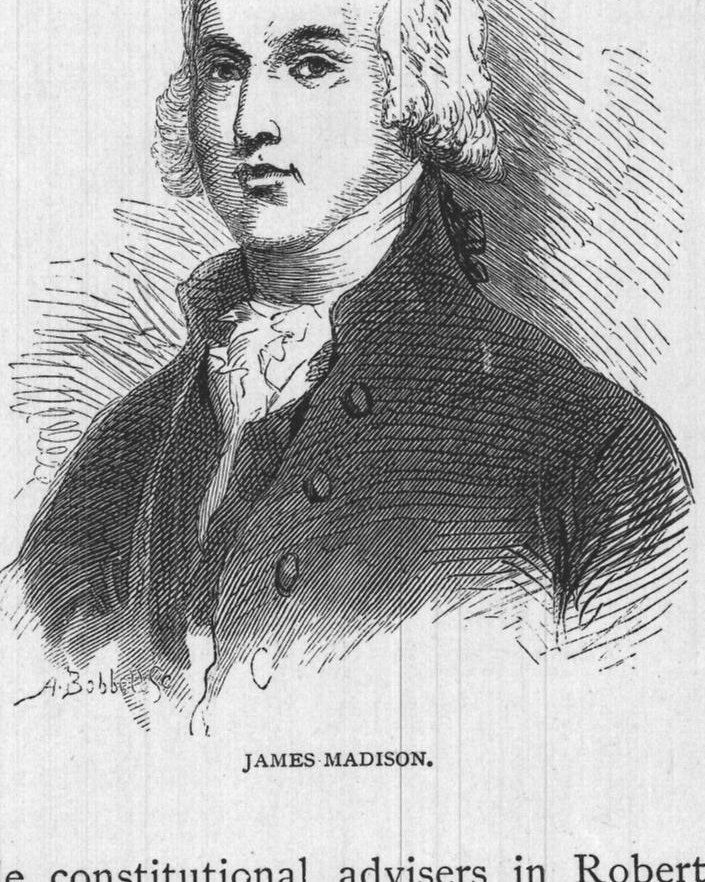
Mr. Jefferson indicated his policy, as follows, in a letter to Nathaniel Macon: "1. Levees are done away with. 2. The first communication to the next Congress will be, like all subsequent ones, by message, to which no answer will be expected. 3. The diplomatic establishment in Europe will be reduced to three ministers. 4. The compensation of collectors depends on you [Congress], and not on me. 5. The army is undergoing a chaste reformation. 6. The navy will be reduced to the legal establishment by the last of this month [May, 1801]. 7. Agencies in every department will be revised. 8. We shall push you to the uttermost in economizing. 9. A very early recommendation has been given to the Postmaster-General to employ no printer, foreigner, or Revolutionary Tory in any of his offices." Mr. Jefferson appointed James Madison Secretary of State; Henry Dearborn, Secretary of War; and Levi Lincoln, Attorney-General. He retained Mr. Adams's Secretaries of the Treasury and Navy, until the following autumn, when Albert Gallatin, a naturalized foreigner, was appointed to the first-named office, and Robert Smith, to the second. The President early resolved to reward his political friends, when he came to "revise" the "agencies in every department." Three days after his inauguration, he wrote to Colonel Monroe: "I have firmly refused to follow the counsels of those who have desired the giving of offices to some of the Federalist leaders in order to reconcile. I have given, and will give, only to Republicans, under existing circumstances." The doctrine, ever since acted upon, that "to the victor belongs the spoils," was then practically promulgated from the fountain-head of government patronage; and with a Cabinet wholly Democratic when Congress met in December, 1800, and with the minor offices filled with his political friends, Mr. Jefferson began his Presidential career of eight years' duration. In his inaugural address, he had said: "Every difference of opinion is not a difference of principle. We have called by different names brethren of the same principle. We are all Federalists--we are all Republicans." Vigor and enlightened views marked his course; and even his political opponents were compelled to confess his forecast and sound judgement in regard to the national policy.
The machinery of the government was now adjusted to an easy-working condition. The treasury was never so full nor the revenue so abundant; and Jefferson was enabled to signalize his accession to office by the repeal of the Excise Law and other obnoxious acts. There were omens of peace abroad, and these promised calmness and prosperity at home. Bonaparte had, in the space of about ten years, as First Consul, brought nearly all Europe trembling at his feet. The old thrones shook in his presence, and when he whispered peace, the nations listened eagerly. The geographical lines of dominions, on the map of Europe, had been changed by his conquests. Only England now remained an armed opponent of the Corsican ruler of France, for by treaties and otherwise, he had conciliated the others; and because of her mischievous doctrines, practically enforced, concerning the freedom of neutrals, the Armed Neutrality of 1780 was revived. Bonaparte threatened her island domain with invasion, and the tramp of a conquering army on the soil of her East India possessions; England arose in her might and defied Europe, and her ships continued to be seen
"Riding without a rival on the sea."
The insolence of the North African pirates now became unbearable, and the United States resolved to cease paying tribute to the Barbary Powers. Captain Bainbridge had been sent, in 1800, in the frigate George Washington, to pay the usual tribute to the Dey of Algiers, and had been treated with cruel insolence by that ruler. After performing the errand courteously, and when he was about to leave, the Dey commanded Bainbridge to carry an Algerian ambassador to the Court of the Sultan at Constantinople. Bainbridge politely refused compliance, when the haughty governor said: "You pay me tribute, by which you become my slave, and therefore I have a right to order you as I think proper." Bainbridge could not sail out of the harbor of Algiers without the permission of the vigilant guns of the castle, and was compelled to yield. He bore the swarthy ambassador to the Golden Horn, when the Sultan saw our starry-flag for the first time. He had never heard of the United States of America. His own flag was garnished with a crescent, and he considered it a favorable omen for a flag bearing the stars of heaven to enter the waters of the seat of the Moslem Empire.
Bainbridge was granted a firman to protect him from further insolence from the Barbary rulers, and he used it efficiently. When he returned to Algiers, he was ordered by the Dey to go on another errand to Constantinople, when the captain peremptorily refused. The African, enraged, sprang from his seat, and threatening Bainbridge with personal injury, ordered his attendants to seize him. Bainbridge quietly produced the firman, when the lion became like a lamb. The Dey obsequiously offered the man whom he had just regarded as his slave, his slave, his friendship and service. Bainbridge, assuming the air of a dictator, demanded the instant release of the French consul and fifty or sixty of his own countrymen, whom the Dey had imprisoned, and they were borne away in the Washington in triumph. Then he wrote to the Secretary of the Navy: "I hope I shall never again be sent to Algiers with tribute, unless I am authorized to deliver it from the mouth of our cannon."