Call for Volunteers
Lee was afraid to attack the Nationals at Centreville, so he sent Jackson on another flank movement which brought on a battle at Chantilly, north of Fairfax Court-House. It was fought in a cold and drenching rain. For awhile the conflict was very severe, and in it Generals Philip Kearney and Isaac A. Stephens perished. The losses on each side were large. The Nationals, under General Birney, held the field that night, and the next day the broken and demoralized army was sheltered behind the fortifications around Washington city. Pope now repeated, with great earnestness, a request to leave the Army of Virginia and return to the West. His desire was gratified. Then the Army of Virginia disappeared as a separate organization and became a part of the Army of the Potomac, and McClellan was placed in command of all the troops defending the Capital. The disasters which had befallen the armies of the Potomac and of Virginia caused a momentary gloom to fall upon the spirits of the loyal people, but it was soon dispelled.
At the request of the governors of many States, the President, on the first of July (1862), called for three hundred thousand volunteers to serve during the war; and in August he called for three hundred thousand more, for three months, with the understanding that an equal number would be drafted from the citizens who were between eighteen and forty-five years of age, if they did not appear among the volunteers. These calls were cheerfully responded to; and the Confederate government, alarmed, ordered General Lee to make a desperate effort to capture Washington city before the new army should be brought into the field. Lee was immediately reinforced. Perceiving the folly of making a direct attack upon the well-fortified National Capital, he crossed the Potomac above that city (near the Point of Rocks) into Maryland to assail Baltimore, and if successful, to fall upon Washington in the rear. He made the passage with almost his entire army, and on the 7th of September was encamped at Frederick, on the Monocacy. There, on the 8th, he issued a stirring appeal, in the form of a proclamation, to the people of Maryland, and raised the standard of revolt. He did not doubt that thousands would resort to it; on the contrary, he lost more men by desertion than he gained by recruiting there.
When General McClellan heard of Lee's invasion of Maryland, he left General Banks, with some troops, to defend Washington, and crossing the Potomac above the National Capital, with about ninety thousand men, he advanced cautiously toward Frederick, which Lee evacuated at their approach. There McClellan discovered Lee's plan for seizing Washington. It was to take possession of Harper's Ferry and open communication with Richmond by way of the Shenandoah Valley, and then marching toward Pennsylvania, entice McClellan far in that direction. At a proper moment Lee was to turn suddenly, smite and defeat his antagonist, and then march upon Washington.
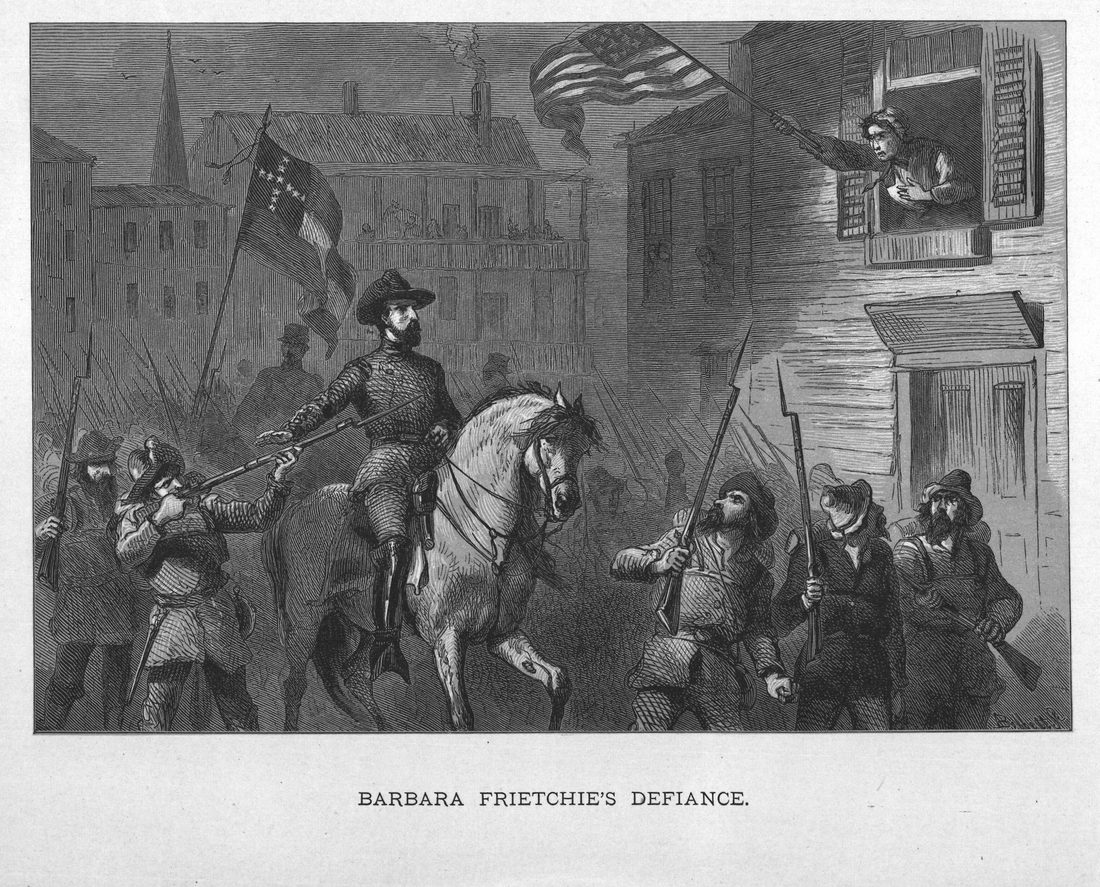
It is related that when the head of Lee's army led by "Stonewall Jackson" entered Frederick, Barbara Frietchie, a very old woman, in defiance of an order for hauling down every Union flag, kept one flying from the dormer window of her house near the bridge over the Monocacy Creek, in the town. Seeing it, Jackson ordered his riflemen to shoot away the staff. When it fell the patriotic Barbara snatched it up, and leaning, says Whittier,
She shook it forth with a royal will;
'Shoot, if you must, this old gray head,
But spare your country's flag,' she said.
A shade of sadness, a blush of shame,
Over the face of the leader came:
The nobler nature within him stirr'd
To life at that woman's deed and word;
'Who touches a hair of yon gray head,
Dies like a dog! March on!' he said.
All day long through Frederick street
Sounded the tread of marching feet.
All day long that free flag tost
Over the head of the rebel host."