Battles on South Mountain and Antietam Creek
The Nationals followed the Confederates from Frederick, in two columns, over the South Mountain into the beautiful valley of the Antietam Creek. The right and centre of the Nationals moved by the way of Turner's Gap, Burnside leading the advance; and the left, composed of Franklin's corps, by way of Crampton's Gap, on the same range, nearer Harper's Ferry. At Turner's Gap, Burnside fought a desperate battle on the 14th of September; and at the same time Franklin was trying to force his way at Crampton's Gap, to get between General Lee and Harper's Ferry, where Colonel Miles, a Marylander, was in command of National troops. The strife at Turner's Gap ceased at dark, with a loss to the Nationals of about fifteen hundred men, of whom a little more than three hundred were killed. Among the latter was the gallant General Reno. The Nationals intended to renew the battle in the morning; but the Confederates withdrew under cover of the night, and Lee concentrated his forces on Antietam Creek, near Sharpsburg. Franklin, in the meantime, had fought his way over the Mountain into Pleasant Valley; and on the evening of the 14th (September) was within six miles of Harper's Ferry, which was then invested by a strong force under "Stonewall Jackson." The Confederates held the advantageous positions of Maryland and Loudon Heights on each side of the Potomac, which commanded the post at Harper's Ferry, and the latter could be preserved from capture only by help from outside. This Franklin was about to give; but before he could do so, Miles surrendered the post to Jackson, after sending away his cavalry. This unfortunate and unnecessary movement, deprived the Nationals of a vast advantage which they might have gained by the apparently easy possession of Harper's Ferry, at that time. Miles's conduct was such, that his loyalty to the Republic was justly suspected.
On the 16th of September, the Confederate army was well posted on the heights near Sharpsburg, on the western side of the Antietam Creek. The Confederates had been followed from South Mountain cautiously, for McClellan professed to believe them to be in overwhelming numbers on his front. But Lee's army then numbered only sixty thousand, while McClellan's effective force was eighty-seven thousand. The latter hesitated to attack; and when he was put upon the defensive by a sharp artillery assault by Confederate cannon, the crisis had passed before he was ready to respond. Then the brave and energetic Hooker was permitted to cross the Antietam with a part of his corps, commanded by Generals Ricketts, Meade, and Doubleday. This passage was made on the extreme right of the Confederates, where he had a sharp and successful combat with the foe led by General Hood. Hooker's men lay upon their arms that night. Other National troops passed over under cover of the darkness. These were the divisions of Williams and Greene, of Mansfield's corps, who bivouacked a mile in Hooker's rear.
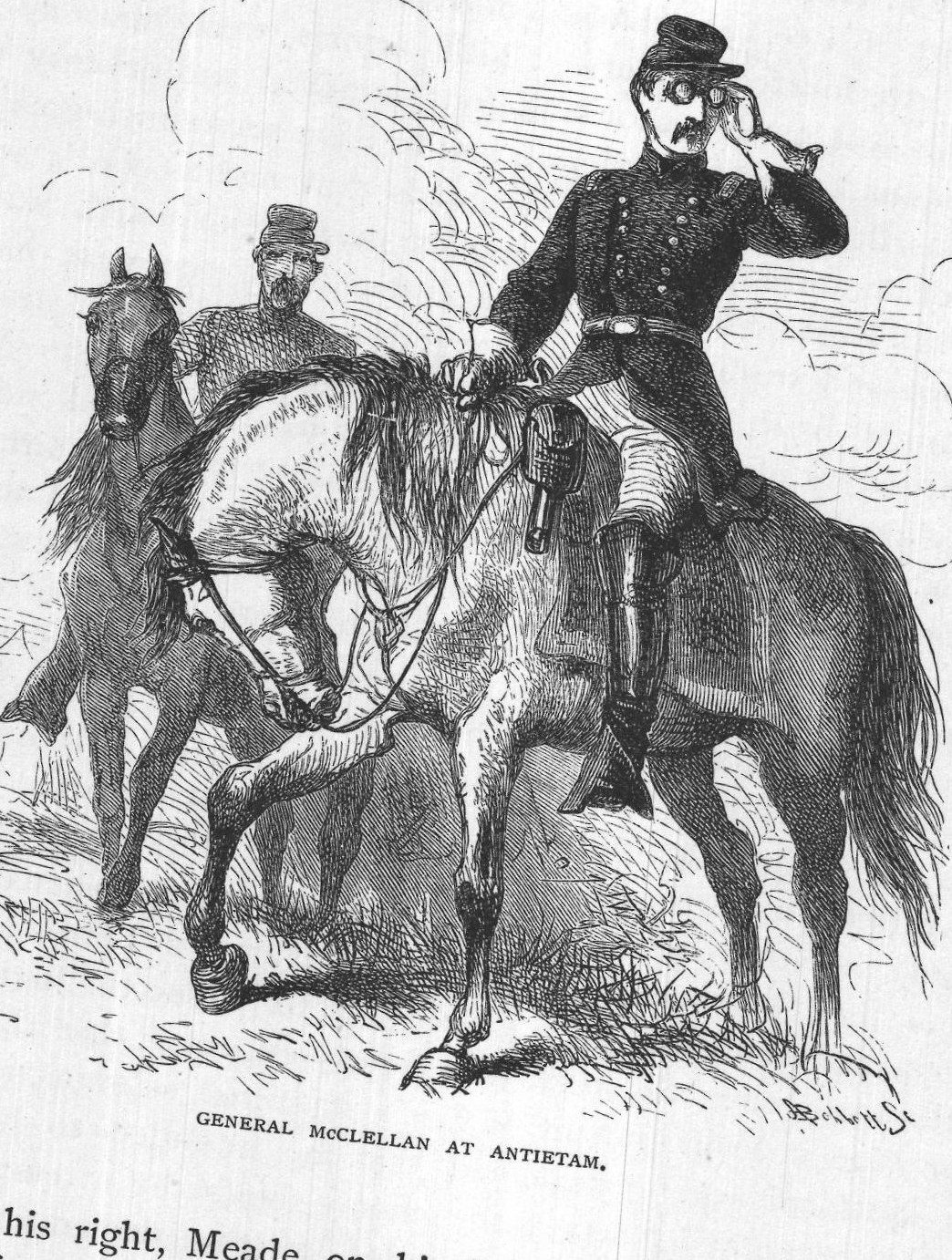
The best of McClellan's generals expecting a heavy engagement in the morning, awaited these movements with great anxiety. In this feeling the army of Lee concurred. At dawn on the morning of the 17th (September, 1862), Hooker opened the battle by assailing the Confederate left with about eighteen thousand men. The enemy were led by Jackson. Hooker had Doubleday on his right, Meade on his left, and Ricketts in the centre. With varying fortunes the contest raged on that wing of the army and along the centre until late in the afternoon. The National chief, with a lofty faith that all would be well, did not leave his room at Pry's (his headquarters) that morning until eight o'clock, when the hills had been echoing the cannon-thunder for hours. Then he went out and viewed the progress of the battle from the opposite side of the Antietam, where he held Porter's corps, with artillery, and Pleasonton's cavalry in reserve until toward evening, when he sent some troops to assist the fighters.
Meanwhile General Burnside, with the left wing of the Nationals, had been holding in check, and fighting the Confederate right under Longstreet, since eight o'clock in the morning, with varying success; and he was on the point of gaining a victory there, when the Confederates were reinforced by General A. P. Hill's division, which had hurried up from Harper's Ferry to the support of Lee. Darkness ended the struggle, which had lasted from twelve to fourteen hours. Both armies were severely smitten. The Nationals lost twelve thousand four hundred and seventy men, and McClellan estimated the Confederate loss to have been much greater. The advantage was decidedly with the Nationals that night. Lee's army, shattered and disorganized, and his supplies nearly exhausted, was without reinforcements near; while McClellan's was joined the next morning by fourteen thousand fresh troops. A vigorous movement on his part, that morning, might have put the whole Confederate force into McClellan's hands as prisoners of war; but with chronic hesitation and indecision, he refused to allow his army to pursue the retreating foe until thirty-six hours after the battle. His reasons for his dilatoriness were given in an apologetic tone, in his report, as follows: "Virginia was lost, Washington was menaced, Maryland invaded--the National cause could afford no risks of defeat."