The Army at Fredericksburg and Battle There
When, on the morning of the 19th of September, McClellan advanced, Lee had fled, under cover of the night, and was with his shattered army behind strong batteries on the Virginia side of the Potomac. A feeble pursuit was attempted and abandoned. Two brigades crossed the river, and were surprised and driven back into Maryland, when Lee, counting upon McClellan's habitual slowness, moved leisurely up the Shenandoah Valley. McClellan took possession of abandoned Harper's Ferry, and called for reinforcements and supplies to enable him to pursue the fugitives; and ten days afterward, when the news was hourly expected that the Army of the Potomac were in swift pursuit of Lee's shattered columns, the commander of the National army proclaimed that he intended to hold his troops where they were, and "attack the enemy should he attempt to cross into Maryland." The President, astounded by this declaration, hastened to McClellan's headquarters, in person, to ascertain the true state of the case. He was so well satisfied that the army was capable of a successful pursuit at once, that he ordered McClellan (October 6, 1862) to cross the Potomac immediately for that purpose. Twenty precious days were afterward spent in correspondence between the disobedient general and his patient superiors, before the former obeyed, during which time Lee's army was thoroughly recruited in every way, and his communications with Richmond were well established.
The beautiful month of October passed away. The roads in Virginia were never in a finer condition; and the loyal people were becoming exceedingly impatient, when, on the 2d of November, McClellan announced that his great army was once more on the soil of Virginia, prepared to move southward on the east side of the Blue Ridge instead of up the Shenandoah Valley, as he had been ordered to do. The patience of the Government and its friends was now exhausted. They had lost faith in McClellan's ability or disposition to achieve a decisive victory over the Confederates, and on the 5th of November he was superseded in the command of the Army of the Potomac by General Ambrose E. Burnside, of Rhode Island. So ended General McClellan's unsuccessful military career. He then entered the field of politics in opposition to the administration, and was equally unsuccessful there.
The Army of the Potomac was now about one hundred and twenty thousand in number. It was reorganized by Burnside; and he took measures for the early seizure of the Confederate capital rather than for the capture or destruction of the Confederate army. He made Acquia Creek, on the Potomac, his base of supplies; and he hastened to place his army at or near Fredericksburg, on the Rappahannock, from which he might march on Richmond. Lee, in the meantime, had gathered about eighty thousand men on the Heights in the rear of Fredericksburg, with three hundred cannon, and had destroyed all the bridges that spanned the Rappahannock in that vicinity.
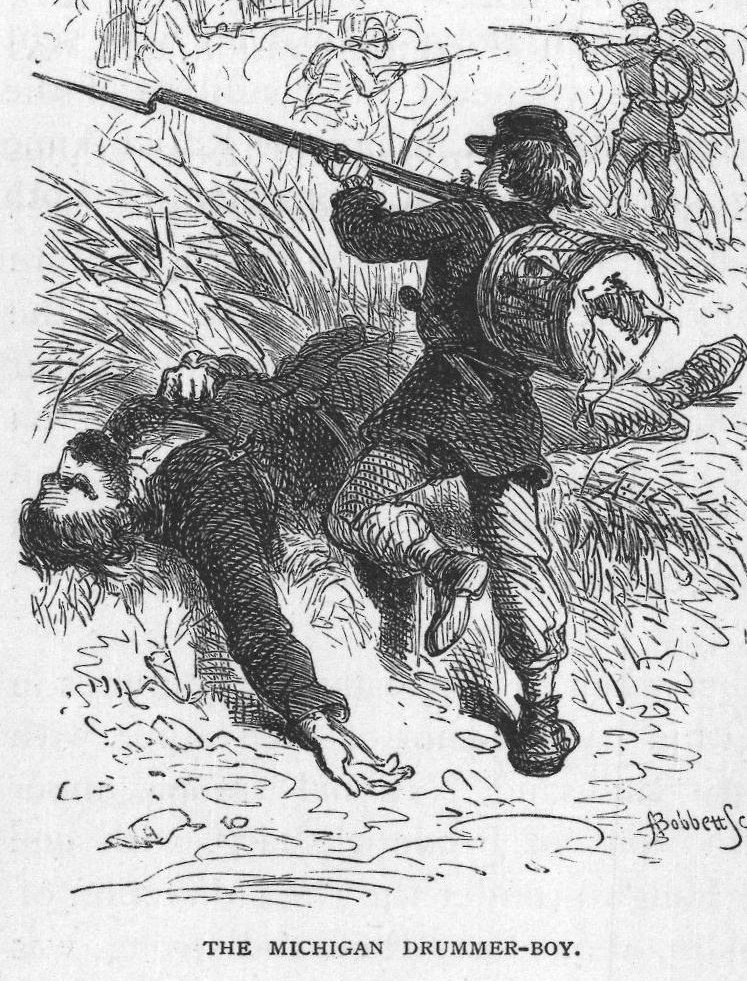
It was the second week in December when the opposing great armies in Virginia were lying in parallel lines within cannon-shot of each other, with a narrow river between them. Sixty thousand National troops, under Generals Sumner and Hooker, lay in front of Fredericksburg, with one hundred and fifty cannon on Stafford Heights under the chief direction of General Hunt; and the corps of Franklin, about forty thousand strong, was encamped about two miles below. The troops could cross the river only on pontoons or floating bridges; and on the 11th of December, early in the morning, the engineers went quietly at work to construct five of them. These men were assailed and driven away by sharp-shooters concealed in buildings on the opposite shore. The batteries on Stafford Heights then opened a heavy fire on the town to drive out the enemy, and the city was set on fire, in many places, by the shells; but the sharp-shooters remained. Then a party of volunteers went across the river in open boats, in the face of flying bullets from Mississippi rifles, to dislodge the sharp-shooters. A drummer-boy from Michigan, named Hendershot, begged leave to go along, but was refused permission. Then he asked and obtained permission to push off one of the boats, when he allowed himself to be dragged into the water. Clinging to the vessel, he was conveyed to the opposite shore. Several men in the boat were killed; and when the boy was climbing the bank, his drum was torn in pieces by a flying fragment of an exploded shell. Then he seized the musket of a slain companion, and fought gallantly until the sharp-shooters were driven away or captured. The bridges were finished, and by the evening of the 12th a greater portion of the National army occupied Fredericksburg.
On the morning of the 13th the National army made a simultaneous assault all along the National line, where a most sanguinary battle occurred, which ended with a repulse of Burnside's forces with a loss of almost fourteen thousand men. In this struggle, Generals Franklin, Couch, Hooker, Sumner, Meade, Doubleday, Howard, Humphrey, Wilcox, Hancock, French, Sturgis, Getty, Meagher and others were conspicuous. In the fight, the Confederates lost about half as many as the number lost by the Nationals. Burnside, anxious to gain a victory, was disposed to renew the battle the next day, but was dissuaded by some of his best officers, and his troops remained on the city side of the river until the night of the 15th unmolested by the Confederates. Then, under cover of darkness, they crossed the stream with all their cannon, taking up the pontoons behind them.