Battle of Tippecanoe
At the beginning of November, the governor and his troops encamped upon a dry oak elevation, that rises about ten feet above a surrounding wet prairie, near the junction of the Tippecanoe and Wabash, and there he was visited by The Prophet, who proposed a conference. Harrison suspected treachery, and arranged his camp with care on the afternoon of the 6th of November, to meet any sudden emergency. He ordered that each corps forming the extreme line of the camp should hold its ground, in case of an attack, until relieved. In the event of a night attack, the cavalry were to parade, dismounted, with their pistols in their belts, and act as a reserve corps. Two captains' guards of forty-two men each were detailed to defend the camp. So prepared, the whole camp excepting the sentinels and guards, were soundly sleeping at an early hour. At the same time there had been preparations made by The Prophet for treachery and murder, when the camp of the white people should be filled with sleepers. Surrounded by his dupes, The Prophet brought out his Magic Bowl. In one hand he held a torch, in the other a string of holy beans which his followers were required to touch in token of an oath, and so be made invulnerable in battle. Then he went through a long series of incantations and mystical movements, his solitary eye (for he had lost one) rolling wildly. These ended, he turned to his seven hundred warriors, told them that the time for attacking the white man had come, and holding up the string of beans reminded them of their oath which the touch of them implied. "The white men are in your power," he said. "They sleep now, and will never wake. The Great Spirit will give light to us, and darkness to the white men. Their bullets shall not harm us; your weapons shall be always fatal." Then followed war-songs and dances, until the savages, wrought up to a perfect frenzy, rushed out to attack Harrison's camp.
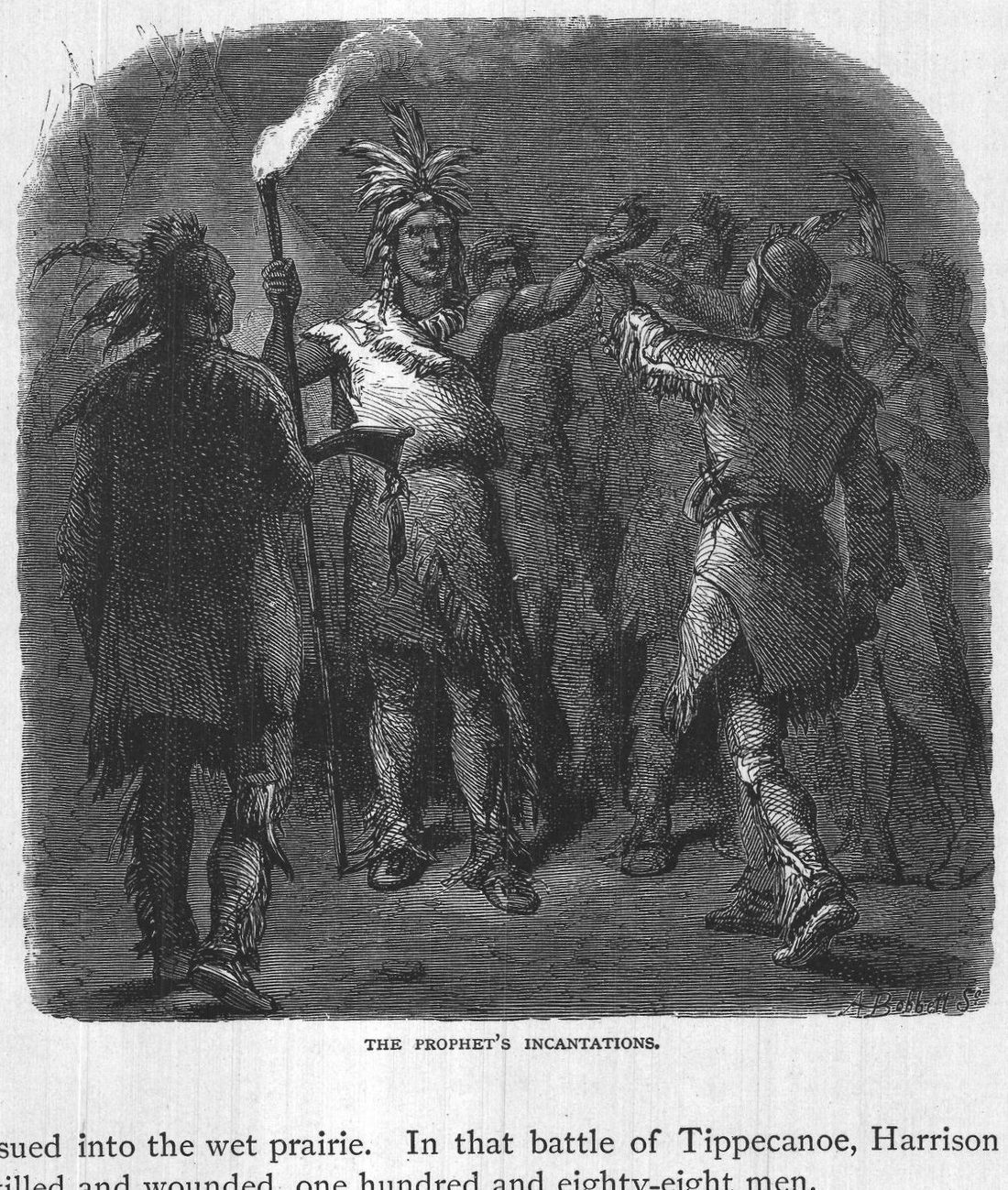
At four o'clock in the morning of the 7th, Harrison was just pulling on his boots, when a single gun was fired by a sentinel. This was followed by horrid yells. The whole camp was soon aroused, to receive a murderous fire from the savages, who had crept up stealthily to the verge of the camp before they were discovered. A very sharp battle ensued, which lasted until daylight, when the Indians were driven away at the point of the bayonet and pursued into the wet prairie. In that battle of Tippecanoe, Harrison lost, in killed and wounded, one hundred and eighty-eight men.
Tecumtha, who was really a great man, while his brother was a demagogue and a cheat, was absent in the South, at that time. On his return, he found all his plans frustrated by the folly of The Prophet. Vexed and mortified, he was compelled to abandon his schemes for a confederacy, but became a firm and active friend of the British in the war that speedily ensued. His brother, The Prophet, lost caste with his people. Upon a gentle hill toward the Wabash, this demagogue stood on that dark and gloomy November morning, at a safe distance from danger, singing a warsong and performing some protracted religious mummeries. When he was told that his followers were falling before the bullets of the white men, he said, "Fight on; it will soon be as I told you." When at last the warriors of many tribes--Shawnoese, Wyandots, Kickapoos, Ottawas, Chippewas, Pottawatomies, Winnebagoes, Sacs, and a few Miamis--fugitives from the battle-field, lost their faith and covered The Prophet with reproaches, he cunningly devised a lying excuse for his failure. He told them that his predictions had failed of fulfillment because, during his incantations, his wife touched the sacred vessels and broke the charm ! His followers, though superstitious in the extreme, would not accept this explanation as an excuse, and they deserted him in such large numbers, that he was compelled to take refuge with a small band of Wyandots, his town having been set on fire. The foe scattered in all directions, and hid themselves where the white man could not easily follow. A poet of the time wrote:
And swift the fugitives pursue !
'Tis vain; rein in--your utmost speed
Could not o'ertake the recreant crew.
In lowland marsh, in dell or cave,
Each Indian sought his life to save;
Whence, peering forth, with fear and ire,
He saw his Prophet's town on fire."
These events, so evidently the work of British interference, aroused the spirit of the nation, and out of New England there was a general desire for war with Great Britain. The administration, impressed with the great responsibility of such a measure, and having the entire body of the New England people in opposition, hesitated.