Trouble with the Indians
So hostile had the Indians appeared in the spring of 1810, under the influence of these leaders, that General W. H. Harrison, then governor of the Territory of Indiana, invited the brothers to a council at Vincennes, in August. Tecumtha appeared with four hundred full-armed followers. The inhabitants were greatly alarmed by this demonstration of savage military power. Harrison was cool and cautious. The bearing of the chief was bold and haughty. He refused to enter the place wherein the council was to be held, saying: "House were built for your to hold councils in; Indians hold theirs in the open air." He then took a position under some trees in front of the house, and, unabashed by the large concourse of white people before him, he opened the business with a speech marked by great dignity and native eloquence. When he had concluded, one of the governor's aids said to him through an interpreter, as he pointed to a chair: "Your father (General Harrison) requests you to take a seat by his side." The chief drew his blanket around him, and, standing erect, said, with scornful tone: "My father! The sun is my father, and the earth is my mother; on her bosom I will recline;" and then seated himself upon the ground.
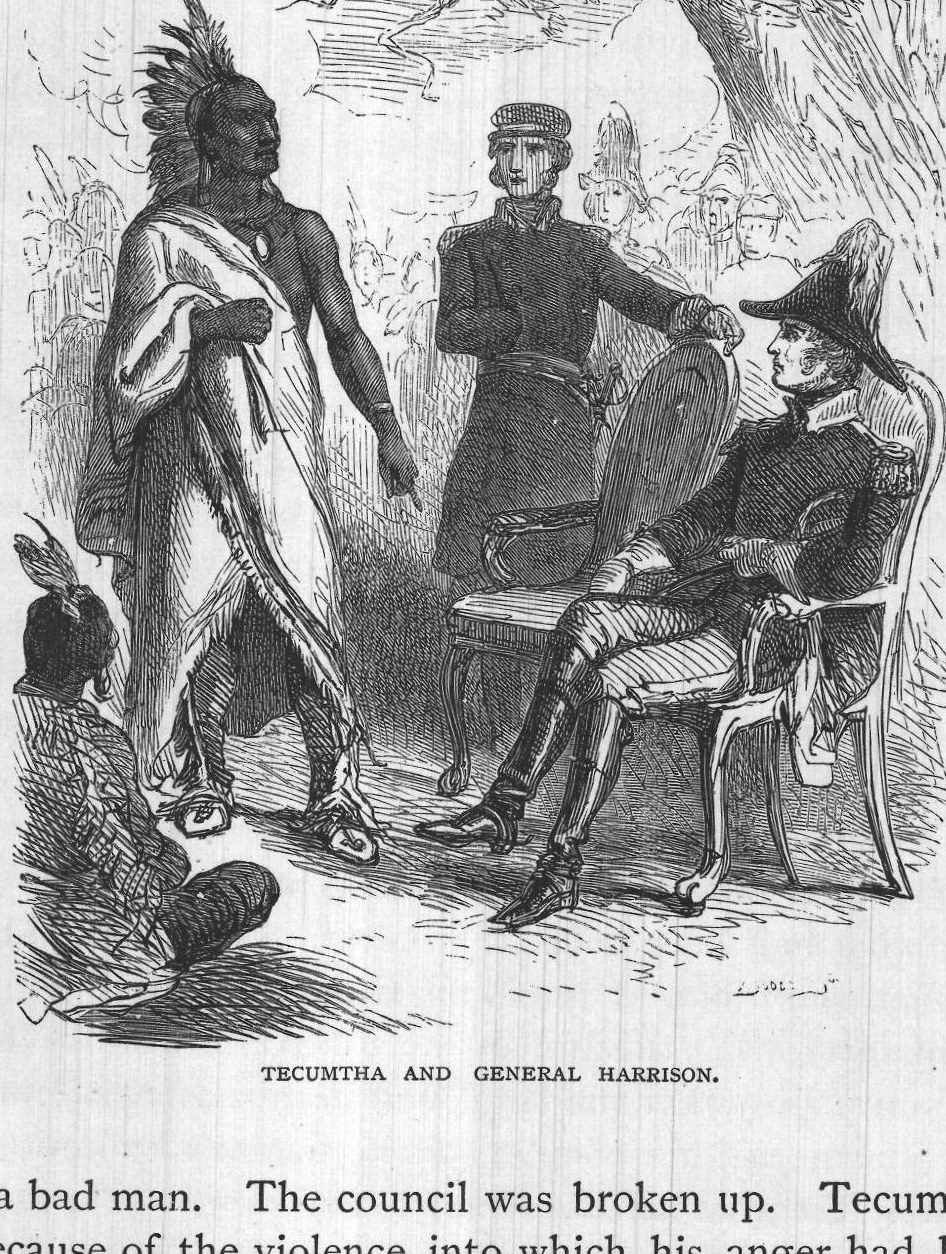
The chief had declared it to be his intention to form a confederacy for the purpose of preventing any further cession of lands to the white people, and to recover what had been ceded. "Return those lands," he said, "and Tecumtha will be the friend of the Americans. He likes not the English, who are continually setting the Indians on the Americans." The governor, in reply, told him plainly that the lands had been received from other tribes, and that the Shawnoese, his people, had no business to interfere. Tecumtha sprang to his feet, cast off his blanket, and, with violent gestures, pronounced the governor's words false. He accused the United States of cheating and imposing upon the Indians; and then giving a sign to his warriors near him, they sprang to their feet, seized their war-clubs, and brandished their tomahawks. The governor started from his chair and drew his sword, while the citizens seized any weapon or missile they could find. It was a moment of great peril to the white people. A military guard of twelve men, under some trees a short distance off, were ordered up. A friendly Indian cocked his pistol which he had loaded secretly while Tecumtha was speaking, and would have shot the chief dead. The guard were about to fire, when Harrison, perfectly cool, restrained them, and a bloody encounter was prevented. The interpreter, whom the Indians all respected, told Tecumtha that he was a bad man. The council was broken up. Tecumtha expressed his regret because of the violence into which his anger had betrayed him; but Harrison perceived that war with the followers of the chief and his brother was probable, and took precautions accordingly.
In the spring of 1811 the hostile savages began to roam over the Wabash region, in small parties, plundering the white settlers and friendly Indians. Harrison sent word to Tecumtha and The Prophet that these outrages must cease, and that he was fully prepared to defend the settlers against any number of warriors which they might assemble. Tecumtha, alarmed, went to Vincennes, where he saw seven hundred well-armed militia. He made solemn assurances of friendly feelings and intentions; and then went to the tribes of the Choctaws, Chickasaws and Creeks, in the South, and tried to get them to join him in a league against the white people. Meanwhile Governor Harrison, exercising discretion given him by his government, gathered a large force from Kentucky and elsewhere, at Vincennes, and late in September (1811) marched up the Wabash Valley toward the town of The Prophet near the junction of Tippecanoe Creek and the Wabash River. On the way he built a fort near the present town of Terre Haute, which was called Fort Harrison.