Banks
THE eventful administration of President Madison drew to a close in 1816. During that year the efforts of the government were put forth to complete the readjustment of the finances of the country after the derangements produced by a state of war. Direct taxation was reduced one-half, and other changes were made. The Bank of the United States had expired by the limitation of its charter in 1811, and banks authorized by the several States had appeared in all parts of the Union. At the close of 1815, there were one hundred and twenty of these institutions, with an aggregate capital of $40,000,000, and an emission of notes estimated at $200,000,000. The finances of the government were then in a wretched condition. The public credit had been depressed by the unpatriotic action of the Peace-Faction, and from the same cause there was a general suspension of specie payments by the banks, the notes of which were greatly depreciated-twenty per cent in Baltimore and fifteen in New York. In this state of things the friends of a national bank pressed its claims upon Congress, and in the spring of 1816 a second bank of the United States was chartered for twenty years with a capital of $35,000,000, the United States subscribing for stock to the amount of $7,000,000. The creation of this bank gave an impetus to general business. The State banks were compelled to resume specie payments. Some of them were aided in their efforts by the national bank, while more feeble ones were finally obliged to close their doors. The government bank went into operation early in 1817, and receiving on deposit the funds of the national government, it soon became a powerful financial institution. It was so powerful that when President Jackson was inaugurated in 1829 he evinced hostility to it, and waged war upon it as a dangerous institution until it expired by the limitation of its charter, in 1836, which was never renewed by Congress. The bank was re-chartered by the Legislature of Pennsylvania in 1836, but made a final suspension four years afterward, when, on winding up its business, there remained nothing for the stockholders- the whole capital was gone.
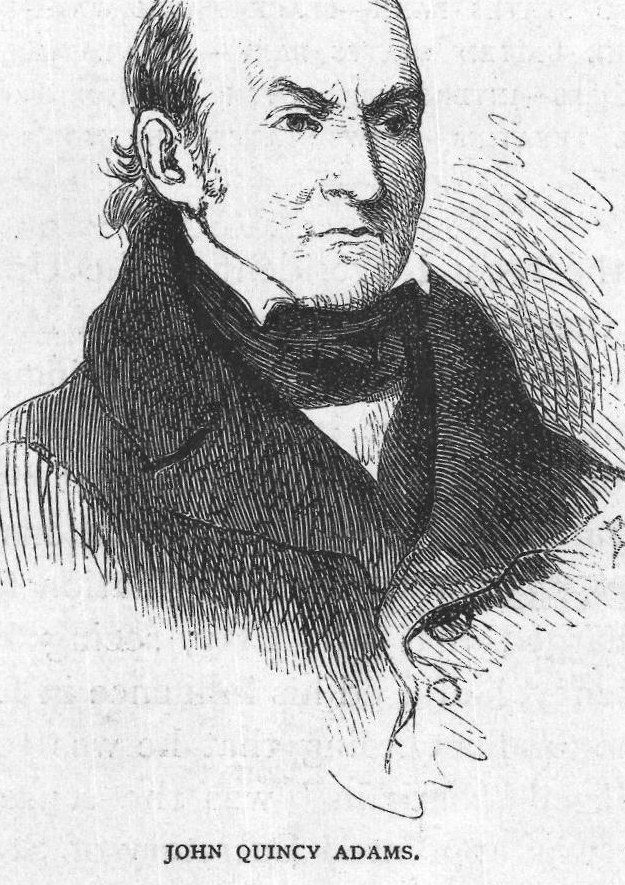
During Madison's administration Louisiana and Indiana were admitted into the Union as States-the former in April, 1812, and the latter in December, 1816. There had been warm discussions on the subject of the admission of Louisiana, the Federalists strongly opposing the measure. The question of boundary between the possessions of Spain and the United States, in that region, was a serious one. Eastward of the vast territory which, under the title of Louisiana, had been ceded to the United States, and bordering on the Gulf of Mexico, was a region in possession of the Spaniards, known as East and West Florida, the dividing line between them being the Perdido River, now the line between Florida and Alabama. The western portion was claimed by the United States as included in the cession, while the Spanish authorities asserted that their possession extended to the Mississippi. With the act for the admission of Louisiana was passed another act, annexing to that State that part of West Florida lying between the Mississippi and Pearl Rivers, and all eastward of that stream to the Perdido was annexed to the Territory of Mississippi. This measure produced unpleasant relations between the United States and Spain, which continued several years; and the dispute was not settled until after the retirement of Mr. Madison from the Presidency. The latter event occurred on the 4th of March, 1817. James Monroe, his Secretary of State, was his successor, having received an almost unanimous vote for the high office in the electoral colleges. At the same time Daniel D. Tompkins of New York was elected Vice-President by a large majority. Monroe was the fifth President of the United States, and he entered upon the duties of his office under favorable auspices for himself and his country. His inaugural address was liberal in its tone and gave general satisfaction, and the beginning of his administration was regarded as the dawning of an era of good feeling. The Federal party was declining in strength, and from the dominant party which had elected him, the President chose his cabinet-ministers, composed of John Quincy Adams of Massachusetts, Secretary of State; William H. Crawford of Georgia, Secretary of the Treasury, and John C. Calhoun of South Carolina, Secretary of War. These were all aspirants for the Presidential chair. B. W. Crowninshield was continued Secretary of the Navy, and William Wirt was appointed Attorney-General. The President was thus surrounded by some of the ablest men of the republic as his constitutional advisers.