Home › The Young People Who Suggested the Book › The Young People Who Suggested the Book
The Young People Who Suggested the Book
Yes, it is a lively American group of boys and girls, that family which I have in my mind just at this moment. It goes without saying that they love mischief, and when they are not as busy as bees at school, they are just as busy at something else at home. They are such voracious readers of Wide Awake that the head of the house, in order to keep the covers on the books, or the leaves inside the covers, is obliged to subscribe for no less than three sets a year! Of course, all who have their wits sufficiently advanced belong to the Chautauqua Young Folk's Reading Union. But they are not only members of this association, every one of them follows all the hobbies afloat in the play-ground or the school-room. They are collecting the coin of the realm, past, present, and to be, and make the life of a good-hearted cousin in the distant region of Hong Kong a burden by their many pleas for specimens of the legal tender of that country. Furthermore, they have caught the postagestamp mania, and the oldest boy, who possesses literary aspirations, has begun to exhibit stray autographs of various local celebrities, led off by a gorgeous card from the executive mansion itself, on which it is easy to read the name of our august President. Nothing would induce him to divulge the way in which this treasure was obtained. My unqualified admiration of such a great feather in his cap led to the bringing forth by a little sister of some hidden treasures peculiar to herself. "Oh, that's Polly's latest craze! You see, last winter, grandma gave a big party, and R. S. V. P.'d all the invitations. Polly saved every note that came, and cut off the seals, and all the what-youcall-'em's at the top. Now, every time mamma gets a letter Polly has to have a look at it, and then, if it is aristocratic, snip go the scissors." "No, I don't, either," protested poor Polly, confusedly; "anyhow, the only reason you don't take the postage-stamps is because they are only just the everlasting two-cent fellows. Besides, the best ones never came from grandma's party - they were most all nothing but letters, queer little ducks and cut-off arms, and such things, but Ettie McCormick and I sent to England for these beauties, just where Ettie's cousin bought hers, and we got lovely little pictures. The store is in London, somewhere on Pickaninny Street - " "Oho! Oho! did they dance the double shuffle there, and steal chickens? - Pickaninny, oh, my!" "Well, it sounded just like that, and who was it called the twelve patriarchs the twelve partridges yesterday morning at prayers, I'd just like to know?"
So we looked at the little English crests and coats-of-arms that Polly hoarded with so much care, and I asked the children what the little crowned hearts and diagonal bars, the golden fleur-de-lys, and the rampant lions meant. They studied the enigmatical mixture of lions and animals for some moments, and shook their heads, one young hopeful declaring that all they meant was that the people WHO SUGGESTED THIS BOOK. who had them thought they were better than the people who hadn't. The big brother covered the humiliation of his ignorance by declaring that Americans ought not to know anything about such things; we were all equals, etc. "Not too fast, little people," said the father, just coming in; "even our republic, with all its scorn of titles and insignia, shows a trace, after all, of the old heraldic spirit. Which of you can tell me where that trace is, and what it is?"
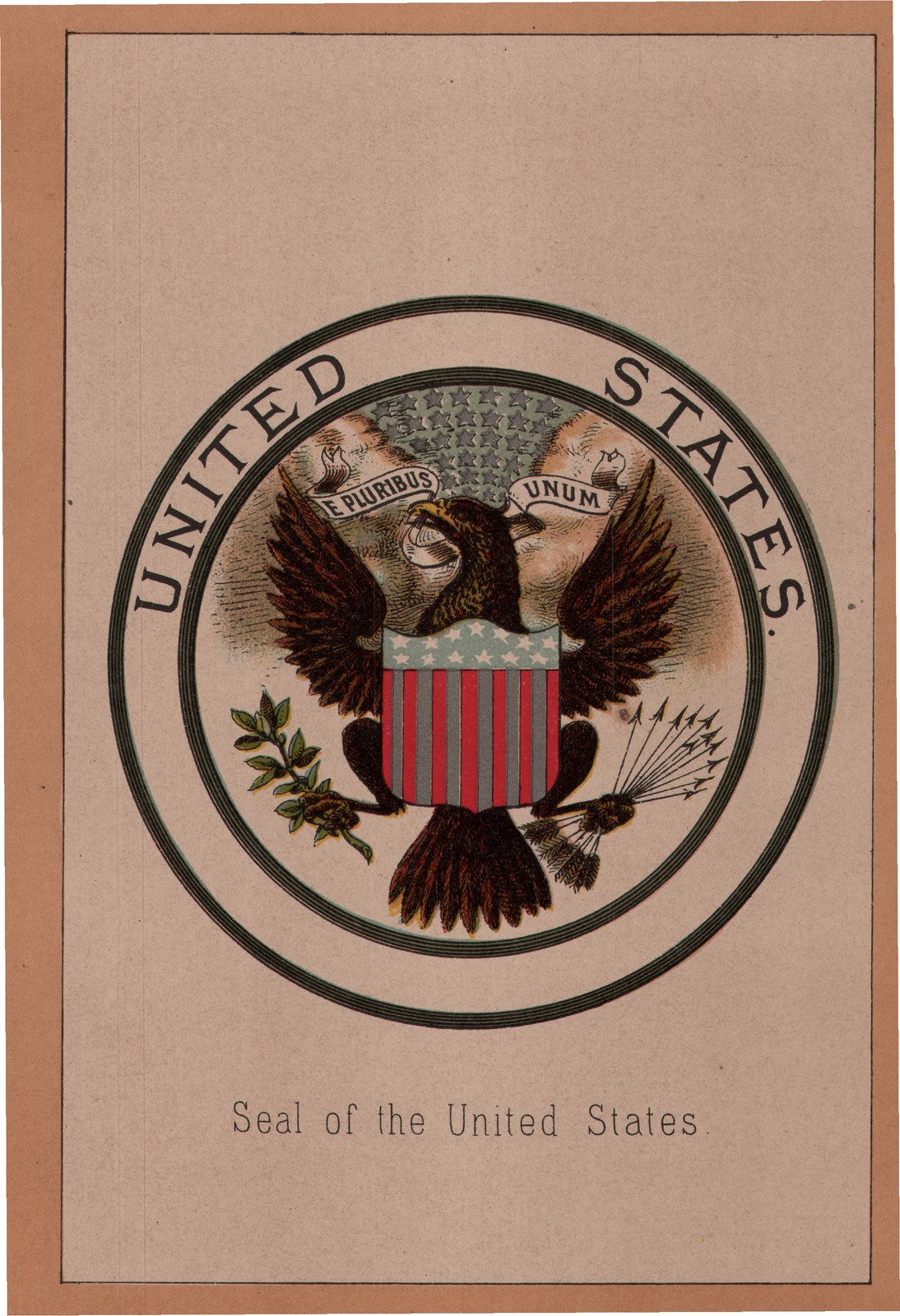
As nobody seemed to know, he asked them if the United States had a coat-of-arms, or not. The big brother recovered himself, and the spread eagle was quickly displaying his wings and the shield on its breast in all its glory before us. The motto, too, was given, but when some one asked what it signified, although the English rendering was echoed by a chorus of voices, no one but the father could tell the history of its origin. "The shield is rather pretty," said the father; "tell me what it means, and why we chose it?" No one knew. "Ah, ha," was the paternal rejoinder; "it seems to me that although you may not care much for the plumes in your neighbors' hats, it would be as well for you to understand what your country itself has chosen as a proper adornment. It was on the very day when the Declaration of Independence was signed and read, that wise old Dr. Franklin, Mr. John Adams, and Mr. Thomas Jefferson were appointed by the eminent men of the land, then gathered together in Philadelphia, to put their worthy heads together and concoct a device for the Great Seal of the United States of America, or, in other words, to originate a coat-of-arms that should satisfy the needs of the new-born Republic, and by which she might be distinguished amidst her sister nations. There happened at that time to be in this country a French West Indian named Simitier, who knew how to cut silhouette portraits, a kind of artistic production then very fashionable. He could also paint miniatures and execute rather pretty water-colors. Upon him did these good patriots fall, insisting that he must help them in their exigency. The shield which, after much labor, he produced, was one divided into six quarters. Dr. Franklin's eye glanced disapprovingly over it. Such European fol-de-rol did not please him. He would prefer to see a representation of the grand Old Testament warrior, Moses, in his well-known position on the shores of the Red Sea, with his staff uplifted and the affrighted waters gaping before him. This for one side of the shield, and on the other should be engraved Pharaoh and his iniquitous hosts gasping their lives away in the rushing waves of the returning sea. Mr. Adams, who now gave his attention to the design, was one of the remaining two that prevented the committee from being a one-man power. He thought as slightingly of Moses as a typical American subject as he scorned the thoroughly European incongruity of the West Indian. He had a classical taste, and thought of the choice of Hercules, where the hero rests on his club, with Virtue standing beside him, pointing persuasively towards a mountain up which it seems his duty to ascend, and Sloth lies at his feet, trying to persuade him to tread the flowery walks of pleasure with her. Then Mr. Jefferson - he had his individual views on the subject, and did not hesitate to express his disapprobation of all the above suggestions. He looked, however, with greater favor upon the Scriptures as a mine of suggestion, than upon the entire realm of mythology, and thought the children of Israel, who marched through the wilderness with their Baedeker WHO SUGGESTED THIS BOOK. in the shape of a cloud by day and a pillar of fire by night, as not a bad idea for the prominent side of the seal. For the other side, it would please him to see Hengist and Horsa, from whom it is claimed we are descended. Jefferson seems to have had more decided notions upon this subject than did his two companions, and it was finally decided that he should solve the difficulty alone. He therefore made a design, thoroughly satisfactory, no doubt, to himself, but, unfortunately, the unreasonable nation for whom it was drawn showed itself critical, and the design was not accepted. Three years later two gentlemen from Virginia and one from Georgia were appointed to struggle as best they could with this question. The result of their deliberations was a new design, quite different from all those which had preceded it. Congress took it, looked and frowned. It was evident that what she wanted she did not know, but just as evident was it that what she did not want she also knew. Three more years went by, and a new committee was formed. They toiled and worked, but could not find it within them to do better than their predecessors. Congress now grew cross, and in a fit of desperation bade its secretary put an end to the matter if he could; if not, the country would set an example to all other nations by doing without a seal. This good secretary was of a hopeful temperament, and, calling to his assistance the talents of a friend in Philadelphia, he succeeded in producing what he was sure would please the demands of his exacting master. Congress had thought herself ready to adopt any device that might be forthcoming; but, alas for the hopes of the sanguine secretary! she found she could greet this sketch with no greater warmth than she had done the many others. Fortunately, the courage of the committee was equal to the occasion, and a final drawing for a seal was produced, that, with some modifications, was adopted. The motto, E Pluribus Unum, was the suggestion of Jefferson, and appeared in his early design. He took it from a Latin poem called 'Moretum,' written by Virgil. The poem is a vivid description of the early meal of an Italian peasant, and in it little descriptions of his early life are given. 'Moretum' is a kind of pottage or salad, made of herbs, that the peasant, with his servants, mixes before the break of day, grinding all the ingredients together with a pestle. "So much for the seal as we look at it. And now for the signification of the various devices that form the seal. The designers took two of what England calls her noblest 'ordinaries,' or marks, the 'chief,' or upper third of the shield, and the vertical lines, or 'pales.' The pale is repeated thirteen times, and represents the thirteen original States, all of which join together in supporting the chief. This chief unites them all and represents Congress. Congress, naturally, preserves the union of the States, but what would become of this august body were it not upheld by the States? The colors, too, are significant, white representing purity, and red valor. The chief is blue, and that means vigilance, besides many other noble qualities. As for the eagle, upon whose breast, the escutcheon is placed, that noble bird is to show that the American Republic must depend upon itself, and upon itself alone. In one claw it holds the olive-branch of peace, and in the other the arrows of war. The crest above the eagle's head is a constellation, and shows that a new state is taking its place among the older powers. The reverse of the Great Seal is a pyramid, but this is never used. WHO SUGGESTED THIS BOOK. "But," continued the father, "it is not alone upon our great National Seal that heraldry in her queer republican dress manages to get introduced to our good American society. You can see her asserting herself in a much more conspicuous manner elsewhere. Indeed, she is doing so this very moment upstairs in our garret." "Never!" chorused the indignant children. "Ah, but she is. Wasn't it only last Fourth of July, in the evening, that I saw you roll up our great flag and tuck it away in some trunk of your mother's in the attic? To be sure, you did so, and you know how carefully you folded it, and how proud you are of it; and now I wonder if any one of this good family who think that the best part of an aristocracy lies under the ground,' can tell me where those beloved stars and stripes were found, and for what reason we selected them as the emblems for our national flag?" "Yes, indeed, I do," piped Polly's pet sister; "I know: "When Freedom from her mountain height Unfurled her standard to the air, She tore the azure robe of night And set the stars of glory there; She mingled with its gorgeous dyes The milky baldric of the skies, And striped its pure celestial white With streakings of the morning light; Then from his mansion in the sun, She called her eagle-bearer down, And gave into his mighty hand The symbol of her chosen land!" " "That was a very beautiful fancy of Mr. Drake's," said the father, as he kissed her flushed cheek, "I am very glad that my little girl has already learned one of the jewels of our American poetry, but I am afraid the idea is only a fancy. The fact is, we are displaying, actually displaying, some of old England's cast-off glory! Our stars and our stripes, altered a little, to be sure, to meet the needs of the occasion, come from the old Washington coat-of-arms." orge Waching At this the whole family of seven children sat upright, stiff and scarlet. Nothing but the fact that the word of their father was a sort of second Bible to them, and that his person, if no one else's, was to be held in reverence, prevented an explosion of violent and vigorous denial.