Home › The Young People Who Suggested the Book › The Young People Who Suggested the Book: Johnny
The Young People Who Suggested the Book: Johnny
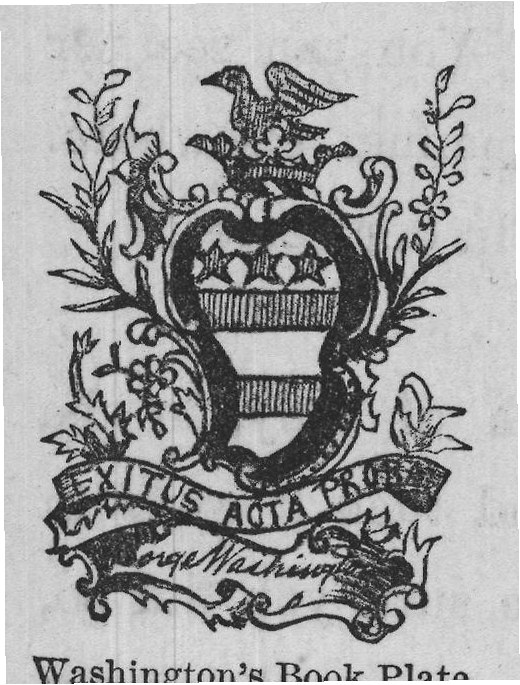
Washington's Book Plate. "Nothing but old English stars, after all," moaned sister number one; "I don't think they are half as pretty now as I did before." "Why, children," laughed their mother, "what shall we do with you? Your very name is as English as Johnny MacGregor's is Scotch, and yet I have never heard one of you suggest that your father should travel down to Springfield and get our dignified body of legislators to alter it to a thoroughly good, indigenous American name. But it isn't too late to do that even yet, and until the next session begins you can be revolving the pros and cons of such good surnames as Mr. Young Man not Afraid, or Mr. Swift Moccasons, or some other appropriate Indian names." "I hadn't thought of that," said the middle boy, reflectively, "most of our names are English, aren't they. I guess Johnny MacGregor hadn't either, when we were teasing him yesterday about the lilies and the roses."
WHO SUGGESTED THIS BOOK. "What was that," asked the mother. "Why, don't you know it, mamma, ""The lilies may fade and their white petals droop, The rose from its stem may sever, The thistle and shamrock together may die, But the stars, they shall shine on forever." "He did think of it, too," savagely burst in the pet sister. “Just after you left, Sam McPherson stuck his hands in his pockets and said he was a bigger Briton than any MacGregor ever was, besides being born an American too. Johnny looked just as mad as could be and turning his nose up at him, said our whole nation wasn't anything more than just a pack of poor relations, third or fourthrate cousins, who as soon as they got a little money ran straight back to the old country, and fawned around and cringed about for a little recognition at the doors of their rich relatives." "Oh, awful!" chimed in all the children. "Whatever truth there may be in what Johnny's blunt Scotch tongue has said," remarked the father, with some gravity, "I hope none of my boys tried to equal him in lack of courtesy." "No, we didn't," said the second brother, "but I am afraid it was not because we wouldn't have done so if only we could have thought up something pat and true to say." 66 "Oh, Joe, I don't know about that," corrected truthful little Polly. "I am sure I heard you say something about the poor relation slamming their doors on these rich cousins one day at Yorktown." "Maybe I did, but that was just the solemn truth. I do wish, Peggy, you didn't have such sharp ears, and that you didn't tell things in such a queer way. It sounds just as though I meant well, as though I meant to say something not just - you know." But the laugh was on Joe, and it was not until quiet was restored that the father proceeded to tell them that "it was not long after the Declaration of Independence had startled royal George the Third, as he sat in the English studio of the great portrait-painter Benjamin West, that Congress announced as its dictum that henceforth the flag of the United States of America should consist of thirteen stripes, alternate, red and white, with a canton, or square, of blue in the right-hand upper corner, dotted with thirteen shining stars, a constellation. John Adams is said to have suggested the constellation of Lyra, which is formed of thirteen stars, as the most appropriate representation for our little cluster of states; not only because of the coincidence in number, but also for the reason that the lyre in the hands of Orpheus signified harmony. The blue of the field was taken from the edge of the old Covenanters' banner in Scotland, and in our flag meant the league and covenant of the United Colonies against oppression. The stars were arranged in the form of a ring, which, like the circling serpent of the Egyptians, symbolized eternity. Our English cousins, however, do not always read the meaning that we give to our stars and stripes. Some years ago, when Campbell was one of the brightest of Britain's poets, he wrote this: - "United States! your banner wears Two emblems - one of fame, Alas! the other that it bears Reminds us of your shame, Your standard's constellation types White freedom by its stars, But what's the meaning of your stripes- They mean your negroes' scars.' WHO SUGGESTED THIS BOOK. "As this was a rather unfamiliar reading of our American symbol, and rather distasteful withal, it cannot be said that Mr. Campbell's verse received a very cordial greeting on this side of the Atlantic. Before long a reply was sent back to the audacious poet, fashioned in this way: - ""England! whence came each glowing hue That tints your flag of meteor light - The streaming red, the deeper blue, Crossed with moonbeams' pearly white!
The blood and bruise - the blue and red - Let Asia's groaning millions speak, The white, it tells of color fled From starving Erin's pallid cheek! -' "The retort courteous was taken in good part by Campbell, and a very magnificent set of his works was forthwith sent to the doughty champion of the maligned flag. "Two rather curious alterations are noticed in regard to the use in our own country of the stars and stripes. On our banner the stars are five-pointed, and on our coins the points are six. It is possible that the designer of our coins came from the continent, whilst that of our flag was one of England's children. Then in the arrangement of our stripes; for many years before the civil war the North always displayed the flag with the larger number of the stripes in red, while in the South white was the predominating color. Besides these two fields, the seal and the flag, in which Heraldry shows a trace of relationship with our Republic, each State permits her to claim it in a special way with itself. Each State has its own seal or coat-of-arms, and although some of these seals show a remarkable disregard for all known laws of heraldry, and are really quite sufficient to lay this 'Fair Queen of Science' in her tomb, she still lives, and each State clings to the original symbol adopted. The seal of Maryland does not suffer so much from the ridicule of English heraldists as do some of the others, it being embellished with the shield of Lord Baltimore. Massachusetts, too, is allowed to escape with but little criticism, as it is associated with the memories of the good Sir Algernon Sidney, who, during his life, was so warm and true a friend of the Colony. The others, however, especially of such recent States as Oregon and Kansas, tax the powers of description and the self-restraint of English heralds to the utmost. One ambitious herald endeavors to describe the Kansas coat-of-arms in pure heraldic terms, - for you must know that heraldry has a language of its own, - and succeeds in this way " "Now, father," interrupted the oldest daughter, "you mustn't; my dearest friend at school comes from Topeka, in Kansas, and I couldn't, I just couldn't, with any sense of honor, listen to a single word that would hurt her feelings."