Home › What Heraldry Means. - College of Arms › What Heraldry Means. - College of Arms
What Heraldry Means. - College of Arms
AND now that we have learned so much about the gay doings that went on when heraldry was at the very pinnacle of its glory, do you not think it would be a good idea to try to find out what the word "heraldry" means? If the big brother were here I dare say he would answer our question directly, by saying that it was what heralds did, or something akin to that, but do you suppose he could be clever enough to tell us what "herald" means, not what the duties of a herald were, but the true signification of the name? Clever or not, however, he is not here, and so I shall ask those of you who have scraped up a sort of bowing acquaintance with the "Sprechen Sie Deutch" language, to remember that there is a word in this mellifluous tongue which is the equivalent of our "army," the word, "Heer," and from this comes our word "herald," one who carried messages of war or peace between sovereigns and armies. After a while the duties of heralds became much more complicated and onerous. They took part in all royal ceremonies, such as marriages, baptisms, funerals, and, with much éclat, at the coronations; they were also sent with invitations to tournaments, thus taking journeys that occupied many weeks. At these tournaments it was their duty to blazon, or "blasen," the arrival of the various knights; in other words, to tell their names and the countries from whence they came, describe WHAT HERALDRY MEANS. their insignia, and examine into the right of each to appear within the lists. The word "Blasen" also comes from "Der Vaterland," and it - yes, yes, I hear you, you say it means "to blow," to blow with a trumpet. The heralds blew their trumpets to draw attention to the description they were about to give of some approaching knight, and so I, though having no trumpet with which to blow, still if you should wish me to describe any of Polly's little treasures, should be compelled to "blazon them" for you, the heraldic term for giving a description. In those early days even the commonest of the people knew the language of the herald, and when, in a few words, he described a very elaborately decorated shield, they understood precisely what was meant, and very much better, I can assure you, than you, with all your French and German erudition, could possibly understand me.
Here is a very well known coat-of-arms, and an extremely beautiful one also. It is quarterly 1st and 4th gyronny of 8, or and sable, for Campbell, 2d and 3d argent a lymphad sable proper for the lordship of Lorne, crest, a boar's head fesswise erased or, armed argent, langued gules; supporters, two lions guardant gules; motto, "Ne obliviscaris."
Now tell me, have you any idea how this shield is decorated? Yet it is the familiar one of the Duke of Argyle, the great Mac Calam More.
Campbell, Duke of Argyle.
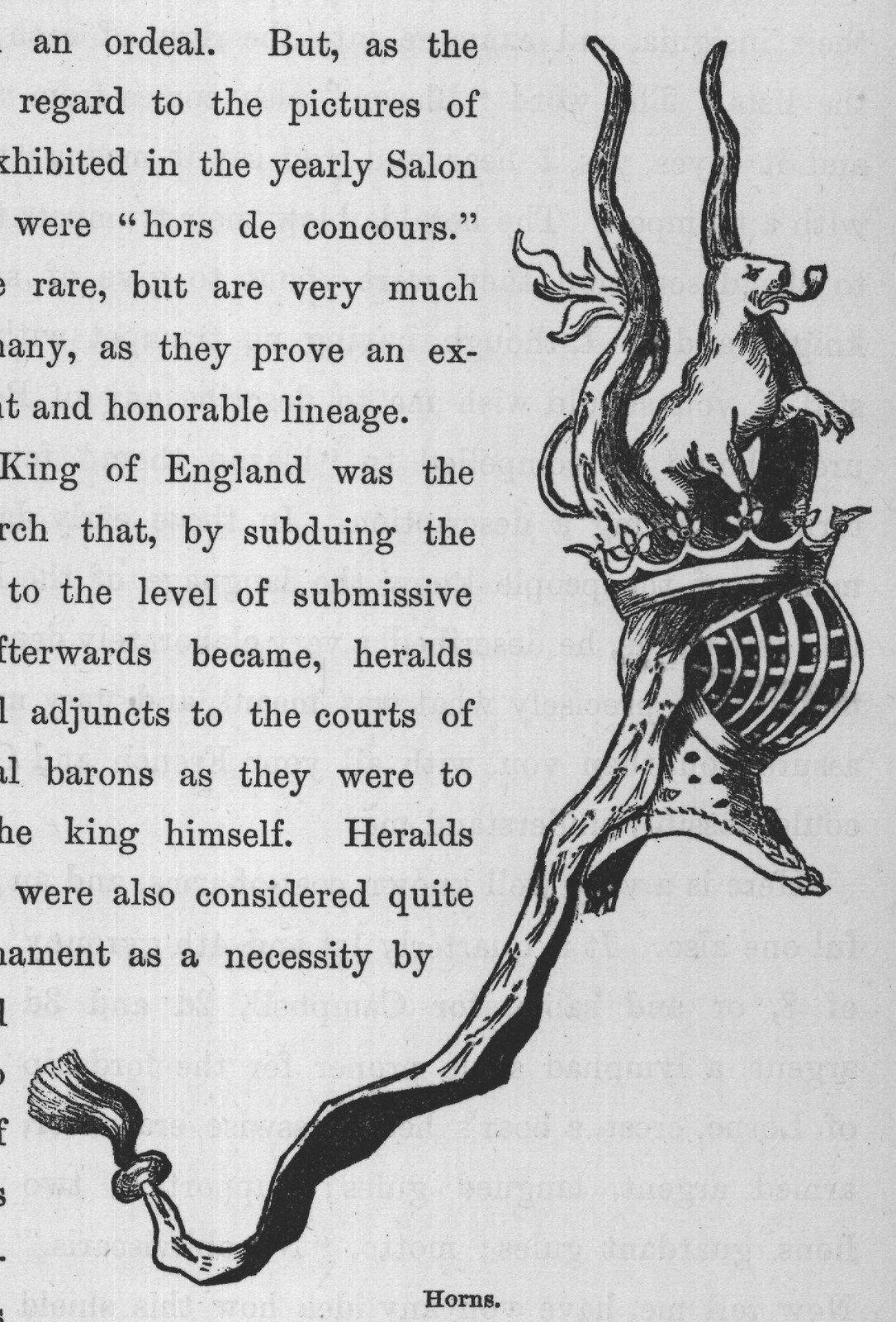
In Germany, when a knight appeared for the first time before the lists and had his right to bear arms carefully examined by heralds, he was allowed to place two horns upon his helmet, one rising on either side of the crest. After this he was never again subjected to such an ordeal. But, as the French say in regard to the pictures of certain artists exhibited in the yearly Salon at Paris, they were "hors de concours."
Such crests are rare, but are very much prized in Germany, as they prove an exceedingly ancient and honorable lineage. Before the King of England was the powerful monarch that, by subduing the haughty nobles to the level of submissive subjects, he afterwards became, heralds were as natural adjuncts to the courts of those old feudal barons as they were to the court of the king himself. Heralds and pursuivants were also considered quite as much an ornament as a necessity by these nobles, and were expected to be the first of their households to greet the arrival of illustrious Horns. guests. Sir Walter Scott describes the reception given to Lord Marmion at Norham Keep: - "Two pursuivants, whom tabards deck, With silver scutcheons round their neck, Stood on the steps of stone By which you reach the dungeon gate, And there, with herald pomp and state, They hailed Lord Marmion.
WHAT HERALDRY MEANS.
They hailed him Lord of Fontenaye, Of Lutterward and Scrivelbaye!
Of Tamworth Tower and town; And he, their courtesy to requite, Gave them a chain of twelve marks' weight, All as he lighted down.