Home › Crusader Legends › Crusader Legends
Crusader Legends
In this way the evening's talk kept on until the little heads disappeared to hobnob with the pillows of their beds, and it occurred to me that, after all, perhaps this "corpse of the feudal ages," this institution of heraldry, brilliant with memories of tournaments and hard-won victories, might interest even the stalwart republican minds of our non-reverencing boys and girls. "Feudal corpse" as it is called, not only the Englishman, but the American, pays a very pretty annual sum for keeping it properly embalmed. An English boy, whose father seals his letters with a noble crest or an ancient coat-of-arms, knows that for the privilege of so doing a guinea goes yearly into the heraldic exchequer; and if his mother fancies to ride abroad in her own coach, upon the panels of which the same old heirloom shines, then, instead of one guinea, two must pay the tax. America does none of this; she can fling such moneymaking laws a defiance, as with great republican serenity she did some years ago, when Mr. Crampton of England was the British ambassador to America. His coach, brought from England, met with some slight mishap, and was despatched to a carriage-builder who plied his trade in the American capital. Not many weeks after the coach had been repaired and returned, the ambassador had occasion to step again into the factory, and there, to his amazement, he beheld a number of buggies, coaches, and wagons, all bearing his 66 own ornamental coat-of-arms! When careful scrutiny had satisfied him that the device was his very own, his British blood rose, and his British tongue was quick to inquire how this happened. Was he to be the recipient of a munificent and unexpected gift? reckon not, sir," was the careless reply, "you see, when your carriage was here, some of our customers admired the pattern of your arms, and concluded to have them painted on their own carriages!" But though America gets rid of the tax-gatherer, she doesn't escape the herald's grasp entirely. She must pay her share in the cost of the myrrh, frankincense, and all sweet spices. This she does when her merchant princes, travelling throughout the length and breadth of Europe, feel a sense of lack that nothing but a call upon the College of Arms in London can relieve. With fifty dollars bright and yellow, as good a coat-of-arms can be procured as the wits and fancy of the college can contrive; or, if with a name that answers to any of Great Britain's lords, he chooses to say that "all Stuarts are cousin to the king," he can get his claim for a few shillings well studied out, and perhaps be permitted to assume the aristocratic bearings. But in olden days, when the nobility could neither read nor write, and when prowess on the battle-field was the surest and safest stepping-stone to high honors, fair heraldry was a very different nymph from the withered and shrivelled old crone that we confess she has now become, although we don't admit that she's a corpse yet, however near we may think she is to becoming one. To shine before the eyes of their commanders called forth the highest effort of every soldier. Who could tell but that, as at Agincourt, when "every man, no matter how vile or low he be, who for the king's cause has fought and won to-day, is declared of CRUSADER LEGENDS. noble blood and entitled to bear arms," so any day daring and extraordinary feats of valor might once more be rewarded. To induce the devout and the soldierly element of the masses to join in the great crusading movement, Peter the Hermit was allowed to grant not only free absolution for all past and future sins, but to promise that if a soldier in those holy wars should chance to slay an infidel, then such soldier should, oh, joy unspeakable, be declared noble, and permitted to assume for himself whatever device he might select. To commemorate the noble deeds which gave birth to such coats-of-arms, the children of these heroes of the battle-field treasured with intense pride the devices thus chosen. Many and bitter were the feuds engendered in later years by similar arms appearing upon the shields of stranger knights. The legendary origin of these crusading arms was as dear as an untainted name to their owners; and, while mixed with much that is purely imaginary, still these traditions have been handed down for many generations from father to son, until what is true and what is false cannot be distinguished. Should any of our boys and girls, after reading these tales, chance to visit the old tilting-grounds across the sea, I think they would find their enjoyment of the journey in no degree lessened by a knowledge of these treasured remnants of an old heroic age. And these legends, that, despite the sneers and scoffs of the unstoried, practical genius of the day, have been so carefully treasured in Europe by the posterity of the Lorraine. bold and victorious ancestors who fought in Palestine they are "as plenty as dog-tails." Amongst them is the story told by the old French house of Lorraine. It claims that Godfrey de Bouillon, the first Crusader king of Jerusalem, had with him a notable monk, an ancestor of this house, who was one day sadly in need of a quill with which to put his signature to some military document. No quill was to be had, but the genius of Godfrey was equal to the occasion. To seize his bow, cast an eye heavenward, and there with his piercing glance to descry, flying over David's Tower in Jerusalem, three eagles, or alerions, as they were then called, was but the work of a moment; to draw that bow, and send an arrow swiftly speeding eaglewards took but a moment more, and before his illustrious followers could fairly wink their eyes, or the birds know what had struck them, down came the eaglets spitted, one above the other, upon the royal arrow. A full supply for the entire army lay at his feet, and as he plucked the one required for the friar's use, he announced that henceforth, as his coat-of-arms, the monk should display a golden shield, crossed with a red bar, and thereon three silver alerions. If this taxes your faith, dear children, don't believe the story. Somebody has sagely remarked that it was not, after all, Godfrey de Bouillon who drew the long bow, but the person who first told the tale! I dare say that when I tell you that the word alerion is really a very pretty anagram of the word Lorraine you will easily understand me. The prosaic heraldists of to-day who call heraldry a corpse, and turn up their noses at our pretty fairy-like tales, insist that it was on this account that the arms were chosen. The English tell a tale to match it, and show us the arms of the Count de Vesey, of Ireland. This family, without the least scruple of conscience, inform us that although they were at one time barons of Northumberland, and CRUSADER LEGENDS.
T are very proud of that connection, they can prove a much older and nobler pedigree than the Northumberland barons could show. Indeed, the first ancestor whom they deign to claim is Charlemagne the great, Emperor of France and of all the West. His fifth son had a son, and that son had another, who was no less brilliant a personage than our fiery Godfrey of Bouillon. Great is the satisfaction that our noble family feel in their relationship to so illustrious an individual, who "at the head of seventy thousand foot and ten thousand horse, all arrayed in complete armor and under the banners of many princes, but united under his own standard, entered Palestine to exterminate the followers of Mahomet." Jerusalem did submit, and Godfrey reigned as king. The De Veseys, as his descendants, continue to bear the patriarchal cross in memory of his glorious deeds.
Vesey, or de Vesci.
Another legend is that told by three old French families, - the Coucis, the Longuevals, and the Chatillons. They declare that three of their ancestors were comrades in the siege of Jerusalem. One day, the weather being sultry, they were tempted to bathe in some neighboring stream, and whilst thus refreshing themselves, were startled by seeing the enemy dashing towards them. They had but a moment, but it was sufficient to enable them to seize their fur-lined velvet mantles from the river's bank, twist them about their left arms as a shield, and grasp their swords. Then, in no way affrighted, they met the Saracens, and succeeded in not only nobly defending themselves, but in vanquishing the foe. In memory of this they assumed similar coats-of-arms, with but slight variations. Their shields were divided into six quarters. On one shield the divisions ran lengthwise, in another horizontally, and on the third diagonally. Each was in gold and vair, vair being a species of fur, about which we will hear more later.
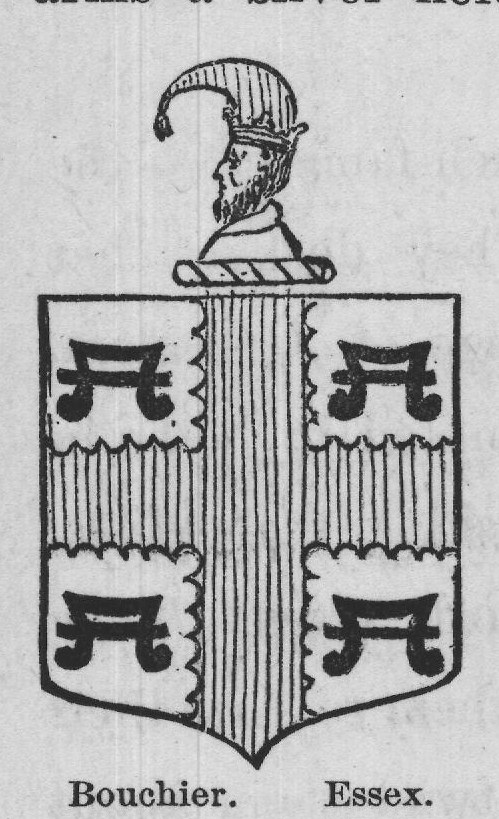
The English are quite as proud of their connection with the Crusades as the French, and the Newtons of England are not ashamed of an ancestor by marriage, a Sir Ancel Gornay, who attended Richard Cœur de Lion in his crusades, and was one of the besiegers of Ascalon. There, by his great valor, he was so successful as to capture an unlucky Moorish king. Proud, indeed, was he of this exploit, and, upon returning to his native land, he bestowed, as a crest, upon his admiring family, "a king of the Moors habited in a robe, crowned, kneeling and surrendering with his right hand his sword." The Bouchiers, too, Earls of Essex, show for their coat-ofarms a silver field, with a scalloped red cross in its centre, and a water bag, or bouget, in each corner. For a crest they have a Saracen, or, to be exact, the head of one, wearing a long cap and coronet. Should you chance to ask any of their descendants what the meaning of all this is, they would (perhaps!) invite you to accompany them to a dilapidated manor-house in Essex County, and there, in the dusky shadows of a grand old hall, they would point out, in an ancient painting that hangs Bouchier. Essex. upon the wall, two figures, one of which, they will tell you, is a Bouchier, long since gone to glory, but whom this picture represents as engaged in desperate conflict with the other figure. This other figure is the undoubted representation of a pagan king, and CRUSADER LEGENDS. the royal infidel is evidently being very much worsted in the combat; the triumphant expression of the good knight Bouchier, who, for "the truth of Christ," is doing such valiant work, assures us that the Saracen will speedily be vanquished. Since the time of this contest they continue to display the head of the infidel as their crest, and at the same time they have also assumed the surname of Bouchier, or butcher! Undesirable as such an honorable appellation may appear to us, their adopting it was consistent with an ancient signification which it possessed. It was given to all great heroes, and was considered a glorious surname. I think, however, we will not begrudge the Bouchiers their claim to this distinction, and be satisfied with whatever humble cognomen chance may have been so good as to give us.
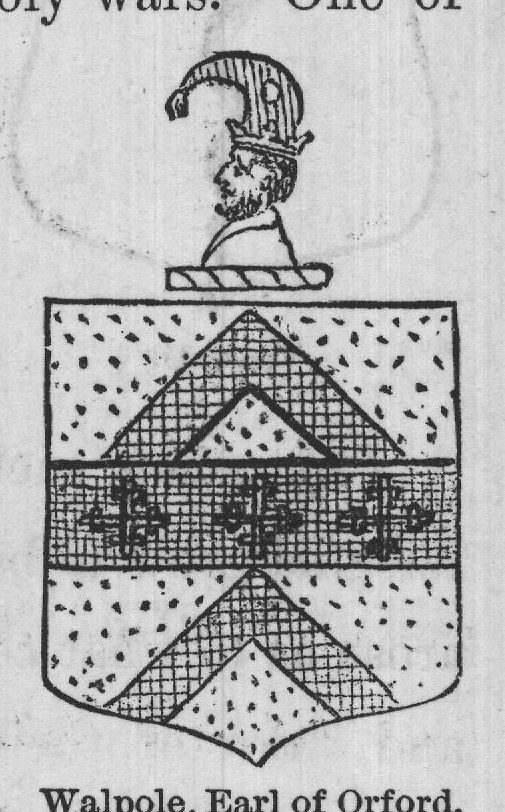
Another Crusader legend ornaments the escutcheon of the Earls of Orford. They also owe their crest to the holy wars. One of their worthy ancestors, Sir John de Robsart, was a Knight of the Garter and a Knight Banneret.
He took part in the Hungarian crusade, some time in 1300, and was one of the most noted military commanders of the day. So soldierly was his bearing, and so great was his military skill during this crusade, that Richard II. gave "his beloved and faithful knight" a sum of money out of his own revenue and replaced the crest that he at Walpole, Earl of Orford. that time displayed - the Wheel of St. Catharine - by one of these extremely popular crests, the head of a Saracen. These Saracen heads, which you will so frequently notice in English coat-of-arms were probably assumed by their owners many years after the incidents with which they are connected had taken place.